
A monthly class series held at Tin Parlour, a conservas wine bar in the back of Nudibranch, in the East Village.
‘Fringe Spain’ is a tinned fish and porrón-fueled exploration of the places where the idea of ‘Spanish wine’ unravels. In our second class, we tasted the legacy of a single grape variety: palomino.
Palomino is the grape of sherry, which means that it’s rooted in the blinding white chalk of one of the world’s most iconic growing regions.
Sherry also means that it’s getting on a boat, one way or another, in service to Empire.
Drought resistant and vigorous, it accompanied pais to the Conquista.
In the wake of phylloxera, a series of right wing Spanish autocrats (Franco the worst and the longest-reigning) encouraged its widespread planting in the very damp, very *not* drought-resistant Galician northwest.
The British, busy slaking their insatiable thirst for sweetened fortified wines, brought it to Australia, South Africa — even to Cyprus. (By the 1960s, they were drinking 13+ million liters/year of “Cyprus sherry.”)
Sherry, like champagne, is a beverage technology that’s been transplanted everywhere (the Finger Lakes! Ukraine!) that we also, nonetheless, think of as a wine of place.
Palomino, meanwhile, is a rootless colonial child, more often tasting like what it’s been made to do than what it could do.
What would happen if we let it sing?
Below are more details on what we drank, where it came from, and where to look if you’d like to dig deeper:
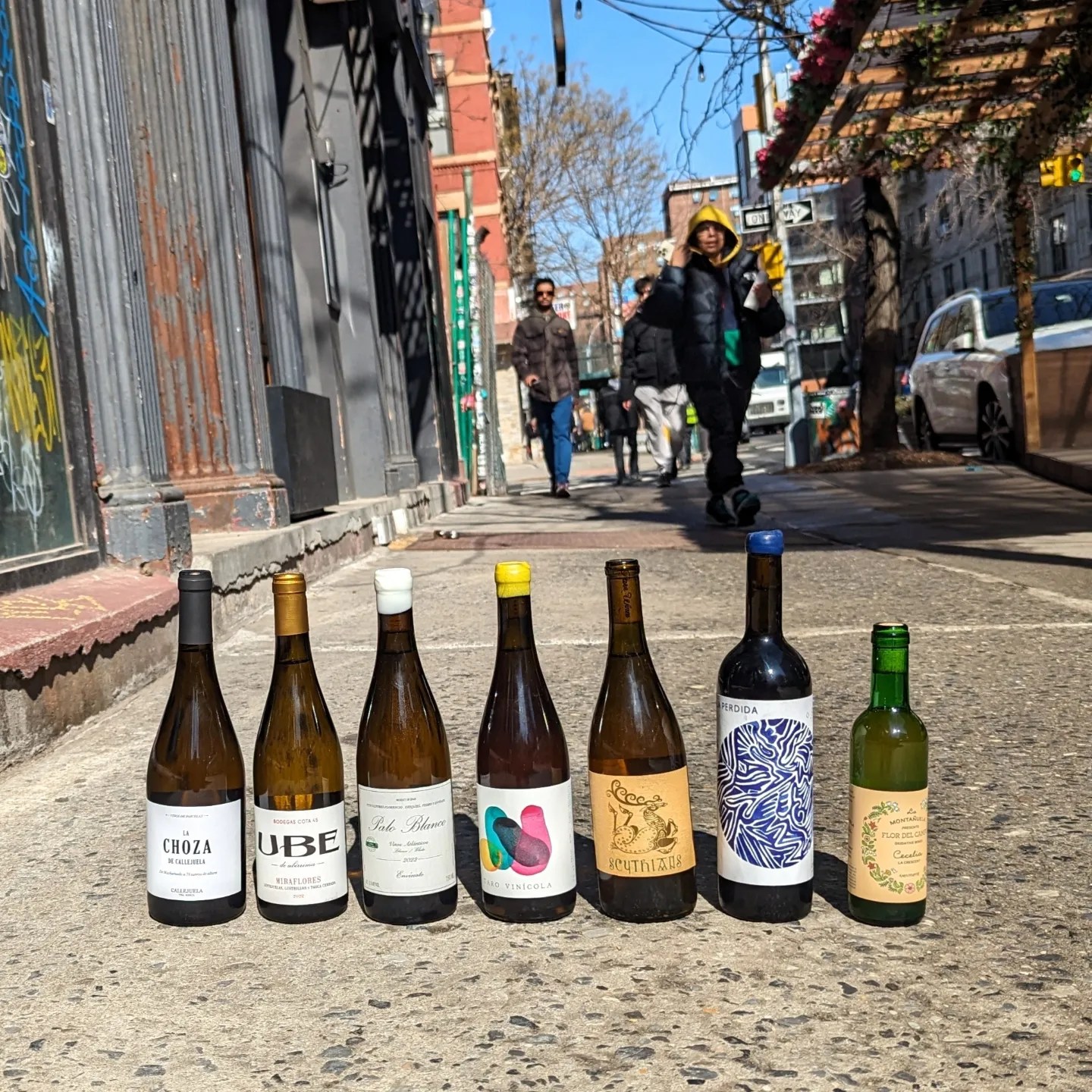
Here’s how this lineup might look on a wine list:
CALLEJUELA, palomino “La Choza” SANLÚCAR DE BARRAMEDA
COTA 45, palomino “Miraflores” SANLÚCAR DE BARRAMEDA
ENVÍNATE, listan blanco “Palo Blanco” TENERIFE
TARO, listan blanco “Frias” LANZAROTE skin contact
SCYTHIANS, palomino + friends SAN BERNADINO COUNTY
LA PERDIDA, garnacha tintorera + palomino “O Poulo” VALDEORRAS
LA MONTAÑUELA, la crescent “Cecilia” VERMONT solera
Questions to ask while you taste
- What associations do you have with sherry? How did these wines complicate those associations, or challenge them?
- We tasted palomino from a range of places: the blinding white seaside chalk of Sanlúcar; the volcanic islands of Tenerife and Lanzarote; the deep, beachy sands in southern California. Do you notice differences in texture, weight and aromatics between these radically different soils?
- Along with our wine, we tasted country ham draped over Korean rice cakes, tuna belly with red peppers, mussels, garfish, and more. How did the food change your experience with the wines? How did the wines change how you perceived the food?
- Does this tasting make you want to drink more wines made out of this variety?
A little more detail
(Scroll further down for a lot more detail)

CALLEJUELA, palomino “La Choza” SANLÚCAR DE BARRAMEDA
Who made it? Two brothers who began in 1980 (and ceased making wine together very recently)—one of the very rare grower sherry producers.
Out of what? Palomino! From a single named vineyard site.
Made how? Aged in manzanilla barrel under a veil of flor, but not fortified or blended into a solera.
From where? Sanlúcar, the part of sherry country closest to the sea, famous for a lacy, delicate style of fino sherry called manzanilla.
COTA 45, palomino “Miraflores” SANLÚCAR DE BARRAMEDA
Who made it? Ramiro Ibáñez, a devotee of the soils and history of Sanlúcar.
Out of what? Palomino! From a few plots inside a single named vineyard site.
Made how? Aged in manzanilla barrel under a veil of flor, but not fortified or blended into a solera. Ramiro’s barrels will come up again later!
From where? Sanlúcar, the part of sherry country closest to the sea, famous for a lacy, delicate style of fino sherry called manzanilla.
ENVÍNATE, listan blanco “Palo Blanco” TENERIFE
Who made it? Roberto Santana, mostly; he has three friends who also form part of Envínate, which also makes wine in Ribeira Sacra (Galicia) and Alicante (hot part).
Out of what? Listan blanco! (Which is to say: palomino.) Ancient, own-rooted vines, braided together.
Made how? Fermented without temp control, aged in a fancy oval-shaped cask from Friuli and one slightly smaller barrel.
From where? Tenerife, on the north slope of the volcano, in the Canary Islands.
TARO, listan blanco “Frias” LANZAROTE
Who made it? Pablo Matallana, who actually lives on Tenerife, but makes wine with this grower’s association on Lanzarote.
Out of what? Listan blanco! Also ancient vines, although in this case they huddle in hand-dug walled craters called hoyos and have to dig through a meter of black volcanic ash before hitting water.
Made how? Skin contact and aging in stainless steel.
From where? Lanzarote, the Canary island closest to the African coast and without a big eroded volcanic mountain in the center to shelter bits of it from the trade winds, it looks like a moonscape.
THE SCYTHIANS, palomino n friends SAN BERNADINO COUNTY
Who made it? Cult sommelier turned natural farmer/winemaker Raj Parr.
Out of what? Dry farmed, never-sprayed vines planted in 1912 in San Bernadino—mostly palomino, but with some other varieties (colombard and muscat? zinfandel and alicante?) peppered in.
Made how? A little bit of skin contact before aging in a mix of barrel, including a Cota 45 barrel from Ramiro.
From where? San Bernadino, a relic of the pre-Gold Rush era, when the California wine industry (such that it was), centered around Los Angeles.
LA PERDIDA, garnacha tintorera n palomino “O Poulo” VALDEORRAS
Who made it? Nacho Gonzalez, an “island winemaker” in the hills.
Out of what? Garnacha tintorera and palomino, the two bulk workhorses planted across Galicia (and the rest of Spain) by Franco that now survive in old, practically abandoned vineyards tucked away in the remote hills of Valdeorras.
Made how? Minimally.
From where? Where Nacho’s grandmother grew up.
LA MONTAÑUELA, la crescent “Cecilia” BARNARD, VT
Who made it? Camila Carrillo, a first-generation winegrower who apprenticed with Deirdre Heekin at La Garagista and named her winery for her grandfather’s farm in Venezuela.
Out of what? La Crescent, a high-acid hybrid variety (what’s a hybrid?) from two sites farmed by Deirdre.
Made how? The last bit of every harvest since 2018, foot-crushed and soaked on the skins for 3-5 weeks, then pressed into demijohns and carboys with headspace. Everything was subsequently married into a single large amontillado bota from Ramiro at Cota 45—a little of each new vintage is added every year.
From where? The limestone and clay of Vermont’s piedmont.
A lot more detail
CALLEJUELA, palomino “La Choza” SANLÚCAR DE BARRAMEDA
Who made it? Two brothers — José and Francisco Blanco Romero, who started Callejuela with their father in 1980. For a long time, they were almacenistas — growers making their own base wines that they kept in barrel until selling them to local sherry bodegas. In 1998 they started making sherry themselves — which makes them noteworthy, and rare, as growers who bottle and vinify their own wines and sherries rather than selling to the merchant houses.
Out of what? Palomino! Specifically, alomino grown on a 4 hectare plot in the pago of Machardnudo, 74 m above sea level, on the white chalk soils called albariza. This is their warmest site, furthest from the sea — often 10 degrees warmer than the winery in Sanlúcar.
Made how? Fermented and aged in old manzanilla barrels, left undisturbed for 7 months (flor forms), bottled without fortification. Ways that it’s like sherry: made from palomino, grown in sherry country, aged under flor. Ways it isn’t: no multivintage blending in the solera, no fortification up to a particular alcohol % with neutral grape spirit.
From where? Sanlúcar de Barrameda, the part of the sherry triangle closest to the sea, where the dry fino sherries are more delicate and form lighter veils of flor than further inland, and are called ‘manzanilla.’
COTA 45, palomino “Miraflores” SANLÚCAR DE BARRAMEDA
Who made it? Ramiro Ibáñez, who calls his bodega an ‘albarizatorio’, or ‘laboratory for studying albariza’; is part of a collective of seven producers called ‘Manifesto 119’ dedicated to the 119 grape varieties apart from palomino recorded in Jerez in the 1800s; and named his bodega for the elevation, in meters, where soils start to get interesting (45). He’s a big nerd! We love him!
Out of what? Palomino! Specifically, 80- to -90 year old vines grown on 5 different plots in the pago of Miraflores, on three different subtypes of albariza that all have names (and different textures).
Made how? Fermented and aged in old—some as old as 150 years!—manzanilla barrels, where they develop a delicate veil of flor. Bottled after resting for 9 months.
From where? Sanlúcar de Barrameda (see above). Hey, this class wasn’t about sherry but here’s a bonus fun thing, your traditional pairing advice for the three styles of dry sherry (under flor the whole time — fino // under flor part of the time and then oxidized — amontillado // oxidized the whole time — oloroso) goes like this: “Fino if it swims, amontillado if it flies, oloroso if it walks.”
ENVÍNATE, listan blanco “Palo Blanco” TENERIFE
Who made it? Four friends who met in winegrowing school in Alicante, and today make wine in three very different parts of Spain (in three different bodegas) under the umbrella name Envínate (literally, something like go wine yourself!). Roberto Santana, who’s originally from the Canaries, leads the project there, on Tenerife. His first vintage was 2016.
Out of what? Palomino! Although here, it’s called listan blanco: 4 parcels of 100+ year-old own-rooted vines trained in the local style called ‘trenzado’ (‘braided’), on the north slope of the island’s central volcano.
Made how? Native fermentation in concrete without temperature control, moved into one big oval cask from Friuli and one smaller oak cask to age, bottled with no alteration except for a tiny addition of sulfur.
From where? Los Relejos, in Tenerife, in the Canary Islands — you can read more, along with some beautiful pictures, in a long and evocative piece from sommelier-turned-wild man in a cabin with cider Brian McClintic here.
TARO, listan blanco “Frias” LANZAROTE
Who made it? Pablo Matallana, a young winemaker who lives in Tenerife and works both there (for himself) and on Lanzarote with a growers’ association named for the local word for the small stone structures vineyard workers shelter in: taro.
Out of what? Palomino! But we’re in the Canaries, so it’s called listan blanco. 120 year-old, own-rooted vines from a single parcel named “Frías” on a little rise near the center of the island.
Made how? Destemmed and macerated on the skins for a week (there’s that color!) before pressing into steel tank. Aged on the lees for 10 months with regular racking before being bottled without filtration and with 28ppm of sulfur.
From where? Lanzarote, the closest island to the African coast and the most arid, with very little shelter from the trade winds (its volcano is the oldest and basically completely eroded). Vines tend to huddle in walled craters dug in the ground called hoyos, and have to grow through a solid meter of black volcanic ash before finding water.
THE SCYTHIANS, palomino n friends SAN BERNADINO COUNTY
Who made it? Well, it’s a new project from cult sommelier turned West Coast natural winemaker Raj Parr — but given how many irons the man has in the fire with his name on them, from Phelan Farm to Evening Land to Sandhi and beyond, this has to be another example of the old adage, “Wine is made by assistant winemakers.” (I just don’t know their name.) No shade, I appreciate the things that Raj has chosen to turn his energy to and advocate for! — in this case, the forgotten viticultural history of Los Angeles and the surrounding area. Just taking this opportunity to remind us all that wine is rarely, if ever, made by just one person.
Out of what? Palomino from the Lopez Vineyard in San Bernadino, head-trained California sprawl in deep sand on its own roots and dry-farmed, planted in 1912. There’s a dash of other varieties in here too — maybe colombard and muscat, maybe some garnacha tintorera or zinfandel too? It’s a field-planted vineyard, like most old vineyards are (including the ones above that confidently read “100% listan blanco).
Made how? Native yeast fermentation, some of it on the skins for a week before pressing and some of it straight juice, in a mix of Cota 45 barrels from Raminro Ibáñez and old French oak. Rested for six months, bottled without filtration and with a dash of SO2.
From where? Before the Gold Rush made San Francisco a city—and turned the Sierra Foothills in to the center of American wine—the California wine industry, such as it was, orbited Los Angeles. Today, the surviving vines—palomino, pais, muscat, garnacha tintorera, zinfandel—are relics sandwiched between exurban sprawl, often neglected, left to fend for themselves. (And so the survivors demonstrate—by living without irrigation, without ever having been sprayed or treated—some of the virtues of that neglect.)
LA PERDIDA, garnacha tintorera n palomino “O Poulo” VALDEORRAS
Who made it? Nacho Gonzalez, who farms a handful of tiny, isolated ancestral vineyard sites in the rugged hills around the place his grandmother grew up. He has a soft spot for the neglected and abandoned, and also loves amphora (that’s him hugging the tinaja in my little collage up top).
Out of what? Garnacha tintorera and palomino — these are both varieties that aren’t native to Spain’s green and verdant northwest. Their planting was encouraged here in the wake of phylloxera and then during Franco’s dictatorship, for their high yields and (in garnacha tintorera aka alicante bouschet’s case) for the color. They came in handy, in other words, for soulless bulk wine, and most people would just as soon forget about them. Nacho feels, however, that these now old vines are important to the historical memory of the region and what happened here, and they find their way into almost all of the wines he makes.
Made how? From a single old vineyard with a few rows of palomino on the far end. Everything is fermented together on the skins in open-top fermenters, and Nacho gradually takes the skins out little by little as the fermentation continues. Then he moves it to steel tank to rest before he bottles in the spring, without filtration or SO2 addition.
From where? Valdeorras, in Galicia — one of the region’s fastest-growing D.O.s, although the new plantings are all down on the flats to make mechanical work easier. Nacho, up on his little remote hills, calls himself an “island winegrower.”
LA MONTAÑUELA, la crescent “Cecilia” VERMONT
Who made it? Camila Carrillo, who made her first three wines in 2018 and named her project after her grandfather’s farm in Venezuela. She’d fallen in love with wine working at a tasting room in Burlington after high school and worked harvests from Australia to Italy before returning to apprentice at La Garagista with trailblazing vigneron Deirdre Heekin. She is currently planting and recuperating a small vineyard of her own.
Out of what? La Crescent from two biodynamically vineyards in Barnard, Vermont worked by Deirdre and Caleb of La Garagista. La Crescent is a cold-hardy, resiliant hybrid out of the University of Minnesota, released in 2002.
Made how? Since 2018, Camila has put aside a little of the last of each year’s harvest for this solera. She destems and foot-crushes the grapes and leaves them on the skins for 3-5 weeks before pressing into glass demijohns or carboys, where they finish fermenting oxidatively. Afterwards, she adds everything to one large amontillado bota from Ramo at Cota 45 (there he is again!), where all of the vintages age together. Inspired by the solera-aged oxidative wines of Jerez, Sanlúcar, and the Jura, this is the first release from the bota.
From where? Barnard, Vermont!
 Children's Atlas of Wine
2 thoughts on “Fringe Spain: PALOMINO”