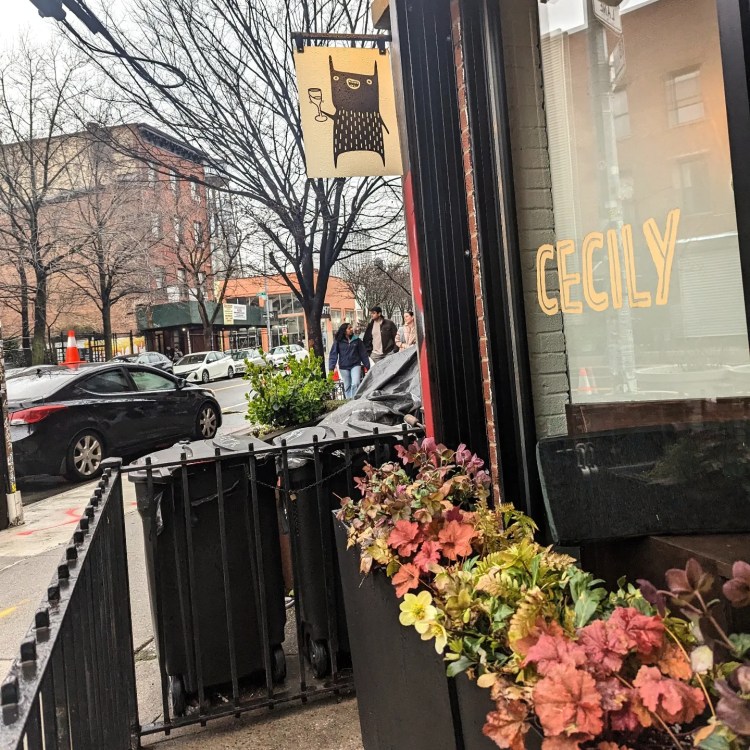
A class co-taught with Kristin Ma, the beverage director at Cecily, a wine-focused restaurant in Greenpoint, Brooklyn, on Saturday, March 23, 2024.
Hybrid vines are varieties that, whether spontaneously in the wild or purposefully, thanks to a grape breeder with a tiny paintbrush painstakingly applying pollen to hundreds of little flowers, have been obtained from two or more different species of vine, of the dozens around the world.
Definitions aside, why might that matter? If wines made from hybrid grapes feel strange, esoteric, or unfamiliar, why has history made that the case?
And if a growing number of natural winegrowers across the world are experimenting with farming and making wine from these varieties right now, what challenges are hybrids allowing them to overcome, and what does that have to teach us about the future?
For a quick primer on what exactly hybrid grapes are, go here. For more details on what we drank, where it came from, and what questions to ask while you’re tasting, read on!
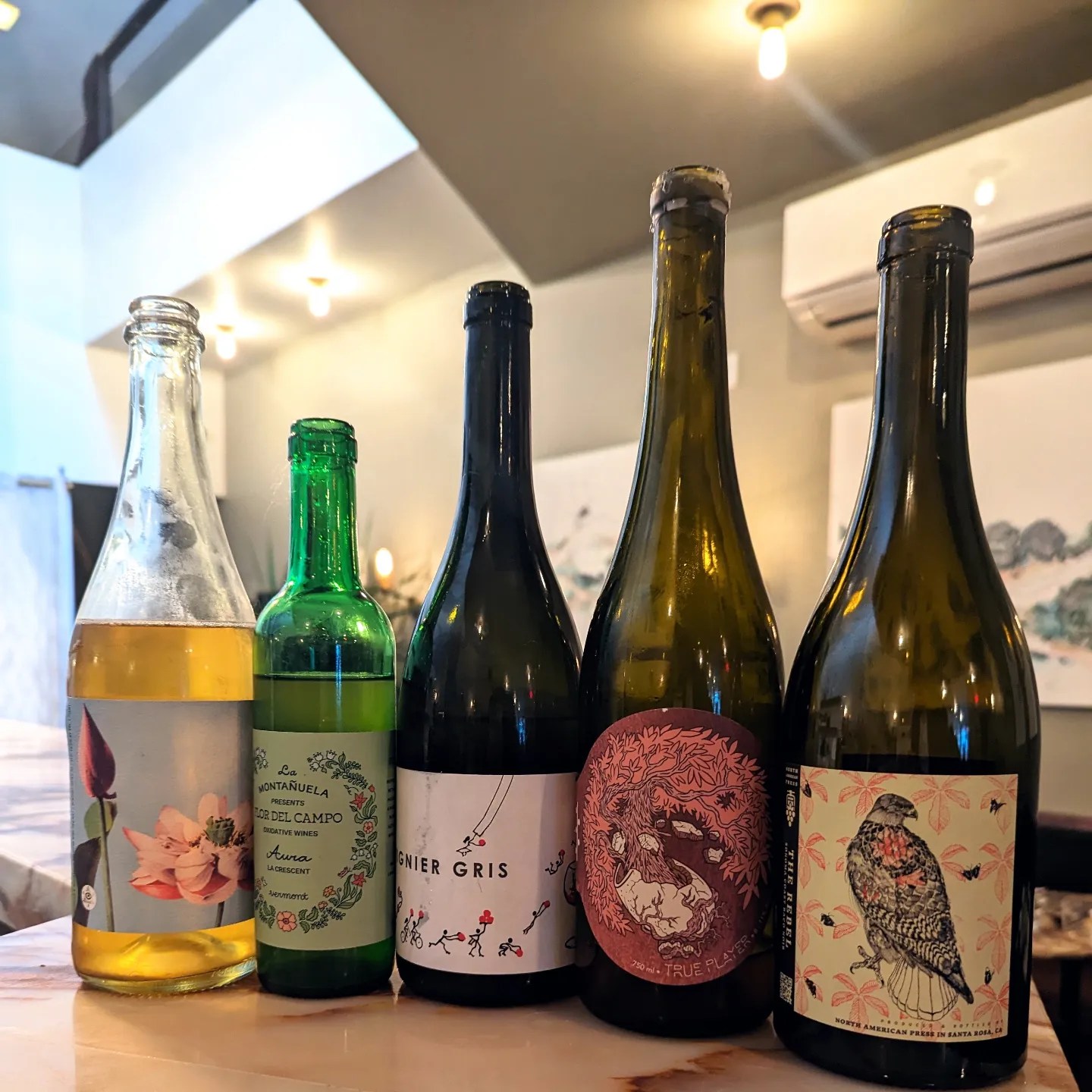
Here’s how our lineup might look on a wine list:
AMERICAN WINE PROJECT, somerset seedless pet-nat “We Are All Made of Dreams” CHIPPAWA COUNTY, WISCONSIN
LA MONTAÑUELA, oxidatively aged la crescent “Aura” BARNARD, VERMONT
JOSEF TOTTER, souvignier gris STEIERMARK
PLEB URBAN WINERY, co-ferment “True Player” APPALACHIA
NORTH AMERICAN PRESS, baco noir “The Rebel” SONOMA
Questions to ask while you taste
- What associations do you have with hybrid varieties? Have you seen wines made from them before? Are they a blank slate?
- We tasted hybrids from a range of different genetic histories, across a range of different places — everywhere from the foothills of the Austrian Alps to the California coast. What challenges do these different regions present? What makes these hybrids adapted to them?
- The wines we tasted were made across a wide spectrum of style, from straightforward (“white”, “red”) to decidedly more esoteric (“co-ferment aged under flor on foraged hickory shag bark”, “oxidative solera”). Which of these wines felt more classic? Which were more challenging? Did your opinion change with food, air, or time?
- Aromatics are complicated, and they hit us where we live: our own sense memories, personal histories, and experiences. Did the aromatics of these wines take you to any places that were new or different to other wines you’ve tasted? Did any feel uncannily familiar?
A little more detail
AMERICAN WINE PROJECT, somerset seedless pet-nat “We Are All Made of Dreams” CHIPPAWA COUNTY, WISCONSIN
Who made it? Emily Rasmussen. Originally from Madison, she worked internationally for a decade in places like Napa and New Zealand before moving back home to start her own project; her first independent vintage was 2018.
Out of what? A magenta-skinned table grape called somerset seedless, one of a number of varieties obtained by an Osceola, Wisconsin grape breeder named Elmer Swenson. They’d become the backbone of the University of Minnesota’s cold-hardy program. Somerset seedless (which actually does have tiny seeds) is disease-resistant, resilient, and carries genetics from labrusca, riparia, and vinifera as well as small amounts of several other American vitis species.
From where? The Driftless Area, in Wisconsin, a wrinkled, karst-geology landscape of cenizas and limestone gorges cut through by the Mississippi River when it’s still a little guy.
LA MONTAÑUELA, oxidatively aged la crescent “Aura” BARNARD, VERMONT
Who made it? Camila Carrillo, who made her first three wines in 2018 and named her project after her grandfather’s farm in Venezuela. She’d fallen in love with wine working at a tasting room in Burlington after high school and worked harvests from Australia to Italy before returning to Vermont to apprentice. She is currently planting and recuperating a small vineyard of her own.
Out of what? Since 2018, Camila has put aside a little of the last of each year’s harvest for this solera. She destems and foot-crushes the grapes and leaves them on the skins for a bit before pressing into glass demijohns or carboys. Half of the la crescent went into a single bota of amontillado from Cota 45 in Sanlúcar — this was “Cecilia”. This bottle, “Aura”, on the other hand, was bottled straight from the glass, for a more fruit-driven, clearer expression of Vermont’s landscape (albeit, still oxidative on purpose).
From where? Barnard, Vermont, home of noted champion of hybrid and New England natural wine Deirdre Heekin. These grapes are from two sites farmed by Deirdre near Lake Champlain.
JOSEF TOTTER, souvignier gris STEIERMARK
Who made it? Josef Totter, who grew up in the Steiermark and worked as a motorcycle engineer for years in Austria and then Italy, where he was gradually turned on to natural wine. He was born on a farm, and in 2012 he decided to come home and change his life.
Out of what? Souvignier gris, a cross between seyval and zähringer. (We used to think was a cross between cabernet sauvignon and bronner — which is crazy, because this was only a few decades ago!) It’s one of a family of new, mostly-vinifera hybrids coming out of central Europe that are called PiWi, pilzwiderstadsfähige. (“Pilz” = fungus or mushrooms, “widerstands” = withstands.) The upshot is that you can grow them with virtually no chemical inputs, at least if what you’re dealing with are mildew and other fungal disease pressures.
From where? The Steiermark, in Austria’s rolling green south. On the Jägerburg, the hilltop village where Totter is from, it’s hot (95 degrees) in the summer and cold in the winter, and you get a ton of rainfall. The local vinifera varieties he was farming had him spraying dozens of times in a growing year. Inspired by a couple of neighbors, he ripped it all up to plant PiWi, and he’s only sprayed once in the half-decade that followed. “To make wine without being addicted to industrial products is really nice :). ” – Josef Totter
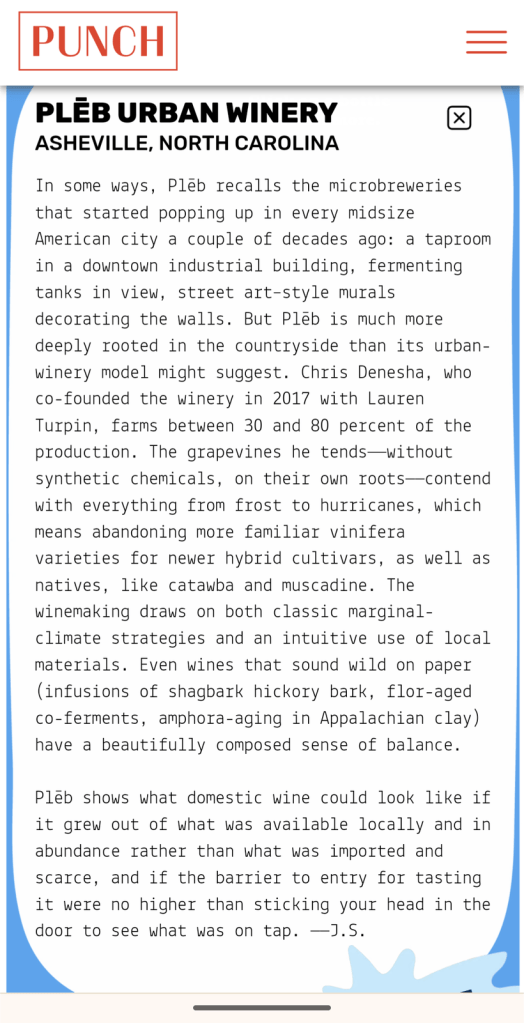
PLEB URBAN WINERY, co-ferment “True Player” APPALACHIA
Who made it? Chris Denesha and Lauren Turpin, who founded Pleb in 2017 in Asheville, North Carolina.
Out of what? A field blend of red and white hybrid varieties (traminette, marechel foch, seyval) fermented with foraged hickory shag bark in a concrete egg; the fermentation develops flor.
From where? Appalachia!
Here’s what I wrote about Pleb for Punch last year:
NORTH AMERICAN PRESS, baco noir “The Rebel” SONOMA
Who made it? Matt Niess, who departed a career making fairly fancy California wine out of the conviction that the state’s future in the face of drought and wildfire lay with exploring hybrids and fruit co-ferments.
Out of what? Baco noir, one of the French-American hybrids (folle blanche x riparia) devised in the late 19th century in the face of phylloxera. It was once one of the most-planted varieties in the Loire Valley, and is still found in Armagnac.
From where? Vines, never sprayed or treated, across a fenceline from some of the most expensive pinot noir in west Sonoma County. Planted in the 1950s by Domenico Callegari,a trained horticulturalist who went AWOL from the Italian Army during WWII and ended up, after much incident, in Sonoma.
And one bonus
What, you might be wondering, was it like to taste these wines? (Assuming you weren’t in the room!) For a variety of reasons, I find it difficult to tell you; hopefully, you’re armed with a little more context for when you have a chance to taste them yourself.
That said, a seminar I co-taught at TexSom in Dallas with Christy Frank last year that covered very similar ground (and even poured different wines from some of the same producers here), got written up by notable wine journalist Jamie Goode. And so if you’re curious to see what tasting notes and scoring looks like for a lineup like this (albeit in a different room, for a different audience), it might be worth a read.
It’s certainly rare that I get to see such thoughtful and detailed responses to the wines I pour for a tasting, beyond what we share together in the moment, whether it’s through a screen or together in a room.
 Children's Atlas of Wine