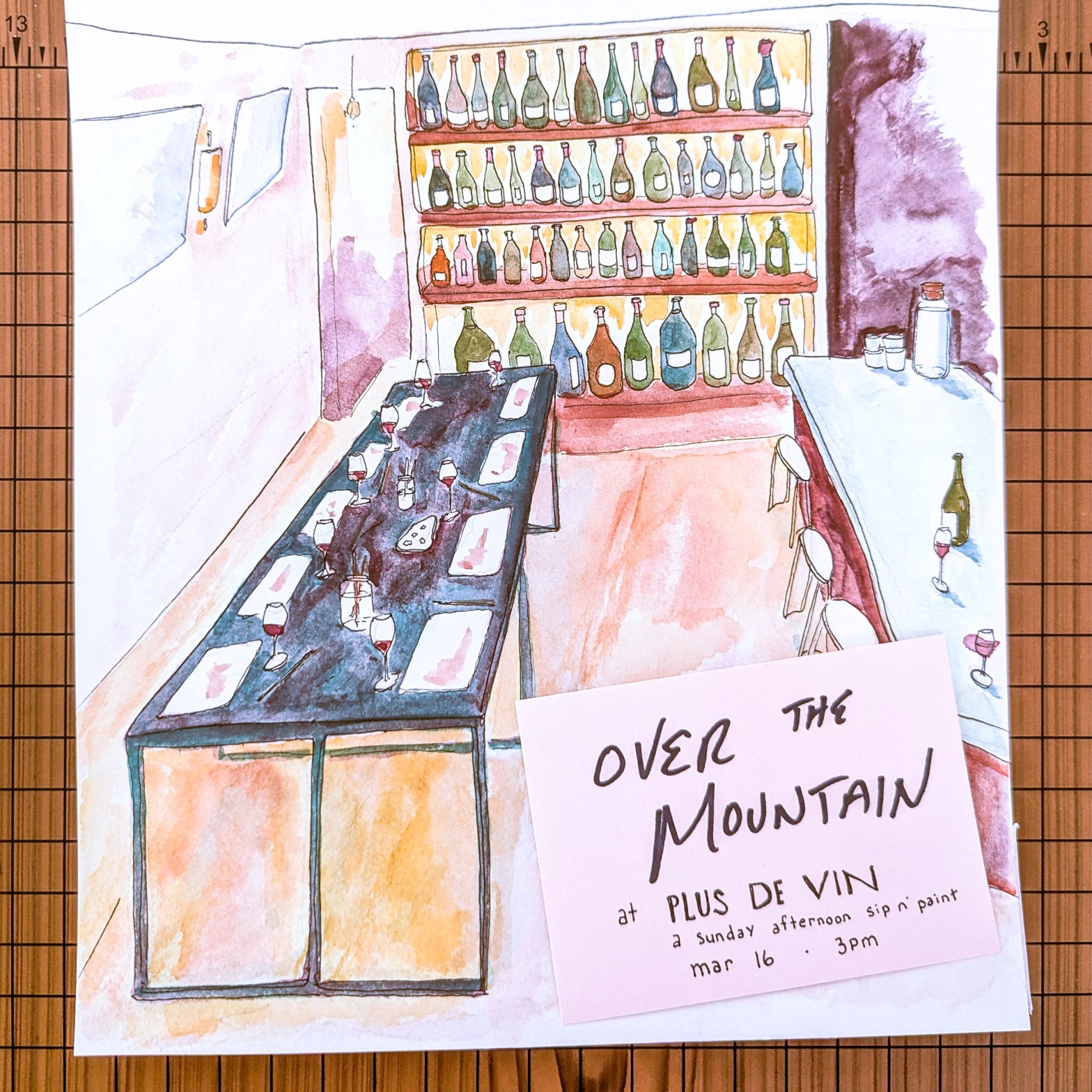
A sip n’ paint at Plus de Vin, a wine bar off the Graham Ave L stop in Brooklyn, held on March 16. Upcoming classes: Sunday afternoon, April 20 [tickets] and May 11 [tickets]
A sip n’ paint class about crossing the Alps, and five wines that made the journey.
From an amphitheater of pergola-trained vines above Carema to the shores of Lake Geneva, we’ll taste five wine that show us how mountains can be as much a crossroads as they are a barrier: wines that breathe in Alpine meadows, soak up sunlight, and blur borders.

What did we drink? Here’s a little more info on everything below:
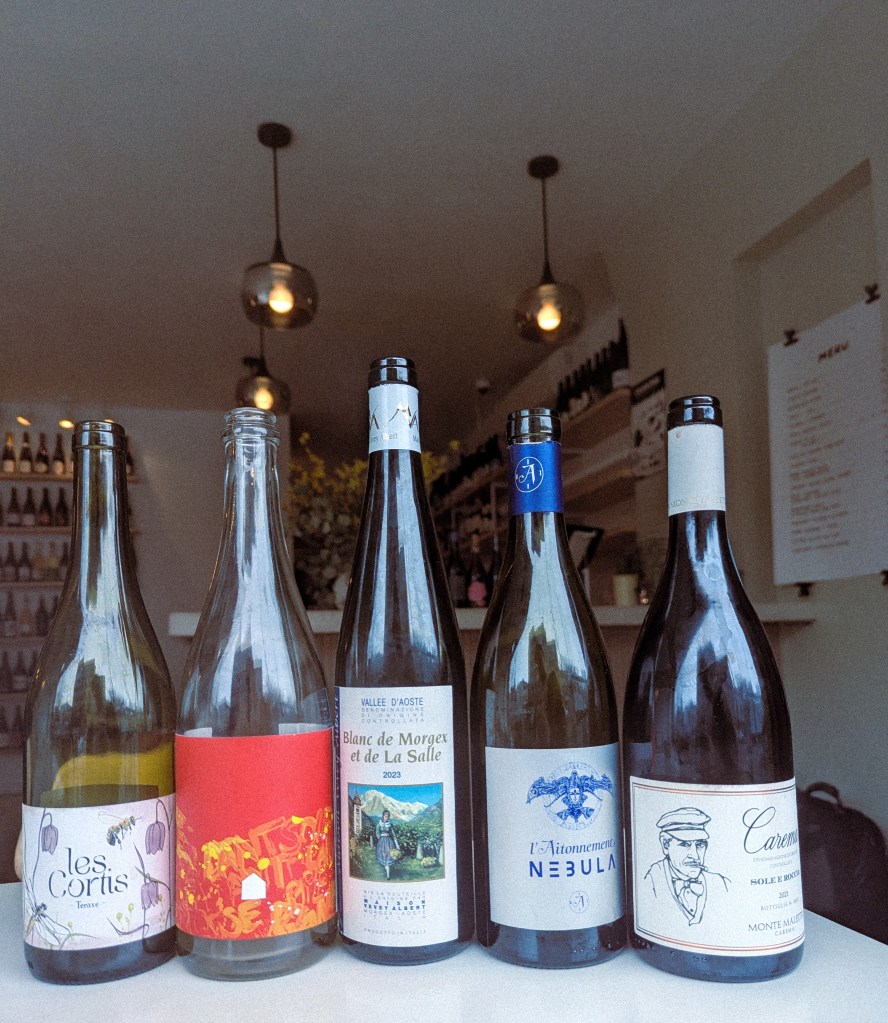
LES CORTIS, “TERAXE” [Bugey]
Who? Jérémy and Isabelle Decoster Coffier, who worked for years for Alice and Olivier de Moor, natural winegrowing legends of the Yonne, and bought their first vines from a retiring grower here in a handshake deal in 2016. The grape is roussette, aka altesse (‘highness’), a princess-peachy, seriously structured white variety of the Savoie. (Do you like chenin? You’ll love altesse!) There is a splash of chardonnay here as well. The place is Bugey, a crumpled section of the foothills of the Jura mountains in a loop delimited by the Rhône river. What to do sit on a patio in 55 degree weather. Bake a potato. Listen to something texturally noisy and soothing? The Quine Tapes bootleg recording of that Velvet Underground show, maybe? Yo La Tengo’s I Can Hear the Heart Beating As One? Sofia Kourtesis’ 2023 bedroom dance album Madres? Bodega pairing Chopped cheese.
Tangent: BUGEY
Here’s a little more about Bugey as a place. (You can skip this to get to the next wine!)
Politically it was a fief of the House of Savoy for almost 600 years, before European nation-states began to coalesce like planets. It was ceded to France in the 1601 treaty of Lyon, which concluded a yearlong war between the King of France and the Savoyards over a little French enclave in the Piedmont called Saluzzo. (Motto of the marquisate: Non sol per questo, ‘Not only because of this’.)
Geographically it’s defined by a loop of the Rhône river around the crumpled-up southernmost foothills of the Jura mountains: little island clusters of vines separated by forested limestone plateaus mostly trying to face south and soak up the sun. And those clusters are tiny — Bugey as a whole only has 500 scattered hectares under vine, a drop in the bucket compared to Saint-Joseph (~1200), Croze-Hermitage (~1800), or oh my god the southern Rhône (50,000++?!!). There are structural reasons you’ll find Côtes du Rhône in Costco and not Bugey, you know what I mean?
As for the wines themselves, it’s a place where you feel the transition between that Alpine energy and Lyon, due west, with Beaujolais orbiting that city like a purple granite moon. There’s Savoyard altesse and mondeuse, but also Burgundians like gamay and chardonnay and pinot noir. Bugey makes, proportionally, a lot of sparkling wine. Up north, where it shades into the Jura, there’s even poulsard, most notably (for those of you studying for exams) in the frothy sweet pink fizz of Cerdon.
O FAYA FARM, “SEUF DÊ FENDANT” [Valais]
Who? Ilona Thétaz, who started her own wine farm (plus apricots and sheep!) in 2020. Ilona has been working in wine since an apprenticeship in 2013, although she originally wanted to be an actress and acrobat. She made her first wines for herself basically at home, for friends, in 2019. Her farm started in the village of Saxon in 2020, but after a devastating 2021 vintage (the year she also fell in love) she relocated to Conthey, a steep, rocky, wild place overlooking the Rhône. The sheep and apricots are still with her. The place is the Valais, the glacial Alpine valley carved by the Rhône before it spills into Lake Geneva, and the biggest wine region in Switzerland. Switzerland makes fair bit of wine, generally high-quality, well farmed, and expensive, and drinks almost all of it themselves. Ilona really embodies the rising generation of more playful, experimental small scale natural winegrowers, which you can find in the natural wine store in my sister’s neighborhood in Geneva, for example, but which barely exist in the export market. The grape is fendant, aka chasselas, maybe the most prominent white grape of Switzerland that, when grown elsewhere in central-ish Europe (Baden, Alsace, etc), is treated as a table grape for snacking or a neutral grape for blending. What to do Roast a chicken at home and have 1-3 friends over. Bodega pairing International snack attack a la unsnackable, my pandemic comfort read. I’m dreaming of Lay’s Green Onion (apparently only a thing now in central Europe?) or Korean shrimp chips from H-Mart.
VEVEY ALBERT, “BLANC DE MORGEX” [Aoste/Aosta]
Who? Mario and Mirko Vevey, a veterinarian and forest service worker who inherited their father’s small winery in 1990. They organically farm 1.5 hectares (a little larger than a baseball field or Gramercy Park), terraced at 3,600 feet in the shadow of Mont Blanc. The place is The Valle d’Aosta, a tiny Alpine river valley dotted with fortresses and tiny picturesque villages that is Italy’s smallest and most sparsely-populated province. Over half the people here still speak patoué valdôtain, a dialect of Franco-Provençal. It only became part of the new Kingdom of Italy in 1861, and before that, for about 700 years, it was basically part of the Duchy of Savoy. The grape is prié blanc, a cold-hardy native of these high mountains that still grows on its own roots here, without grafting. Apart from a tiny bit in the Valais and (surprisingly!) some ancient backyard vines in Castille, it’s only here: 40 or so hectares of vines left in the world. What to do Build a snowman, or a sand castle. Bodega pairing “Cloudy” (salted) Bjorn Qorn.
l’AITONNEMENT, “NEBULA” [Savoie]
Who? Maxime Dancoine, who arrived in Aiton in 2016 to collaborate with the village’s last remaining winegrowers. The grapes are douce noire, once the most-planted red variety of the Savoie, now nearly extinct in its birthplace—as well as a bit of mondeuse, syrah’s mountain cousin. The place is the Savoie, specifically the glacial Alpine valley carved by the Isère. What to do impress a wine snob Bodega pairing chopped cheese sandwich (for non NYers)
Tangent: WINE CLUB PROFILE
This bottle was one of the wines in the winter wine club shipment, which explored the Rhône river from its source in the Alps to its ending in a Mediterranean delta.
Below is the longform profile I wrote about Maxime and his work for the club’s members page. Scroll past the color block to skip ahead to the final wine!
More? Ok more! Maxime was trained in Switzerland — the river makes connections — and arrived in the Savoie only in 2010. He worked for pioneering organic vigneron Louis Magnin, and then for a local oenologist laboratory which covered most of the region, one of those behind-the-scenes jobs that puts you in touch with a lot of different people and gives you a lot of deep experience, very quickly, of place.
He ended up landing in Aiton, tucked up the Isère river in what is today a pretty neglected part of the Savoie (see also: Les Ardoisières, very nearby in St. Pierre de Soucy, which is also where Maxime aged his first vintage). It’s a lot of steep slopes abandoned because they can’t be worked by machine, old nearly extinct cultivars hiding in backyards, faded legacy of wines that, as of the 19th century, were written about as able to “rival the Graves and the Chablis.” Phylloxera, modernity, two world wars, and by the 1950s the vineyard area is a tenth of what it once was: a familiar, sad song.
He took over from the last two vignerons in the village— 58 ares, half the size of Gramercy Park— and has recuperated about a hectare and a half more, plus a new field planting of massale cuttings of a bunch of different cultivars (some of which I’ve never seen before, and this is a special interest of mine!): verdesse, molette, blanc de maurienne, petit saint marie, gringet, and the white and gris mutations of mondeuse. The plots are fragmented and small and in some cases the only way to get to them is by hiking little footpaths like a mountain goat. Maxime believes, as I do, that polyculture and genetic diversity in the vineyard can be a source of resilience against climate change.
The vibe of the wines is, I don’t know another way of saying this, ambitious. There’s a high gloss to them, an evident care and elevated threadcount that makes them very at home on white tablecloths when I’ve served them in fancy wine hospitality situations. He orchestrates ceramic vessels, clay amphora, concrete, 400L demi-muids for his aging, has an entire paragraph on his website about the company he gets his bottles from and how he cleans them, etc. It seems to me he’s looser and more uninhibited in the vines, and a bit more technical and fussy in the cellar: a familiar type.
The grape on stage here, douce noire, is one of those nearly forgotten local cultivars (in 2007, France’s official grape census counted 2 hectares of vines—a hundred thirty years ago, it was the most-planted grape in the Savoie), but it’s had an unexpectedly well-traveled second life.
Recent DNA analyses revealed that it made its way to Argentina, where it’s the second most-planted wine grape in the country, called bonarda, (apparently unrelated to a northern Italian grape of the same name), and that it was also brought to California by Italian immigrants, where it’s called charbono (from charbonneau, a synonym in the Jura). As turca, it’s been planted in the Veneto for a hundred years. The Alps are a barrier and a crossroads.
For a long time it was thought that douce noire was maybe a dolcetto relative, and it’s easy to see why—it has a similar plummy sappiness. When I first tasted it as charbono I filed it in my head as one of those grapes that tastes like its name: a kind of grilled, roasty-toasty steaks over open flame energy. If you’re having dinner, consider preparations with a little char, the caramelization of dates in savory recipes, lamb tagine, black olives. Not only might I pair it with the same things I’d pair with syrah or with a northern Italian red, it could be fun to pop say, a dolcetto from San Fereolo or Cascina Corte in Dogliani, or your bottle of syrah from Thibaud Capellaro, or a teroldego from Elisabetta Foradori, taste them side by side, and see what resonances you find.
MONTE MALLETO, “SOLE E ROCCHIA” [Carema]
Who? Gian Marco Viano, who was working as a sommelier when he fell in love with the tiny but historically mighty village of Carema (pop 800, less than 20 hectares under vine). He began piecing together his patchwork of small terraced plots connected by hiking trails in 2014, and named his winery after the mountain that protects the village. Over the last decade, his work has been the beginning of a revitalization for the village, with other young people joining him as fellow producers and collaborators. The grape is picotendro, the local name for nebbiolo, fragrant, giving very little color, surprisingly tannic. The place is Carema, in the Alto Piemonte, and the most Alpine of the little patchwork of nearly forgotten wine villages (Boca, Bramaterra, Lessona, Gattinara) where the Piedmont ends and the Alps begin. What to do impress a wine snob x2 Bodega pairing beet terra chips
 Children's Atlas of Wine