
A workshop at Lise & Vito in Greenpoint, Brooklyn on Tuesday, April 15 drilling down on wine styles between red and white. Stay tuned for our next industry tasting group!
What does it mean for a white variety’s “typical” expression if it’s fermented on the skins? How do you evaluate two pink wines blind?
We often define wines in the rainbow of expression beyond red and white more by their style than by how they transmit place.
In tasting side by side, though, dramatic differences jumped out in how, say, a pine-y, aromatic cold-hardy macerated white from New York’s Finger Lakes acted next to a salty, rounded one from the Mediterranean Gard — despite the fact that they were both basically made in the same way (whole cluster, 2-3 weeks’ maceration during fermentation).
A quieter, silky co-ferment of red and white grapes from the Alps spoke in a completely different register than the punchy, savory-sweet mix of red and white grapes from central Sicily.
Looking at these wines through the lenses of landscape and climate rather than color doesn’t just explain their differences, it reveals different ways to think about using them — whether that’s pairing them to food, or to a moment.
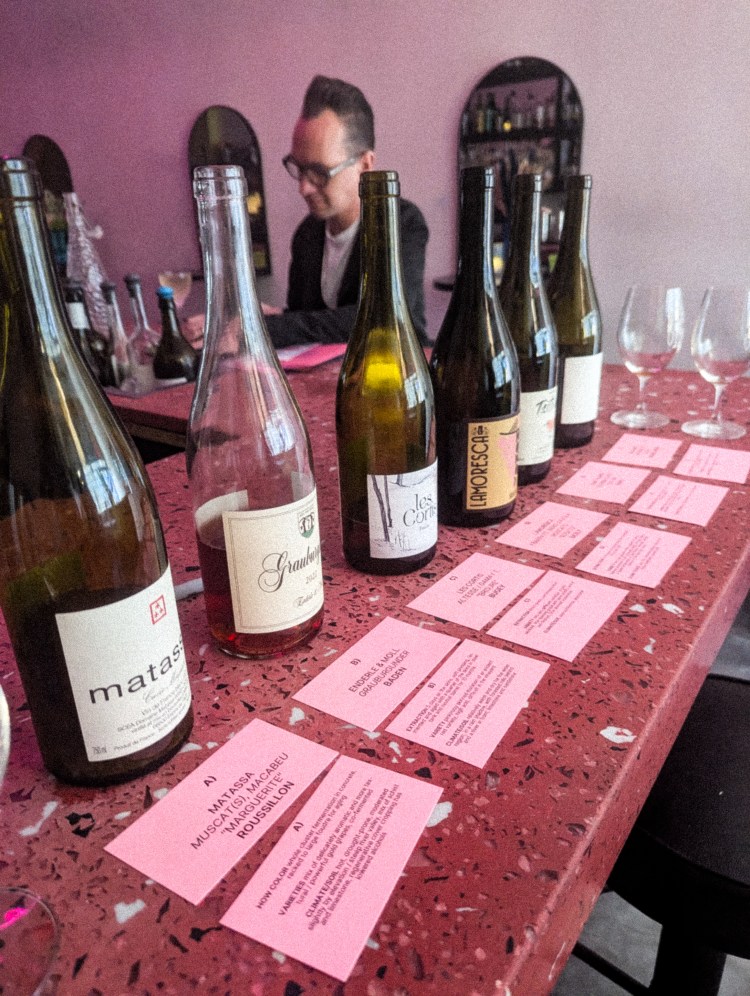
Here’s what we tasted, a little more about each of them, and a couple of questions we asked while we tasted:
A. MATASSA, muscat(s), macabeo “Cuvée Marguerite”, Roussillon
B. ENDERLE & MOLL, pinot gris, Grauburgunder, Baden
Tom Lubbe is one of the icons of Calce, a flyspeck village (population as of the 2022 census: 224) that, since the pioneering work of Gerard Gauby, who started biodynamically farming here in the ´80s, has become a nexus of the Roussillon’s natural wine movement.
Limestone (see that village name) collides here with schist; we are in mountain-forming country, and the geological diversity reflects that. It’s hot, with freshness from elevation and local winds, and drought pressure is a huge issue. Tom stopped tilling his soils years ago, and farms regeneratively; his potential alcohol in this wine has dropped from 13ish to 10-11 as a result, without sacrificing phenolic ripeness. Both muscats are common throughout Roussillon, where they were once used in places like Rivesaltes for fortified, oxidative sweet wines. We talked about the aromatic difference between muscat of Alexandria — its muskier, honeyed jasmine & orange blossom — and muscat à petit grains, with its grape-y, lychee, honeysuckle character (for me, also, a kind of dandelion sappiness). (More about muscat, as promised, here.)
Enderle & Moll’s grauburgunder, meanwhile is another one of my small obsessions: a pink wine made from a ruby-skinned grape associated with industrial white in a style that you could call orange. There are important winemaking differences here, too: just 5 days or so of maceration before pressing, aged in tank along with a quarter of the skins from the press. The climate in Baden, across the Rhine from Alsace, the Grimms fairytale Black Forest to your back, couldn’t be more different, either. (Although Baden is a little warmer than you might think.)
Questions to ask while you taste: What tricky-to-pair foods would these wines unlock? Where would you put the Enderle & Moll on your wine list? How do you want to talk about muscat and sweetness?
C. LES CORTIS, altesse/gamay teinturier “Brisure”, Bugey
D. LAMORESCA, nero d’avola, frappato, zibbibo “Rosato”, Sicily
Isabel and Jérémy at Les Cortis worked with the de Moors in the Yonne for years before buying their first vines from a retiring grower in Bugey in 2016. (Read more about Bugey here.) “Brisure” is a 50/50 co-ferment of direct pressed altesse and a teinturier (red-fleshed) variant of gamay; the result is a pale, peach-colored pink wine that for legal reasons gets labeled as “red wine” on the back.
Filippo and Nancy Rizzo, meanwhile farm a small polycultural estate on Sicily’s central plateau, between Etna and Gela on the southern coast: 4ish hectares of vines are joined by olive groves and prickly pears, and there are no other wineries for miles in any direction. (Filippo worked for Frank Cornelissen before breaking out on his own.)
The 2023 vintage of their rosato (which is what I had notes for coming in to the tasting) is significantly darker because the frappato was hit with mildew and they vinified with about twice as much nero d’avola. It turned out that the bottled I’d pulled from Lise & Vito’s cellar was the 2022, so here’s how they did it:
Zibbibo aka muscat of alexandria is the first pick, and it spends a week starting fermentation on its skins. This is used as a pied de cuve (natural fermentation starter) for equal parts frappato and nero d’avola that have been run through a crusher/destemmer, and everything settles together in a plastic tank for 4-5 hours. Then he presses everything together in a basket press and lets it finish fermentation in the plastic tank before moving it to steel for the winter.
Questions to ask while you taste: What effect does incorporating air / changing the temperature of these wines have, and how might it change how a guest feels about it? If you closed your eyes and tasted these without color references, where would texture and aromatics take you?
E) BLANDINE FLOCH, bourboulenc, “Tsituri”, Gard
F) WILD ARC, traminette, “Luca”, Finger Lakes
Blandine at Chat Huant makes wine in the Loire et Cher, the rolling, forested, transitional country between Tours and Orleans, less well-understood than other regions in the Loire despite being the home of icons like Clos Roche Blanche, Herve Villemade, Thierry Puzelat, Pierre-Olivier Bonhomme etc — but, following a vintage (2021) where she lost everything to frost and went south to purchase fruit to work with, she’s spent more and more of her time in the Gard working with southern varieties. Her lineup is currently a mix of wines made from the grapes of the eastern Loire — sauvignon, gamay, côt — and other bottlings from cépages of southern Mediterranean France: cinsault, grenache, and this bourboulenc, a big-berried, tight-bunched, rather neutral, late-ripening white grape. (Pick too early all you get is acidity, fully ripe a kind of smoky gentle herbal quality.)
Todd Cavallo, meanwhile, is based the Hudson Valley, although he sources fruit from a variety of New York vineyards — including this traminette, from a vineyard in the Finger Lakes. Traminette is a hybrid developed at the Cornell grape breeding program in the 1960s made from a cross between gewürztraminer one of the French-American Seyve hybrids, 23.416. (Read more about hybrids here.) Like its parent, it too is aromatic, in a kind of whole-rosebush way.
Both wines were made roughly the same way — two-three weeks of whole cluster fermentation before pressing and aging overwinter to bottle in the spring. Questions to ask: how do climate and variety affect the texture and aromatics of the wine? How are these two “orange wines” different, and what are some people, pairings, or situations where one but not the other might be appropriate?
 Children's Atlas of Wine