
A tasting workshop at Lise & Vito on Monday, September 22 focused on ungrafted vines and own-rooted wines. Our next industry session will be November 3. [register here]
Wine’s Big One hit a century and a half ago: an aphid native to eastern north America and to which its ecosystem’s native vine species had adapted could be brought unknowingly across the Atlantic too fast for it to die on the trip. Steamships and railroads had made it even easier to bring previously isolated parts of the world into contact.
In this case, it was a pathogen that vinifera — the vine species domesticated in Central Asia 8,000 years ago, spread through the Mediterranean world by Greeks and Phoenicians, and then taken as far afield as Baja California and the Cape of Good Hope by European colonizers — had never encountered.
Starting in 1863, vines in a small corner of the Languedoc began to die. Within a couple of years, it had spread through the region and into Provence and the southern Rhône; within a decade, it was in the Alps, and within two it had crossed the Pyrenees. By the end of the century it was everywhere in Europe, wine regions had been wiped off the map, and millions of vines had died.
It’s a complicated and fascinating story, and in many ways the wine regions and styles we take for granted have all been shaped by this epidemic. The boom in adulteration, industrial manipulation, and railroad-enabled blending that emerged in response to the crisis led in turn to the appellation system. Entire regions, like Isère, the connective tissue between the Savoie and the Rhône, disappeared from the map. Finicky ancestral grape varieties were thrown overboard, landscapes were rewritten, the way vines were farmed and planted changed beyond recognition.
Not to get too sidetracked here! Like I said, there are a lot of twists and turns over the 40 years this crisis had a death grip on the world’s wine industry: Bordeaux merchants fleeing to a train station in northern Spain, Beaujolais schoolchildren pissing on vines, poison injected into the ground, intentional flooding, a worldwide scientific arms race… the reason, for example, that the most-planted grape variety in the Loire Valley through the 1950s was the hybrid vine baco noir.
For our purposes, though, the upshot is that the solution to phylloxera, by and large, has been the one hit on by Texas grape breeder and scientist T.V. Munson: plant phylloxera-resistant rootstock bred from phylloxera-resistant American vines and graft the heads of vinifera varieties onto them.
Same great pinot taste, disease-proof roots!
What this means is that almost any wine you’ve tasted, with some notable exceptions, has been grafted. (Even if you’re drinking, idk, Virginia vidal blanc, most commercial hybrid vineyards are grafted, too — not all hybrids have robust phylloxera resistance.)
What we explored, then, were 7 of those notable exceptions (focusing on white-ish wines): wines made from own-rooted vines, in almost every case own-rooted by default due to their old age — they’d been planted pre-phylloxera and survived.
There are producers out there, like Huet in Vouvray or Cappellano in Barolo, who have planted younger vine own-rooted plots, often next to grafted plots of the same variety — the rare opportunity to do a true side by side. (Unfortunately, dropping $1100 to taste Cappellano’s “Pie Franco” next to the grafted “Pie Rupestris” on the same slope was beyond my financial ability for this tasting. If enough of you join the patreon, though, watch out!)
There are soils the aphid has a really hard time moving through without damaging itself: sandy plots are often islands of phylloxera resistance, and the foliated slate of the Mosel is full of untouched parcels. Islands are hard to get to (we tasted three — Siciily, Crete, and Tinos), and there are entire regions, like Barossa in Australia or the west coast of Chile, where phylloxera has yet to arrive.
But since we’re mostly talking about survival and ungrafted-by-default, the other tricky question box this pops open is, to the extent that there are differences here, in terms of the wines themselves, beyond winemaking choices and soil types, can you put the differences down to the magic special sauce of a direct connection between the root and the vine, or is there something instead about vine age, and a plant’s epigenetic, growing connection to the landscape it’s planted in over decades?
(Also, to the extent that there was no replanting in these regions during phylloxera, it was usually because they were poor. The wine trade had moved on. Commercial production for either high yields or fine wine wasn’t a thing. Vines produce the most at a reasonable level of quality between about 25 to 40 years. A region like Bordeaux is constantly uprooting old vines whose yields make them less profitable and replanting with new material to keep an estate’s stock of prime production vines stable. And there’s evidence that grafting, to say nothing of chemical farming, might have an impact on a vine’s ability to survive to an advanced age.)
None of these questions were going to be solved by tasting these wines. But each of these, a survivor and transmission, opened the door to asking them.
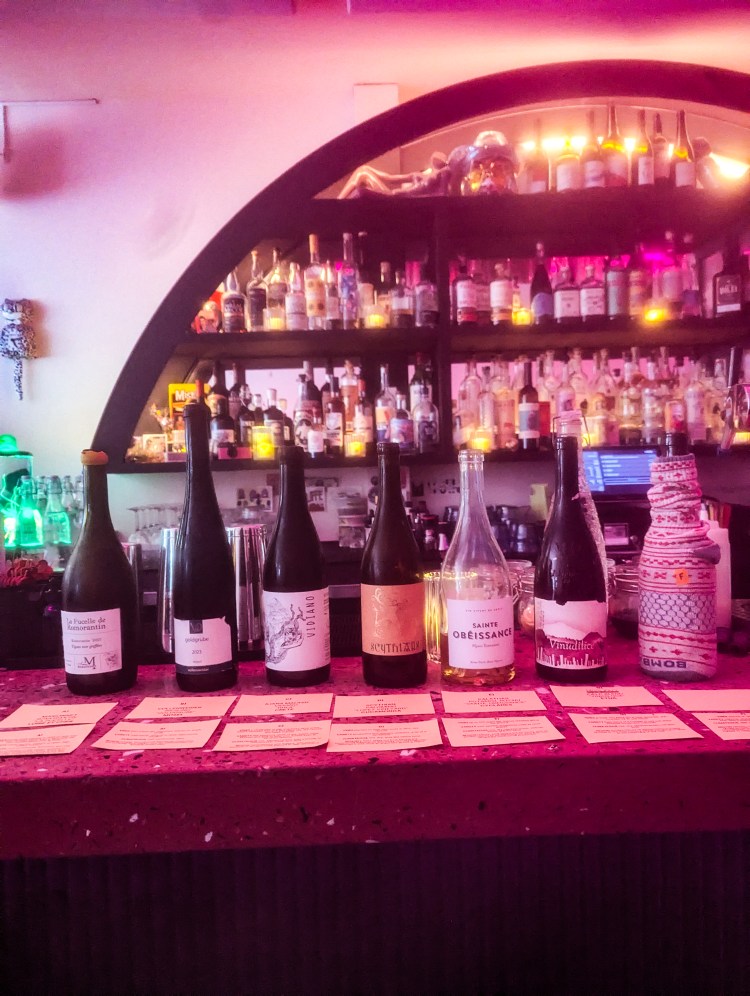
Here’s what we tasted, a little more about each of them, and a couple of questions we asked while we tasted:
A. MARIONNET romorantin “La Pucelle”, Loire et Cher
youngest vines of the bunch! planted in 2007 with cuttings taken from an adjacent plot of ancient, pre-phylloxera romorantin, probably the oldest in the world. (Marionnet says they think it dates back to the 1850s). Technically outside of the tiny appellation for romorantin as drawn today (Cour-Cheverny), and so bottled as vin de france.
B. VOLLENWEIDER riesling “Goldgrube”, Mosel
a parcel of 120+ year-old riesling on the old slate terraces of the Goldgrube, at the top of the Middle Mosel
C. ILIANA MALIHIN vidiano “Rhea”, Crete
a single plot of 150-200 year-old vidiano (the main native white grape of Crete) in the island’s rugged, mountainous heart (in 2022, wildfires fueled by climate change burned over the region; the oldest vines seem to be recovering, but some of Iliana’s new plantings were lost)
D. SCYTHIANS palomino “Lopez Vineyard”, San Bernardino County
planted in 1912 on deep, beachy sand alongside zinfandel and alicante bouschet, in the days when Los Angeles was still a major player in California’s wine industry
E. KALATHAS potamisi, rozaki “Sainte-Obeissance”, Cyclades
‘vignes centenaires’ — a co-ferment of two varieties somewhere between 100 and 200 years old on the island of Tinos, where vines are often trained in loose crawling sprawls over the ground
F. I VIGNERI field blend “Vinidiluce”, Etna
a single plot of centenarian vines mixed between red and white, including grenache, grecanico, two colors of minnella, and others, at one of the highest elevations on the volcano of Etna and completely isolated, surrounded by oak forest
G. LEO ERAZO pais “Resistencia”, Itata
a single plot (a fifth the size of Gramercy Park) of pais planted somewhere between 1867 and 1870. In 2023, it was burned over by wildfires fueled by industrial forestry (eucalyptus and pine plantations) and a warming, drying climate.
 Children's Atlas of Wine