
This post previously appeared in a slightly different form as part of a January, 2024 newsletter.
Well, it looks like we can finally call it: 2024 is the year the Court of Master Sommeliers (Americas) stops using ‘New’ and ‘Old’ worlds as a framework for understanding how and why a wine is the way it is in its blind tasting grids.
As long as we’re here posting for posterity: the ‘Old World / New World’ question has always had two parts, for me.
The first is straightforwardly practical: does it work in explaining what’s in my glass, and why?
The second part: beyond utility, are there downsides to dividing the world into Europe and the places it colonized for the purposes of understanding wine’s history and the way it is today?
The second part felt, to me, like the more important implication — who cares, in comparison, if I understand my blind cabernet flight less clearly? — which is why I opened my Punch piece the way that I did. (And why a writer like Miguel de Leon or Sydney Love is worth listening to on this.)
“But even if it’s bad,” I imagined a reader saying, “that doesn’t make it not true.” Is the truth value of the framework a little shakier than a person might realize? That, for what it’s worth, was the rest of the piece.
The CMS-A may have come around, these four years later, but there’s still plenty of lurching life yet in this zombie of an idea. (“We understand,” the note goes on to say, “that candidates may have established habits in their tasting process. Therefore, those opting to incorporate the Old World and the New World terminology into their deduction will not incur any penalties; it will simply not be scored.”)
So with the war not yet all the way over, as it turns out, let’s take a look at the top three google results for ‘new world versus old world wine’ and see what truth statements are being made:
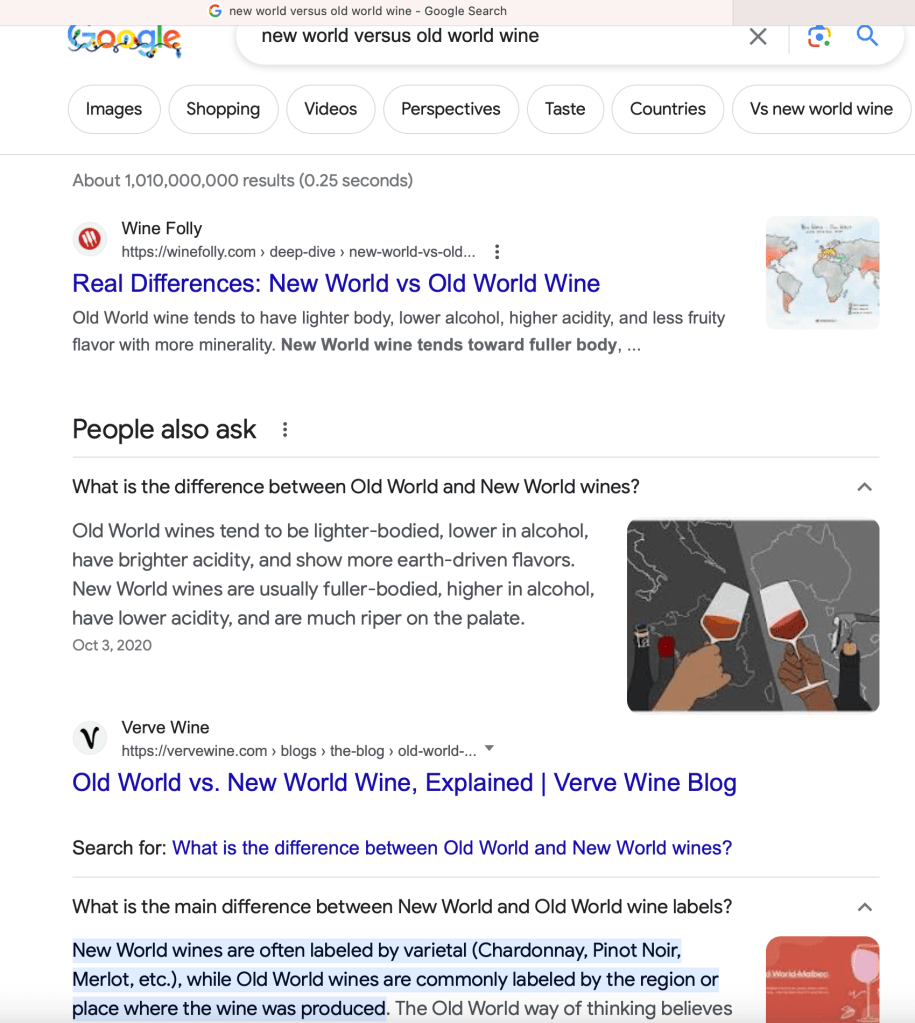
Notably, the comparisons skip right over geography (which gets complicated anyway: is Lebanon the “Old World”? What about the Czech Republic?) and barrel directly towards assertions about label language, production practices, style, and flavor.
To give this the most generous reading possible: In a country club restaurant in 1996, this genuinely might have been an effective way to sum up why your Kendall Jackson chardonnay tastes different than your Chablis.
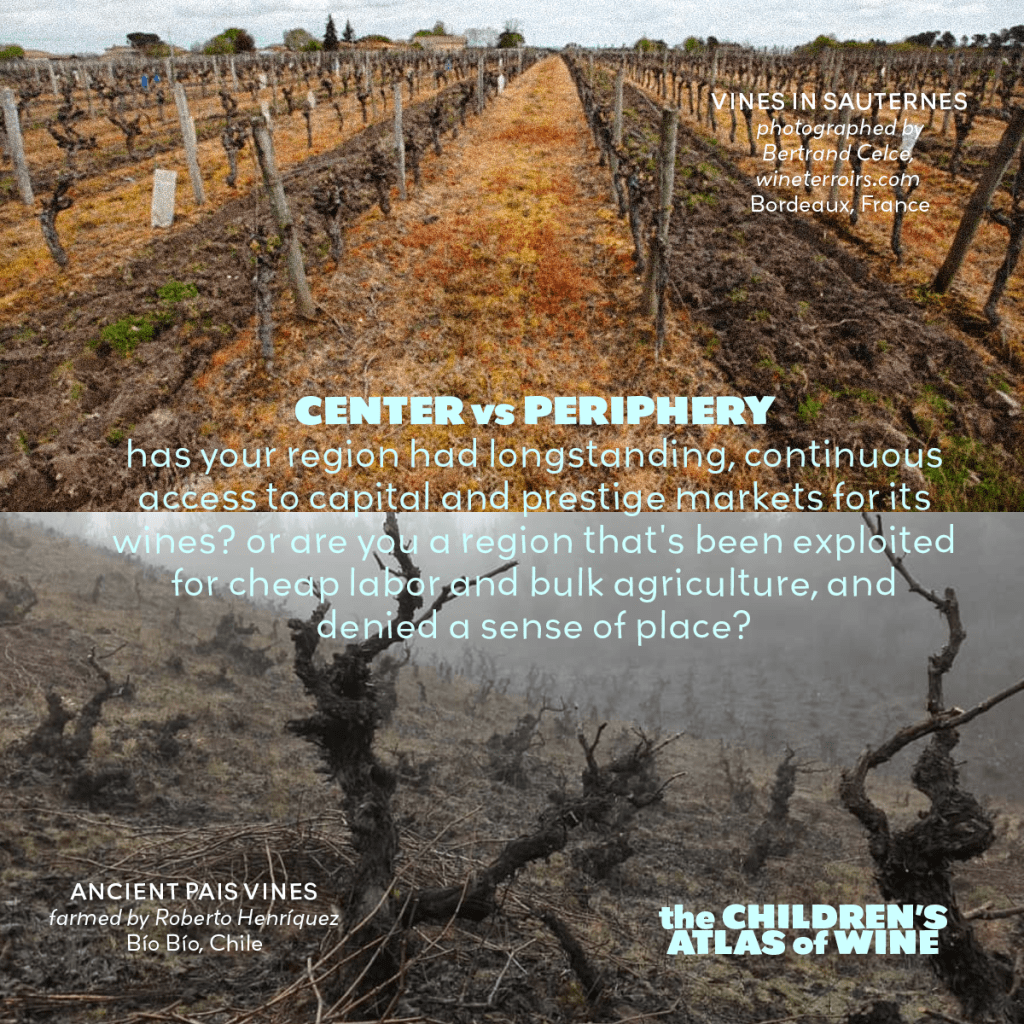
But how does it work when the two wines in your glass are a Super Tuscan from Sassicaia on the right, and Roberto Henríquez’ shimmering 200 year-old pais vines from the green hills of Bío Bío in southern Chile (on your left, naturally)?
What about (one more! I’m having too much fun) a Languedoc chardonnay bag in a box sold exclusively to a European supermarket chain side by side with an 8% skin-contact catawba from the Catskills?
“OK,” people in the industry pursuing certification or studying for their WSET Level 3 or taking their pins off after a shift generally say around this point. “Those wines don’t count. And anyway, if we can’t say French wine is ‘Old World’ and wine from California is ‘New World’, what are we supposed to say instead?“
The CMS’ announcement is a good and overdue start from a historically abusive fraternity in the midst of what I’m given to understand are good-faith efforts at internal reform, but the issue is that the Court of Master Sommeliers isn’t really an educational institution. (Although many of its members teach). It’s a certifying body. Its goal is to establish and maintain minimum professional standards for a role that may or may not even exist anymore. You show up to be measured. How you learn, and where you learn it, happens somewhere else.
And right now is as good a time as any to say that trying to think through these questions, as a teacher, is what led me towards this project (and away from classic frameworks for wine education) in the first place. How do you account for the way wine is, right now, and put it into context?
If we can’t say Old World vs New World, what do we say?
I don’t think this is necessarily the best question (see harm, downsides, above), but I do think it’s totally understandable. What do you do when your binary gets taken away?
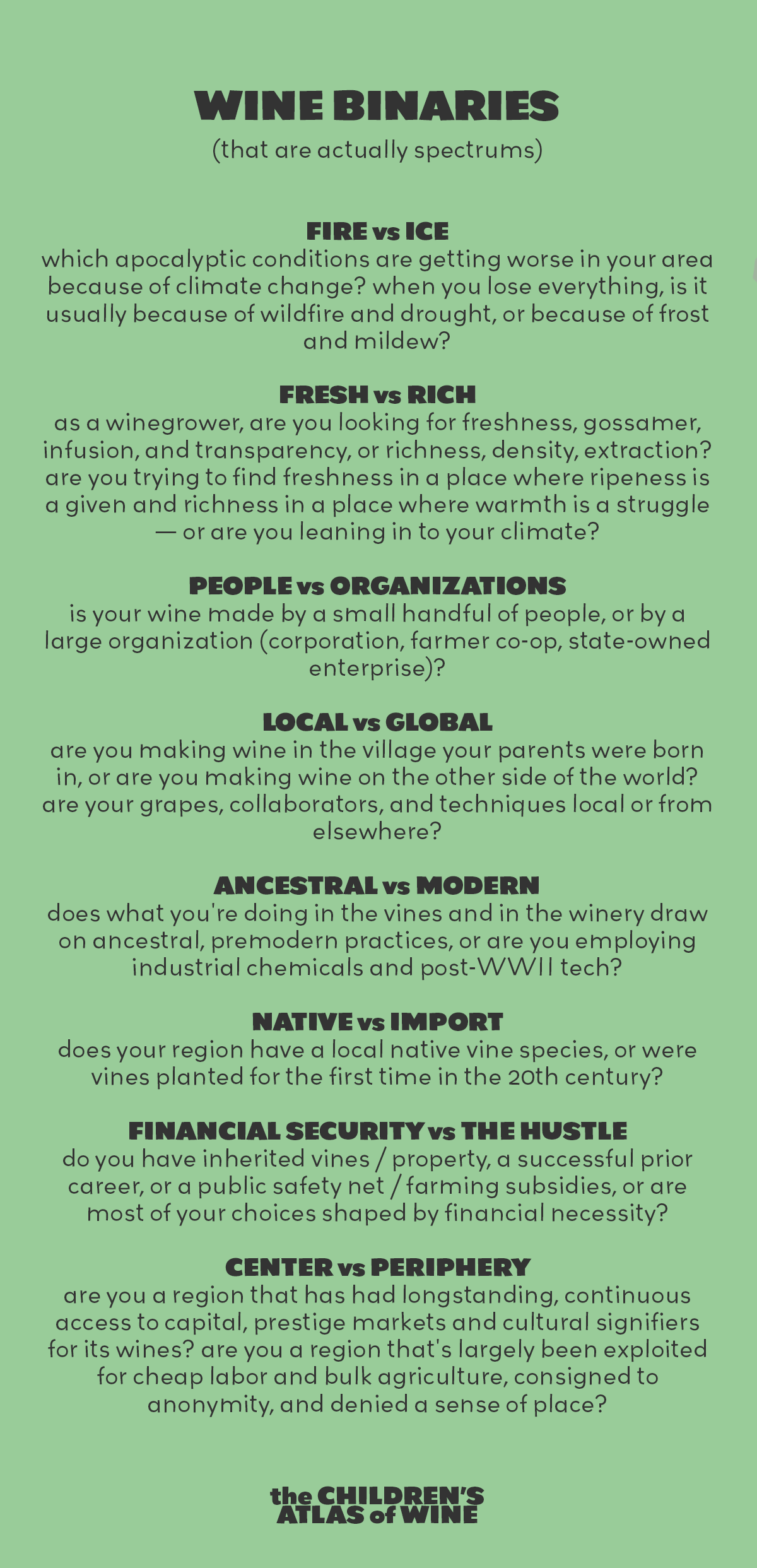
Here is a shortlist of alternative binaries that carve the wine world into two in ways I think could be effective.
It’s not exhaustive, it likely needs tweaking, and like all binaries, those in the list put an arbitrary break on what’s actually a spectrum.
At the very least, though, I would argue that all of them more useful than the framework “(western) Europe or anywhere else.” (In fact, you might notice that one of the ways the New v Old distinction breaks down is that it assumes everything on the list below belongs only on one side of the New/Old fence or the other.)
But who knows — the way to test a tool in your tool kit is to use it! The next time you’re tasting, you might try applying one of these to the wine that’s ended up in your glass. Does it help in understanding what’s there?
(And if you find these frameworks useful, consider supporting more wine education and more toolkits like this via our patreon.)
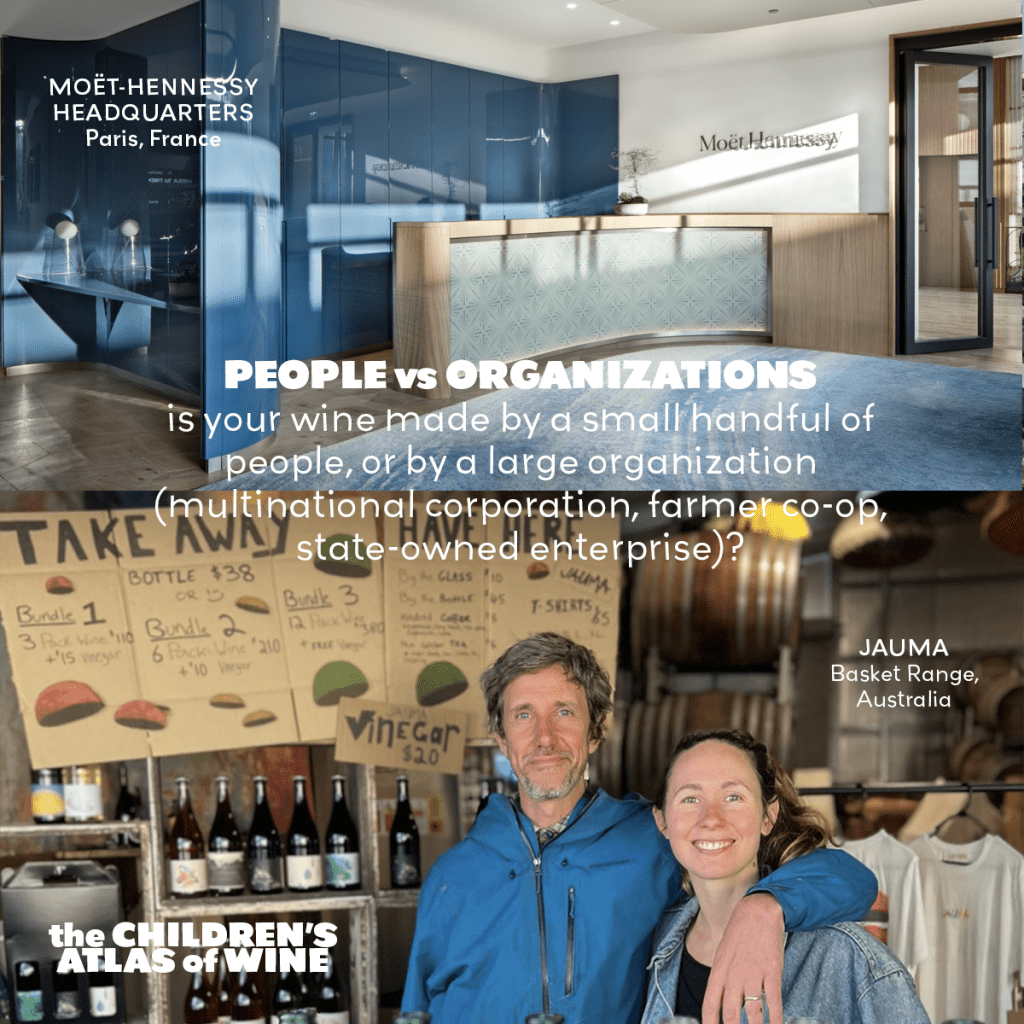
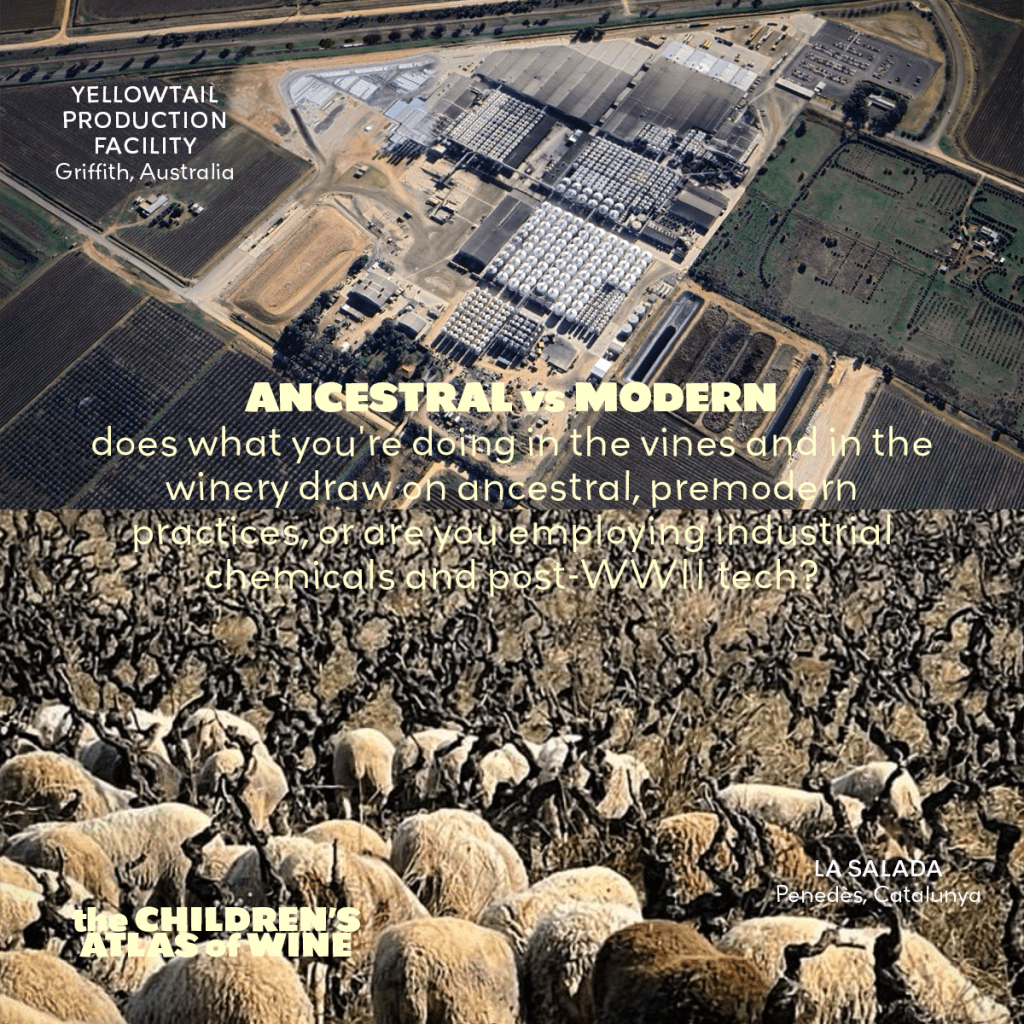
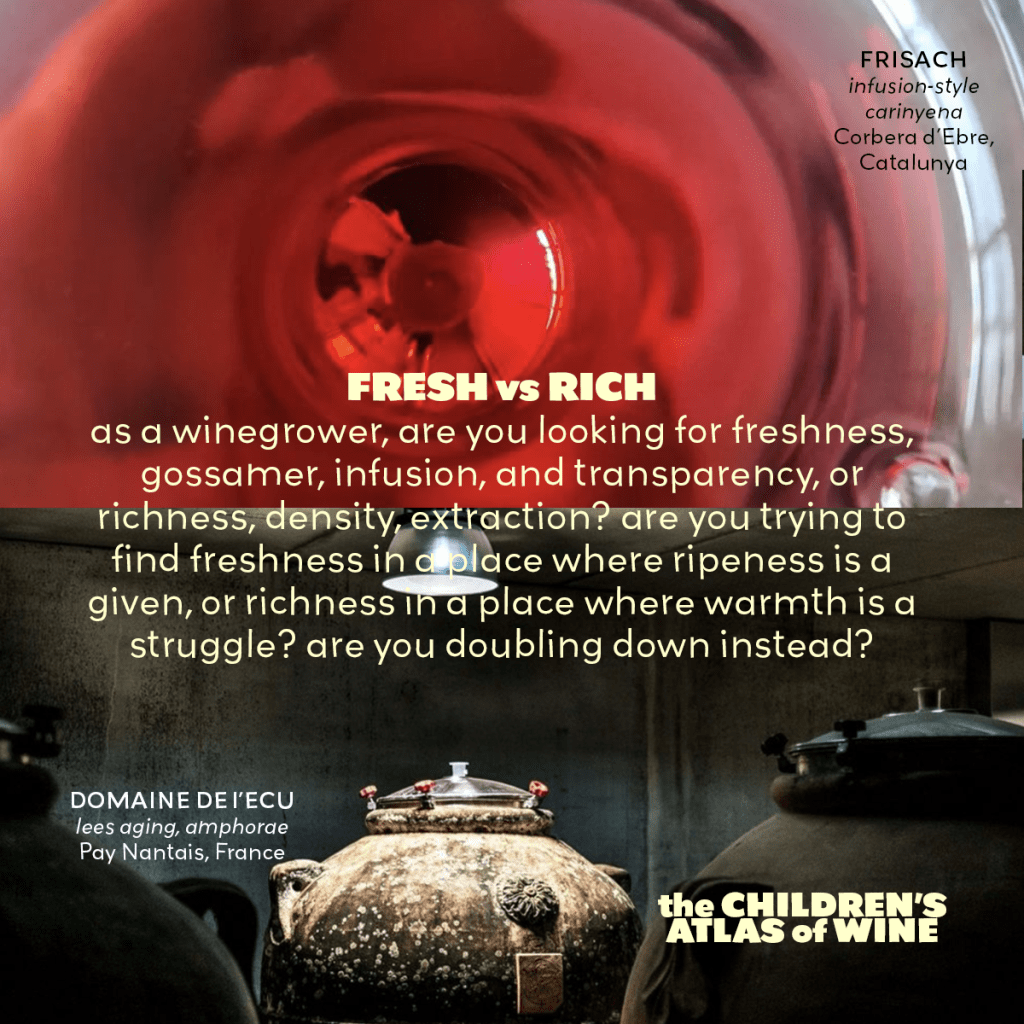
I spent a chunk of my day yesterday making visual examples of some of these binaries featuring a number of my favorite winegrowers. It was an interesting way to test some of the language I’d used — and quickly led to edits.
It’s also hard to walk the line between binaries that are descriptive and relatively value-neutral (“fresh versus rich”) and binaries that seem to be about diametrically opposed values (particularly depending on the example you pick — I was entranced by the satellite image I found of one of Yellowtail’s tank farms — adding white serifs as a caption made it feel like an establishing shot of an Imperial facility from a show like Andor).
And there are some that I didn’t intend as opposed that visually read that way when you contrast them, in ways I wasn’t comfortable with. (I tried a few versions of “Local” v “Global”, for example, with people I love on both sides, and it ultimately made it feel like I was pitting an internationally mobile, immigrant, or transplant winemaker against an ‘authentic’ original — not the textual intention, but definitely an implication of the image.)
I’m probably going to return to this part of the page over and over again going forward — there’s too much to tinker with, and too many people and examples I’d love to feature. Reach out if you have ideas of your own!

 Children's Atlas of Wine
3 thoughts on “‘New World v. Old World’”