PART ONE: ORIGINS
place
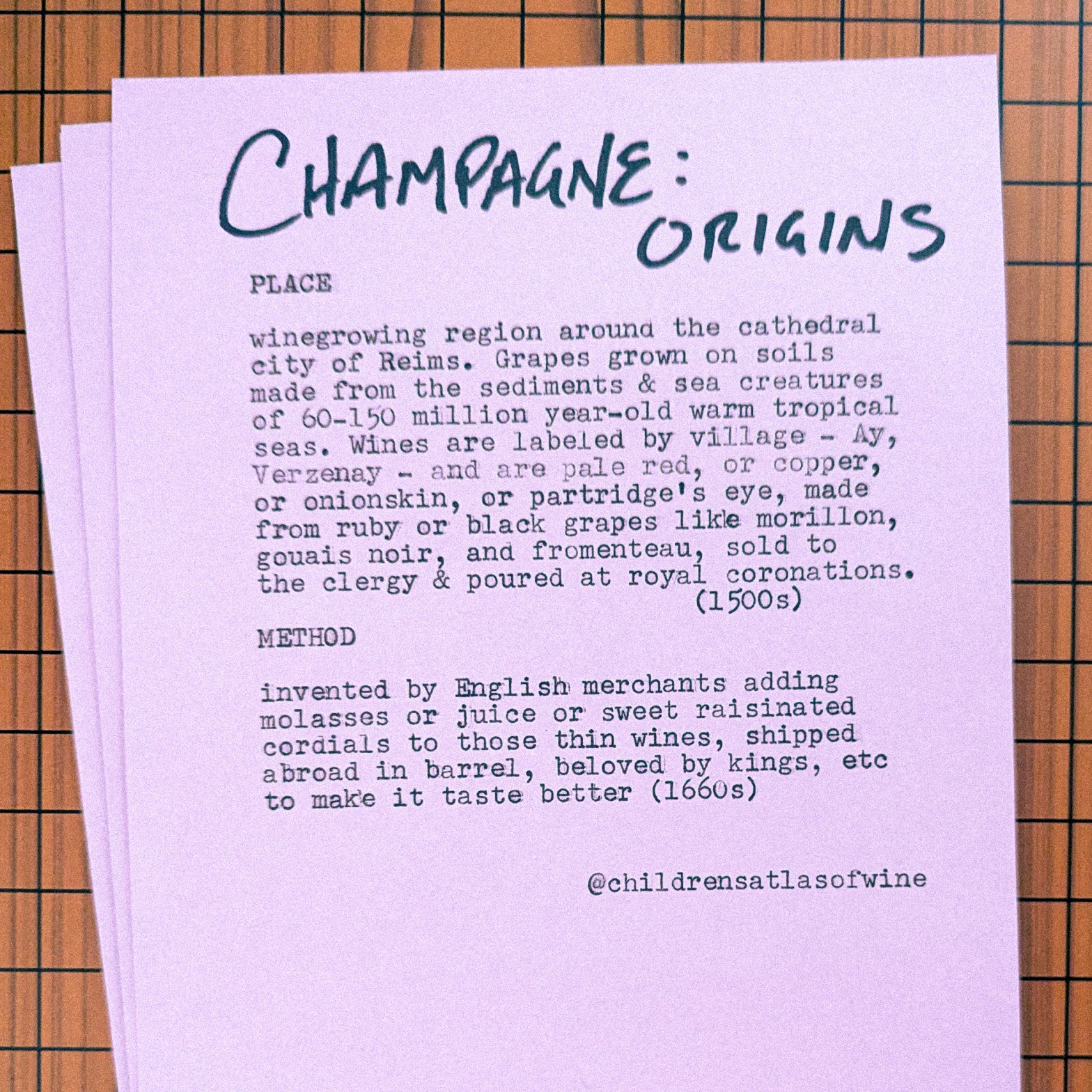
The winegrowing region around the cathedral city of Reims, where French kings are crowned. Grapes grow on soils made from the sediments + sea creatures of 60–150 million year-old warm tropical seas. The wines they make are labeled by village (Äy, Verzenay). They are pale — light red, copper, onionskin, the color of a partridge’s eye — and made mostly from black or ruby grapes like morillon, gouais noir, and fromenteau.
(1500s)
method
Invented by English merchants adding molasses or partly fermented juice or sweet raisinated cordials to those thin wines, shipped abroad in barrel, beloved by kings etc, in order to doctor it to taste.
(1660s)

PART TWO: PROBLEMS (AND SOLUTIONS)
problem no. 1
adding molasses / sugar / brandy makes it “brisk”, which people like. but wine fizzing & frothing in a barrel doesn’t stay brisk for long, and weak wood-fired French glass explodes.
solution no. 1
English coal burns brighter and hotter, glass bottles get thicker, cork is invented. (But workers will still have to wear iron masks with fine mesh and leather aprons in the caves, and for over a century the bubbles will still be unpredictable in texture and strength, and the glass is still liable to burst and shatter. Count the missing eyes and fingers of the old men who handled those bottles.)
(early 1700s – 1830s)
problem no. 2
the newly fashionable, frothy wines of Champagne carry a slurry of yeast like the churned sediment of a river bed, cloudy and opaque
solution no. 2
a rack, upon which trained workers turn thousands of bottles a quarter-turn at a time and fractionally upward twice a day for forty or so days, until they are fully vertical and the slurry has caught in the neck. Digorge sludge by hand.
(1810)
(bonus solution 2a)
invent a vibrating cage that rotates a rack of 504 bottles mechanically, sleeplessly accomplishing the task in just over a week. Within twenty years, become the dominant method for preparing bottles for disgorgement across the region’s large houses.
(1968)
problem no. 3
ok but now there’s less wine in the bottle
solution no. 3
Top off with a mixture of wine, sugar, and even sometimes brandy, all adjusted to different export markets. Invent the world’s first modern branded luxury commodity.*
* advertised with Art Deco posters and railroad publicity tours, distributed globally using the tools of industrial capitalism, etc I know there is archeological evidence for ‘brand marks’ for luxury goods going back to the Phoenicians please don’t @ me
(19th c)
PART THREE: GLOBALIZATION AND REACTION
globalization, a
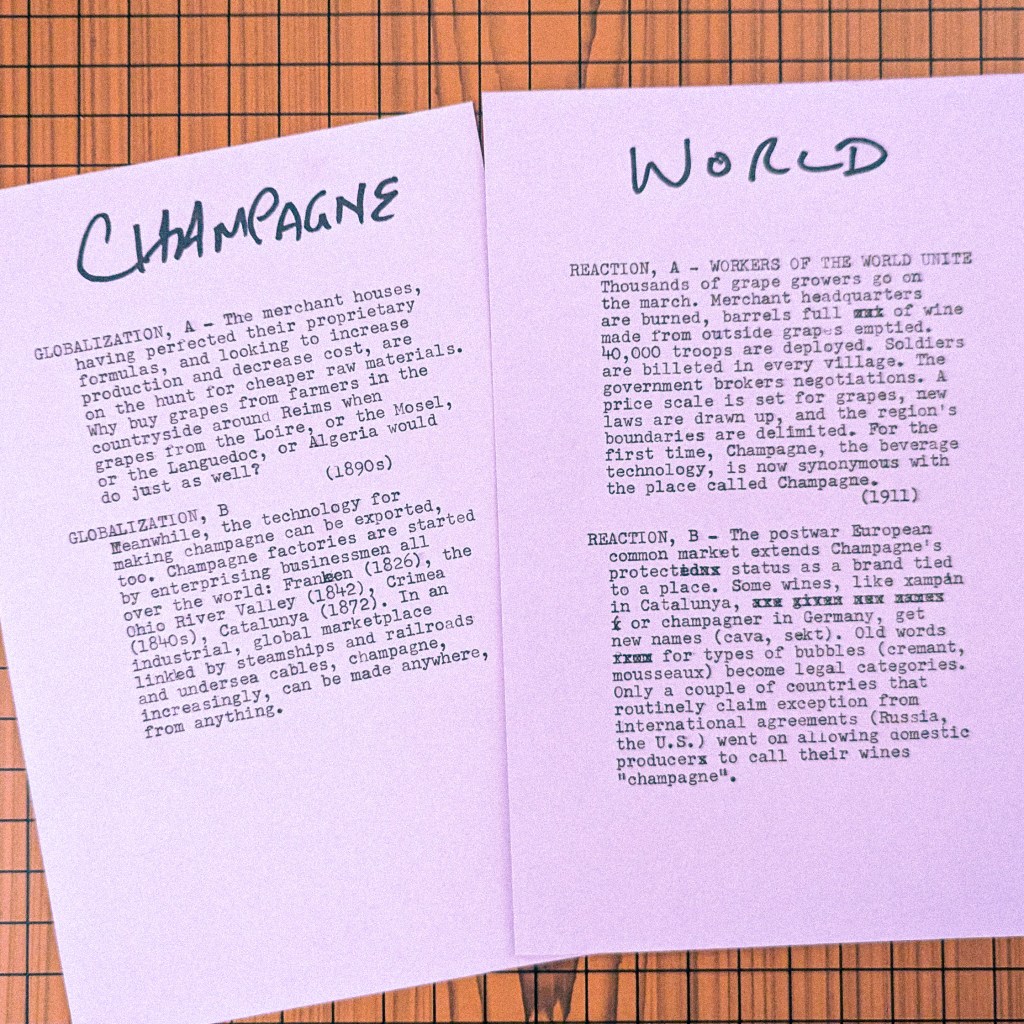
The merchant houses that control Champagne’s now-booming sparkling wine industry, having perfected their proprietary formulas, are on the hunt for cheaper raw materials. Annual production is up to the tens of millions of bottles from tens of thousands a century before. Vineyards are reeling from invasive species and pathogens introduced by transatlantic trade. Why buy grapes from the farmers in the countryside around Reims when grapes from the Loire, or the Mosel, or the Languedoc, or Algeria would do just as well?
(1890s)
globalization, b
Meanwhile, the technology for making champagne can be exported, too. Champagne factories are started by enterprising businessmen all over the world: Franken (1826), the Ohio River valley (1842), Catalunya (1872), Kartli (1882), Crimea (1899). At the 1878 Paris Exposition, Louis Latour shows champagne made out of grand cru Burgundy. In an industrial, global marketplace linked by steamships and railroads and undersea cable, champagne, increasingly, can be made anywhere, from anything.
(1826, 1842, 1872, 1878, 1882, 1899)
reaction, a
WORKERS OF THE WORLD UNITE
Thousands of grape growers go on the march. Merchant buildings are burned, barrels full of wine made from outside grapes emptied, rioters storm barricades manned by dragoons. 40,000 troops are deployed. Soldiers are billeted in every village. The government brokers negotiations between the workers’ syndicate and the houses. A price scale is set for grapes. New laws are drawn up. The region’s boundaries are delimited. For the first time, champagne, the beverage technology, is now synonymous with the place called Champagne.
(1911)
reaction, b
The postwar European common market extends Champagne’s protected status as a brand tied to a place. Some wines, like champagner in Germany or xampan in Catalunya, get new names. (Sekt, cava). Old words for the texture and strength of bubbles (mousseaux, crémant) become legal categories. Other regions create names tied to place to promote their own champagne-method—sorry, ‘traditional method’— wines (franciacorta, cap classique). Only a couple of countries that routinely claim exception from international agreements (Russia, the U.S.) persist in allowing domestic producers to call their wines “champagne”.
(20th century)
 Children's Atlas of Wine
One thought on “Explaining champagne in 3 short parts”