
A sip n’ paint held on in February at Plus de Vin, a wine bar off the Graham Ave L stop in Brooklyn. The next class will be held on Sunday, March 16 at 3pm. (tickets)
A sip n’ paint class about the bottom of ancient tropical seas, and how they make wine taste today.
We tasted five wines grown in the crumbly limestone of the Paris Basin while coloring in maps of where they came from, learned to talk about “minerality”, and explored the impact rocks—and plesiosaurs, and ammonites, and starfish, and prehistoric seagrass —have on the wine in our glass.
Want a little more info about what we drank?
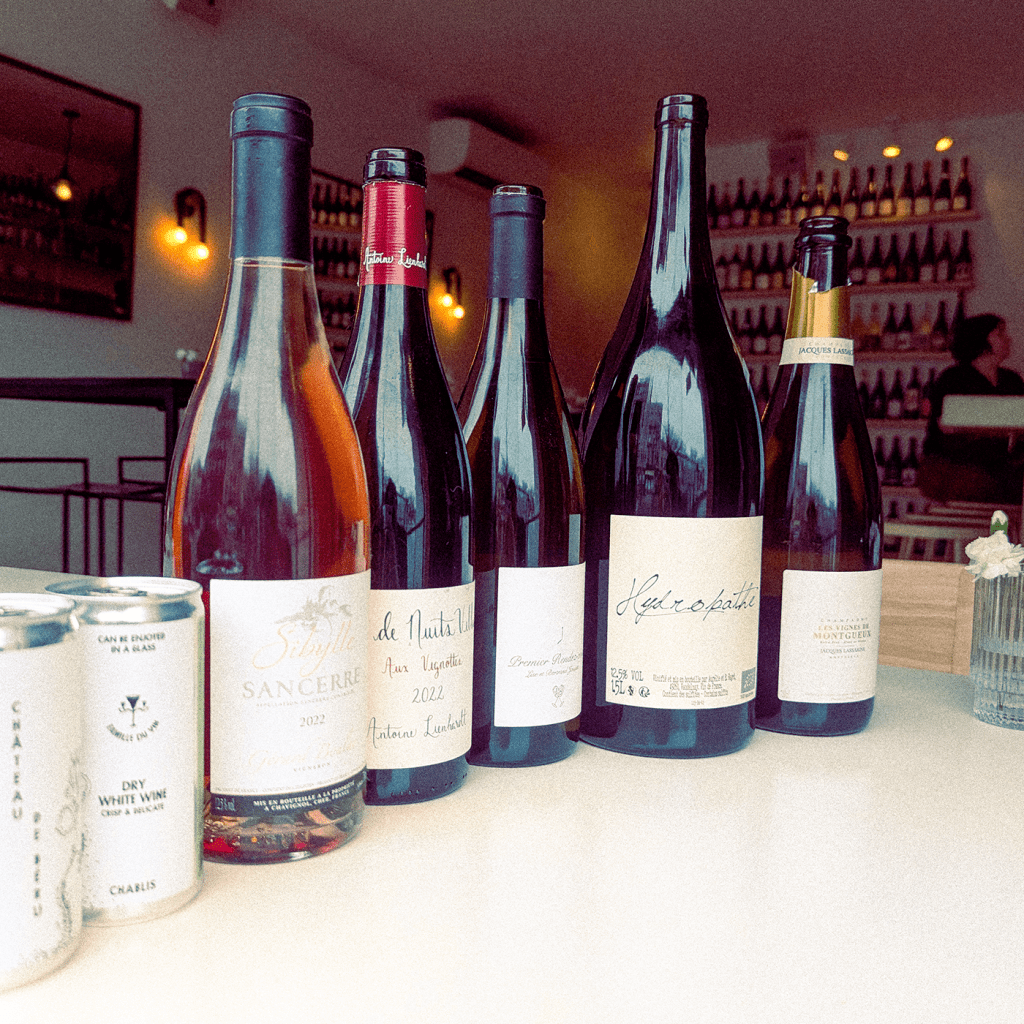
BÉRU, CHABLIS
Who? Athénaïs de Béru, biodynamic farming icon of a 400 year-old château. The grape is chardonnay! (In a can.) Does chardonnay have to taste like fake popcorn butter? No! Chardonnay is an impressionable kid, and a lot depends on the crowd it’s hanging out with. The place is Chablis — a little more about that place here. What to do pack a picnic, take on the Metro North. Bodega pairing “Cloudy” (salted) Bjorn Qorn.
HAGET, “HYDROPATHE”, PINEAU D’AUNIS
Who? Manu Haget, who was a geophysicist for 20 years before escaping to the countryside, meeting a retiring farmer Philippe Gourdon, and buying his vines and cellar in 2016—Gourdon was also lowkey one of the area’s biodynamic farming icons, not somebody who’s internationally famous or whose wines are culty but somebody who other farmers, at least the ones doing it without chemicals, look to. The grape is pineau d’aunis, one of the first varieties I feel in love with as a baby sommelier: a specialty of the Loire, with a distinctive horseradish / talc powder / baby aspirin pepper-chalky side. These are Manu’s oldest vines, and because of the low yields and small size of the plot he bottles it by itself, in magnum only, and I think not even every year. The place is One of the little white villages of Saumur, in the central Loire, where cab franc and chenin reign. What to do Make new friends or toast some old ones. Bodega pairing Chopped cheese.
JOUSSET, “PREMIER RENDEZ-VOUZ”, MONTLOUIS
Who? Lise & Bertrand Jousset. Bertrand is a gentle giant tromping through the vines, Lise is precise, thoughtful, and more in the cellar. A rock from the plot this wine comes from is on my desk at home. The grape is chenin, one of the greatest varieties in the world and forever my love and comfort. The place is Montlouis, across the river from its bigger and much more famous neighbor Vouvray, on a ridge between the Loire and the Cher. Montlouis might be tiny but it is mighty: just a few dozen growers, but while Vouvray slumbers—mechanical harvesting, widespread chemical farming, brand recognition—Montlouis feels like the future. What to do pack a picnic, take on the Metro North. Bodega pairing egg + cheese + crushed potato chips on a kaiser roll.
BOULAY, SANCERRE ROSÉ
Who? Gérard Boulay, who’s been doing this since the ’70s, and converted to organics in 1990. Thirty-five years later, he’s still one of the few people in Sancerre farming without chemicals and fermenting with native yeasts, putting him squarely in the “secretly this is natural wine even though it tastes super classic and there’s a serif font.” The grape is pinot noir, once the main grape of the Kimmeridgean chalk slopes around the village of Sancerre, where wines used to be pale reds— before phylloxera, and two world wars, and the triumph of a vigorous, easier-to-farm variety that would cement its brand identity forever… The place is The village of Sancerre, which has become one of the best-known “I want a dry white wine” shortcuts in the world of wine, tripled in area under vine as a result, and today boasts a price to quality ratio that I can only describe as “dubious.” What to do stay in, have a friend over, make dinner. Takeout pairing Salt + pepper tofu, Szechuan cucumber salad.
LIENHARDT, “AUX VIGNOTTES”, COMBLANCHIEN
Who? Antoine Lienhardt, contemporary Burgundy rising star. 2012: took over family vines— his family had always grown grapes but never bottled their own wine; they sold to the merchants—that was almost everyone in Burgundy until the ’80s—converted to organics and then to biodynamic preparations with as little tilling as possible and lots of botanically diverse cover crop, makes light-touch, infusion-y wines from a place that collectors and classic wine textbooks weren’t touching twenty years ago. The grape is pinot noir, ancient and beloved. More about pinot here. The place is the Côte d’Or — the ‘east-facing slope’ that defines the fanciest vines of Burgundy. Forests on the hilltops to your back, flat fields full of asparagus and potatoes across the highway in front of you, vines on the incline, fanciest vines on what they call the kidney of the slope, about halfway down. We’re specifically just outside Comblanchien (deep cut for real heads: across the road from the Mugnier monopole Clos de la Maréchale) where the hard chalk limestone is closer to the surface and it was historically more valuable to quarry blocks of stone than to plant vines. Polished, pink-veined Comblanchien stone paves the floors of the Opéra Garnier in Paris. What to do Settle in to the library from Beauty and the Beast. Food truck pairing Tacos de carnitas.

 Children's Atlas of Wine