Skip straight to notes + pairings:
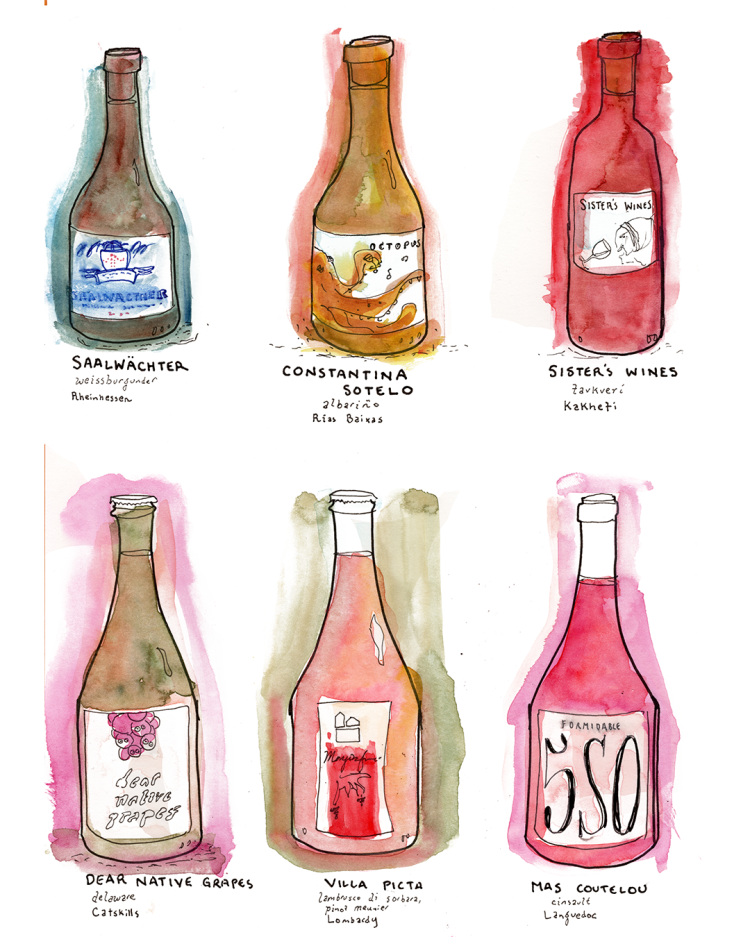
Saalwächter weissburgunder [Chablis, minerality]
Constantina Sotelo ‘Octopus’ albariño [orange wine, typicity]
Sister’s Wines tavkveri [‘chilled red’, origins]
Dear Native Grapes delaware [Americas, local wine]
Villa Picta ‘Mangiafuocco’ lambrusco di sorbara, meunier [Champagne, branding]
Mas Coutelou, ‘5SO Formidable’ cinsault [Burgundy, adulturation]
Read the six-part newsletter series:
Pt. 1 – Chablis, minerality
Pt. 2 – orange wine, typicity
Pt. 3 – chilled red ate rosé
Pt. 4 – what gets to be American (wine)?
Pt. 5 – what gets to be Champagne?
Pt. 6 – this burgundy is cinsault
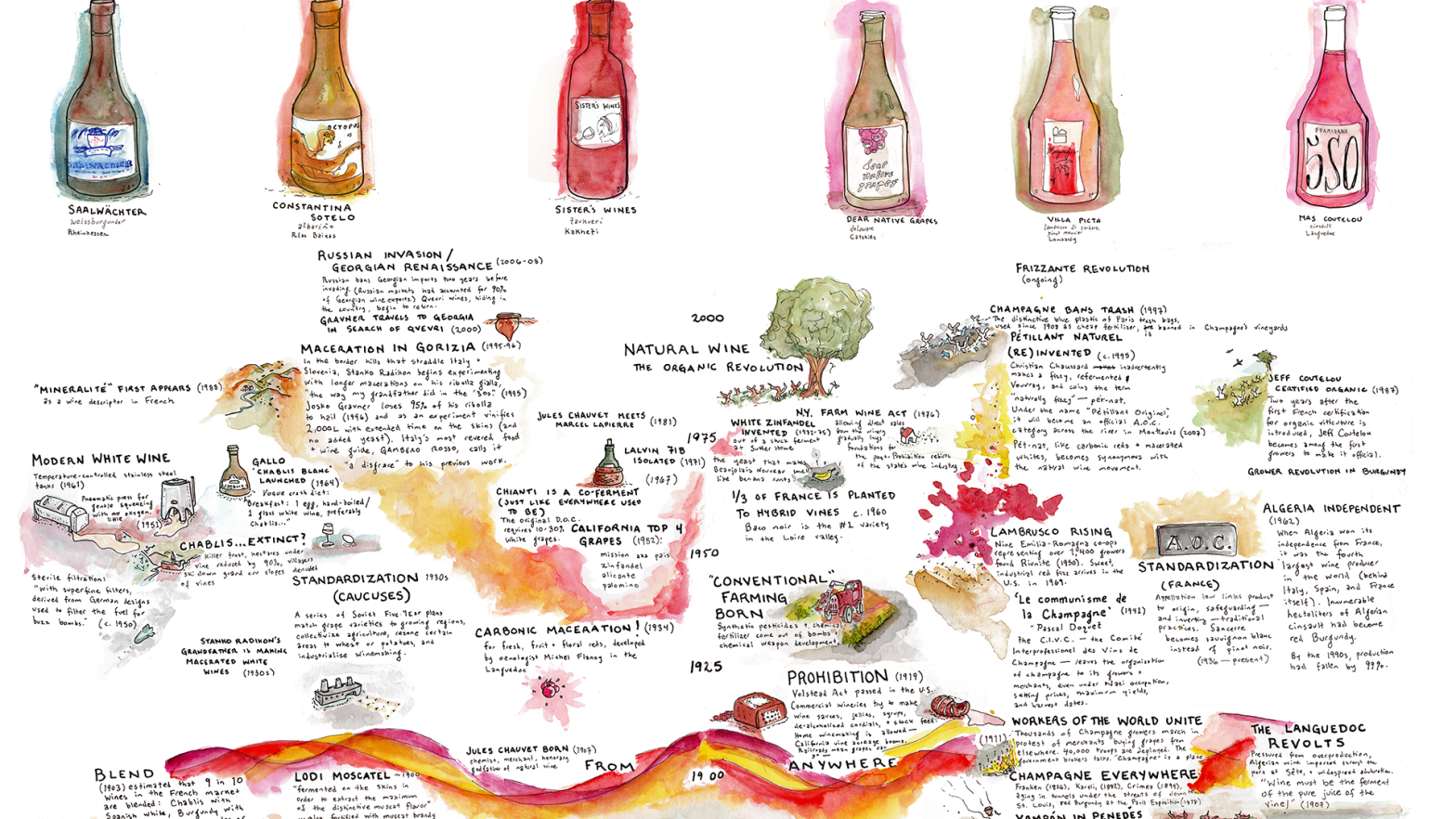
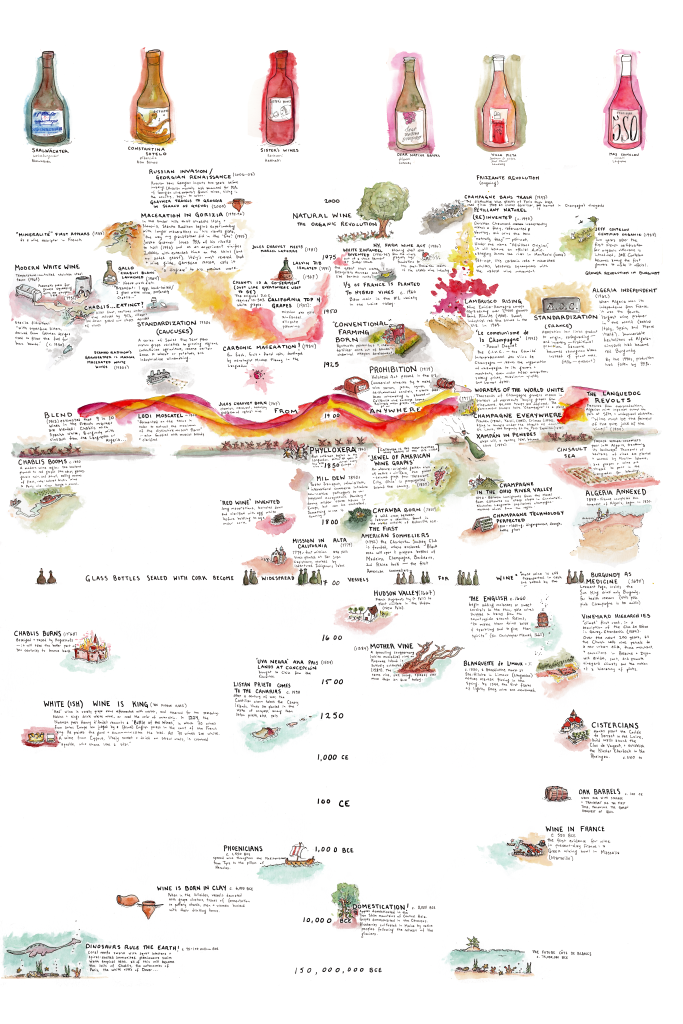
Hi everybody! Welcome to club shipment #3 — TIME TRAVEL. You’ll find info and pairings on each of these wines here.
First, a few touchstones:
These are wines grown and made by people. Some, like Alfie and Deanna at Dear Native Grapes in the Catskills, are brand new, having fermented their first wines in 2021, after the pandemic knocked things sideways. Others, like Jeff at Mas Coutelou, were certified organic at the very beginning of organic certification in France (1987, following the establishment of the Agriculture Biologique certification in ’85 — France was a little late to the organic party!), and can be counted among the foundational figures of their region’s natural wine scene.
All of these wines, in fact, are somewhere on the spectrum of ‘natural wine’: farmed without chemicals, fermented with naturally present yeast and bacteria instead of inoculated cultures, and bottled without addition or subtraction (apart from maybe a little sulfur as a preservative).
That would have gone without saying at certain points in the past. Chemical viticulture was developed between the world wars, and before 1914 or so all farming was basically organic. Dried active yeasts became commercially available in the ’60s, and before then almost any wine would have been fermented with native yeast.
On the other hand, there was never a time when wine was exactly like this, for a variety of reasons.
Drinking a wine bottled without preservatives requires … bottles, for a start. Glass bottles sealed with corks become widespread starting about 300 years ago, but most wines won’t be bottled at the place they’re made by the people who made them until the 1980s. Before that, they’re probably shipped in barrel or tank and bottled by a merchant in the receiving harbor.
Getting those bottles to you across an ocean without sulfur? You’ll probably want cool chain shipping, enabled by refrigerated containers perfected in the 1970s that didn’t become widespread for wine until about a decade and a half ago. Otherwise, you’d be doing something it so that it could survive the voyage.
What got done to 19th century Bordeaux? Here’s the London-based Scottish physician Alexander Henderson in his History of Ancient and Modern Wines (1824):
“there is even a particular manufacture called travail a l’Anglaise, which consists of adding to each hogshead of Bordeaux wine three or four gallons of Alicant or Benicarlo [strong Spanish reds], half a gallon of stum wine [partly fermented juice], and sometimes a quantity of Hermitage. This mixture undergoes a slight degree of fermentation, and when the whole is sufficiently fretted in, it is exported under the name of CLARET”
The wines in this shipment, on the other hand, haven’t been fretted in. Rather than being pinned in a display case, they’re butterflies out in the garden. That means they’ll move and change with air and time, and show different sides of themselves as you get to know them.
On a practical level, that means you’ll want to keep them somewhere cool and dark so that they don’t bruise, fray at the seams, or grow second heads. Any fridge is probably better than no fridge.
It’s also worth letting them settle down for a week or so after their journey, if you can. Even a couple of days of quiet will help — something to keep in mind as these land over the holidays and get thrown immediately into the fray.
Final practical tip, when it comes to pairing these bottles — pairing to meals, to bodega snacks, to emotional states, to the weather or the color of the sunset, to moments in time — remember that there’s a lot of good answers beyond my suggestions. There is no such thing as a wine emergency. If an ingredient isn’t in season, or you’re in a rental and have to drink out of mason jars, or you don’t have a Korean deli a block away from your house stocked with cutting edge 21st century snack food technology, give yourself a little grace. It’s enough to just be present with what’s in the glass.
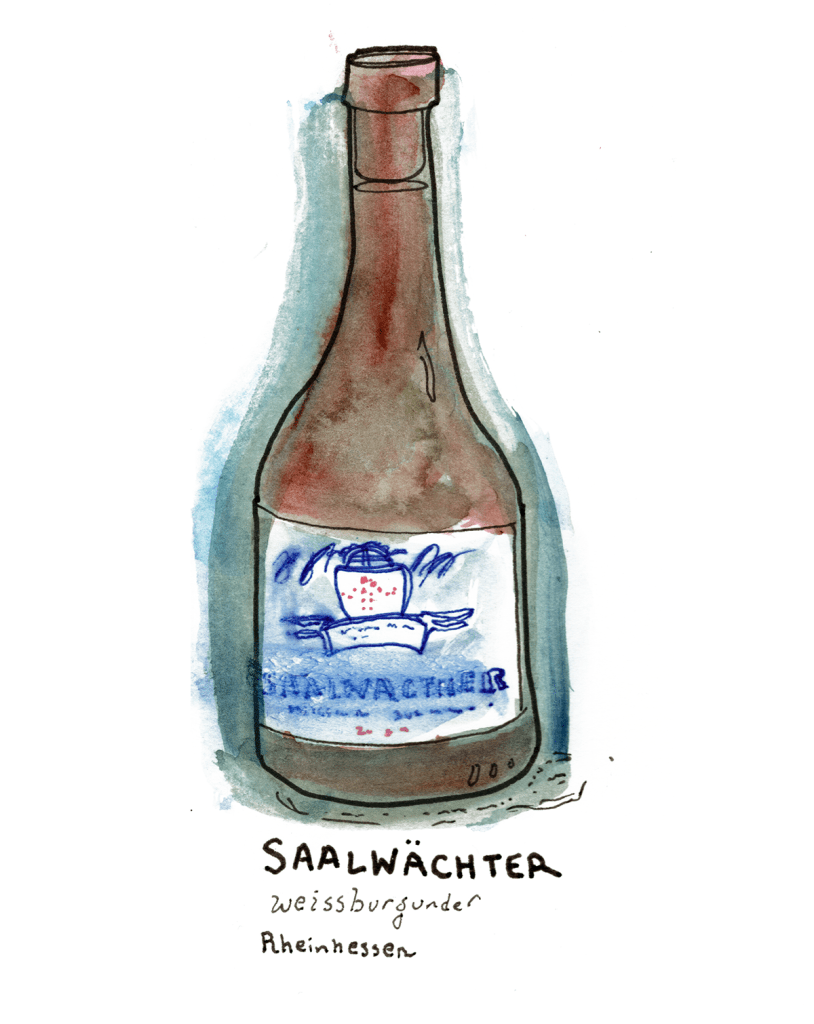
Saalwächter weissburgunder [Chablis, minerality]
In one sentence: from a young new German grower making the kind of tense, chalk-inflected white I’d bring you if you asked me for Chablis
Pair this (bodega): Kyushu seaweed Lay’s potato chips
Pair this (Bridges): mackerel with squash, Meyer lemon, and anchovy
Pair this (at home): two dishes that rely on emulsion and are like magic tricks: pasta al limone (lower-lift weeknight) or pil-pil (the Basque mother sauce usually made with salt cod, there are a variety of recipes out there but it’s really all about technique)
Key dates:
c. 150,000,000 BCE – coral reefs swarm with spiral-shelled ammonites and warm shallow waters swum by plesiosaurs, to later become the limestones of Chablis, the white cliffs of Dover, the catacombs of Paris, and the butter-yellow chateaux of the Loire
1964 – Gallo launches “Chablis Blanc” (it would have been chenin, colombard, maybe a splash muscat or green Hungarian). A Vogue crash diet from the same year: “Breakfast: 1 egg, hard boiled / 1 glass white wine (preferably Chablis) / black coffee … Dinner: 5 oz. steak grilled with black pepper, lemon juice / remainder of white wine (1 bottle allowed per day) / black coffee.”
1988 – ‘mineralité‘ first used in the French wine lexicon.
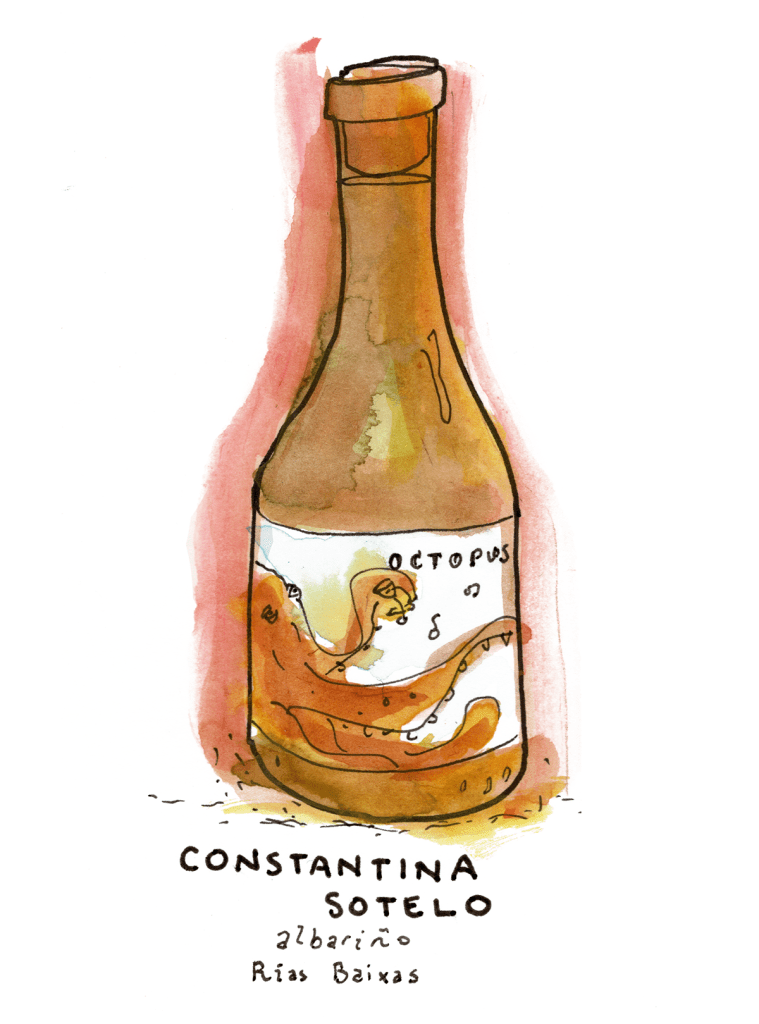
Constantina Sotelo ‘Octopus’ albariño [orange wine, typicity]
In one sentence: Zero-sulfur, skin contact Rías Baixas albariño aged in clay tinajas that’s pretty different from what you’re expecting from Rías Baixas albariño — and also pretty much like what the abuelitos were making in the ’30s.
Pair this (bodega): the best tinned fish your corner bodega carries (Guëyu’s squid in their own ink would be the gold standard here, but is realistically pretty far beyond the definition of ‘bodega’)
Pair this (Kabawa): breadfruit tostón, octopus with dog sauce and capers. pepper shrimp (raw ruby red shrimp with sorrel, scotch bonnet, and thyme)
Pair this (at home): Warming, spiced, with a sweet-savory hit of fruit — try a tagine? There are as many recipes as there are hearths but lamb, apricot and date are what I’m picturing. (Or sautéed pumpkin for a vegetarian option.)
Key dates:
c. 6,000 BCE – Wine is born in clay: pollen on the hillsides, traces of fermentation on pottery shards, men and women buried with their drinking horns.
1224 – White wine is king. Red wine is usually grape skins refermented with added water and honey and reserved for the peasantry. The Norman poet Henry d’Andeli pens a “Battle of the Wines” in which 70 wines from across Europe are judged by a (drunk) English priest in the court of the French king. He praises the good and excommunicates the bad. All are white. A wine from Cyprus, likely sweet and dried on straw mats, is crowned “apostle, that shown like a star.”
c. 1900 – Lodi moscatel is described as “fermented on the skins in order to extract the maximum of the distinctive muscat flavor” (it is also harshly clarified and fortified with muscat brandy)
1996 – In Gorizia, on the border hills that straddle Italy and Slovenia, Josko Gravner loses 95% of his ribolla gialla to hail; as an experiment, he vinifies 20 hectoliters with an extended maceration on the skins and no inoculation. Italy’s most revered food and wine guide, Gambero Rosso, rates the vintage a disgrace to his previous work. A quarter mile / 3-minute bike ride down the road (Strada Provinciale 17), Gravner’s neighbor Stanko Radikon has also been experimenting with longer macerations on his ribolla gialla. “Like my grandfather made it in the ’30s,” he says.
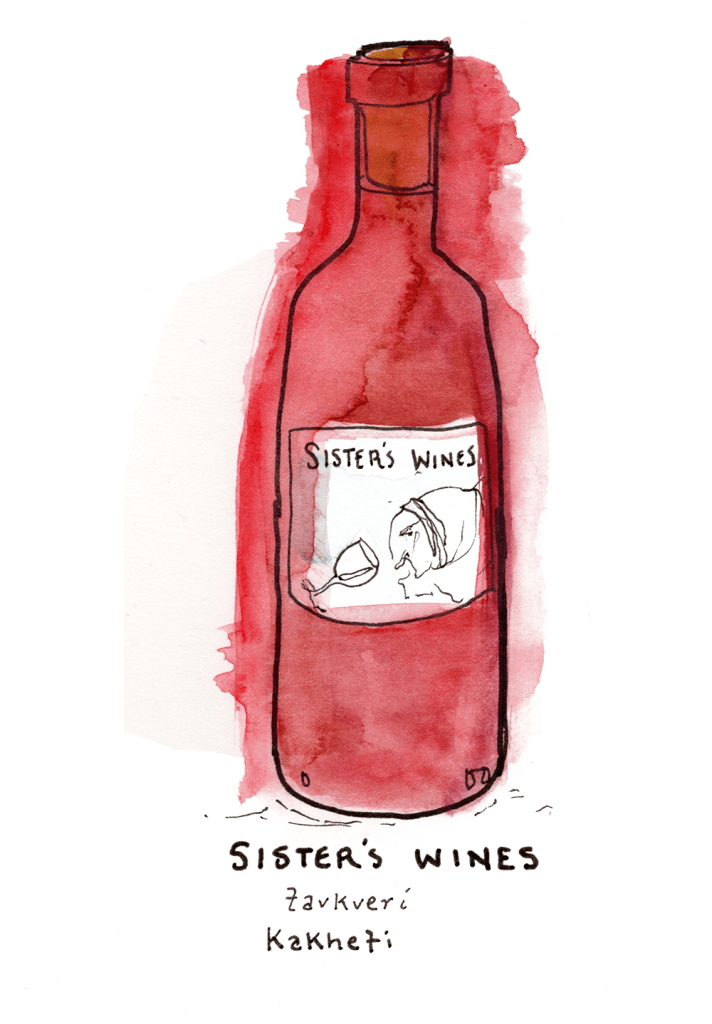
Sister’s Wines tavkveri [‘chilled red’, origins]
In one sentence: A rosé aged in qvevri by Jane Okruashvili in the eastern mountain fortress of Sighnaghi that I’d list under the “chilled red” section of a wine list just to get it into your glass.
Pair this (bodega): Prawn chips, Swedish fish
Pair this (Kabawa): cassava dumplings stewed with creole sauce and cucumber
Pair this (at home): Make tkemali, the Georgian sour plum sauce typical in the west (tkemali is also the name for plum, there are red and green versions, here’s a recipe from Carla Capalbo, who wrote one of the several Georgian cookbooks that have come out in the last several years). In fact, why not make mojo, the universal garlic and olive oil condiment of the Canary Islands, also in red and green versions? (The rojo is red pepper / chili / cumin–based, the verde is cilantro and parsley.) Either way, slather on new potatoes or grilled chicken thighs. If you can save this bottle for the first barbecues of summer, so much the better.
Key dates:
c. 8,000 BCE – Apples domesticated in the Tien Shan mountains of Central Asia.
Grapes domesticated in the Caucusus.
Blueberries cultivated by native peoples in Maine following the retreat of the glaciers.
1934 – Carbonic maceration, a technique for fresh and fruity red wine that will become synonymous with Beaujolais and the birth of the French natural wine movement, developed by oenologist Michael Flanzy in the Languedoc.
1971 – Lalvin 71B, dried active yeast strain that makes Beaujolais Nouveau smell like banana runts, is isolated at the National Institute for Agricultural Research in Narbonne.
2006 – Russia bans imports from Georgia, two years before invading (Russian markets had accounted for 90% of Georgian wine exports). This inadvertently kickstarts a realignment of its export market towards Europe and the US, and a renaissance in Georgian qvevri wines.
2013 – The Georgians invade Paris! Loire natural winemaker Theirry Puzelat, converted the previous year at La Dive Bouteille, imports five Georgian winegrowers for a pre-arrival tasting. Marcel Lapierre is there, as is Eric Texier and dozens more cavistes, sommeliers, and natural winegrowers. Puzelat sells over 1200 bottles of qvevri wine in one night.
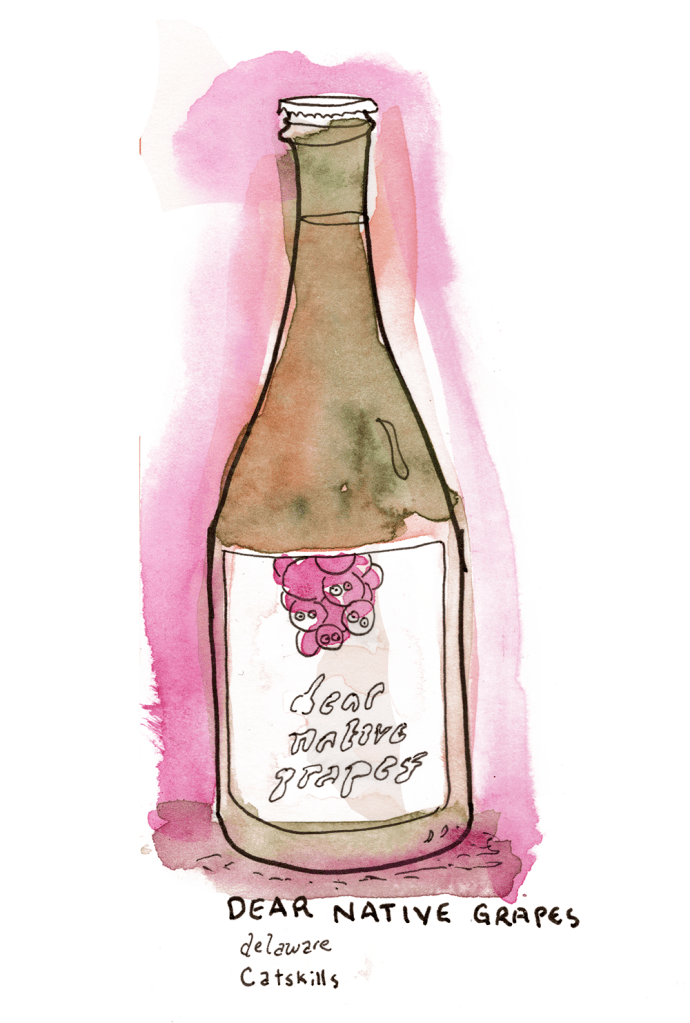
Dear Native Grapes delaware [Americas, local wine]
In one sentence: Resurrecting the forgotten promise of “the jewel of American wine grapes” in the Catskills.
Pair this (bodega): Egg and cheese with jalapeños.
Pair this (Lei): My go-to order at Lei on Doyers Street was the fried whiting and the Lady Edison ham with [seasonal fruit, it was Asian pear for the late summer that I spent going weekly after service at Bridges]. This would be delicious with those.
Pair this (at home): Personally, I might wait to open this until it happens. What better way to celebrate than with the lost promise of American viticulture?
But if those stakes seem too high to hang around the neck of this bottle, I think gathering and connection are the names of the game. Open it when your friend is in from out of town and you want to catch up while they crash on your daybed, or when you have a circle over for craft night, or at a baby shower. Open it when you’re making something with your hands, or instead of doomscrolling, or to reward yourself for a day of community organizing. Open it when you’re doing something that makes you a little hopeful for tomorrow.
Key dates:
1584 – The ‘Mother Vine’, a sprawling scuppernong (white muscadine) vine on Roanoke Island, is actively cultivated; that same vine, still living, spreads over the better part of an acre today.
1855 – The pink-skinned grape ‘from Delaware City, Ohio’ is propagated around the country.
1860 – Catawba, a cross between labrusca and sémillon found growing wild in the woods outside of Asheville, is the most-planted wine grape in the United States. Champagne-method bottles of sparkling catawba age in tunnels under the streets of downtown St. Louis. German immigrant farmers from the Rhineland (usually women) farm catawba vines on the hillside of Mt. Adams in Cincinnati.
1919 – The passage of the Volstead Act inaugurates the Prohibition Era.
2021 – Alfie and Deanna make their first vintage.
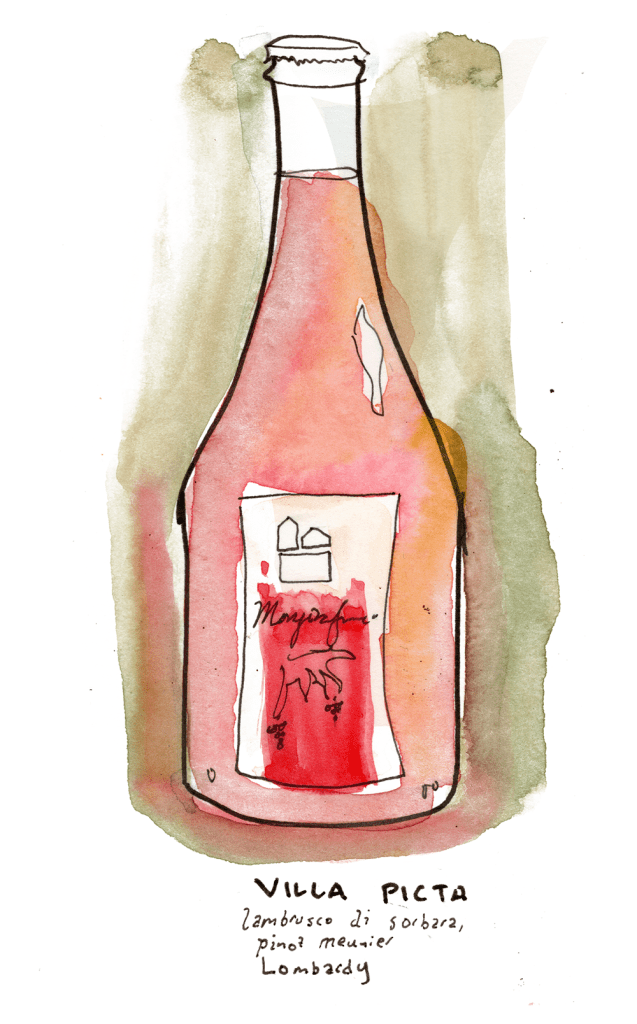
Villa Picta ‘Mangiafuoco’ lambrusco di sorbara, meunier [Champagne, branding]
In one sentence: Electrifying, tradition-defying marriage of outsider pinot meunier with local working stiff lambrusco di sorbara, bubbles to make a meal out of.
Pair this (bodega): tamarind candies
Pair this (Kabawa): that moment when one person gets the dry aged cobia in a clear sour soup with bay leaf (blaff) and a sweet tamarind glaze, and the other gets the grilled goat shoulder with a spicy scallop creole
Pair this (at home): I’m thinking about the emotion behind sofrito: bases that are simmered and caramelized for as long as possible, out of humble ingredients, before giving depth and richness to everyday cooking, the product of nothing more than time. Open this on a Sunday. Make, idk, a ragu. Smoke ribs. Put on a brisket. I think this is the sort of bottle you open for the kind of love that’s enduring and unshowy, that allows for time and a slow braise, that’s heartfelt but prosaic.
Or maybe it’s not! Maybe you sneak it into Coney Island and house a hot dog before getting on some kind of spinning teacup, idk! Love the way you want! I’m getting old!
Key dates:
c. 1530 – a Benedictine monk at Ste-Hilaire in Limoux notices mauzac fizzing in the spring
1662 – Sparkling wine from Champagne invented by English merchants: “Our wine coopers of recent times use vast quantities of Sugar Molasses to all sorts of wines to make them drink brisk and sparkkling and to give them Spirits” – Dr. Christopher Merrit, Some Observations Concerning the Ordering of Wines
1810 – Champagne technology refined: strong, coal-fired glass, a dialing in of the liquor de tirage to start second fermentation, the introduction of riddling and disgorgement. (A rack, upon which trained workers turn thousands of bottles a quarter-turn at a time and fractionally upward twice a day for forty or so days, until they are fully vertical and the slurry has caught in the neck. Digorge sludge by hand. Wear mesh metal masks and thick leather aprons to protect against explosion.)
1878 – Champagne technology everywhere: xampán in Catalunya, champagner in Franken, champagne in the Ohio River Valley…) At the 1878 Paris Exhibition, Louis Latour pours champagne-method red Burgundy from the grand cru of Richebourg. Down the hall are Nicholas Longworth’s sparkling catawbas.
1908 – Paris begins sending its trash to Champagne as compost — for nothing more than the cost of transportation. (This will continue until discontinued in 1997 — to this day, you can still find the distinctive blue plastic of Paris trash bags in the vineyard soils of Champagne.)
1911 – Champagne merchants routinely source grapes and juice for their wines from as far afield as Algeria and the Rheinhessen. In 1911, thousands of grape growers go on the march. Merchant buildings are burned, barrels full of wine made from outside grapes emptied, rioters storm barricades manned by dragoons. 40,000 troops are deployed. Soldiers are billeted in every village. The government brokers negotiations between the workers’ syndicate and the houses. A price scale is set for grapes. New laws are drawn up. The region’s boundaries are delimited. For the first time, champagne, the beverage technology, is now synonymous with the place called Champagne.
1950 – In northern Italy’s Emilia-Romagna, nine cooperatives representing over 1,400 growers found Riunite, creating a centralized postwar industrial base for mass-produced wine.
1969 – An importer based in New York’s Little Italy, Banfi, begins sourcing sweet red sparkling lambrusco from Riunite for the U.S. market.
2017 – A small collective of natural winegrowers in Modena starts a collective, ‘Frizzante Revolution’, aimed at celebrating wine outside the mold of industrial lambrusco.
2024 – “‘Mangiafuoco,’ the color of pomegranates, Paolo’s attempt to play with plush, riotous fruit—given by Pinot Meunier—which he tucks into a corset with the tense, delicate Sorbara.” — can you tell Amanda Smeltz wrote this? I’m certain.
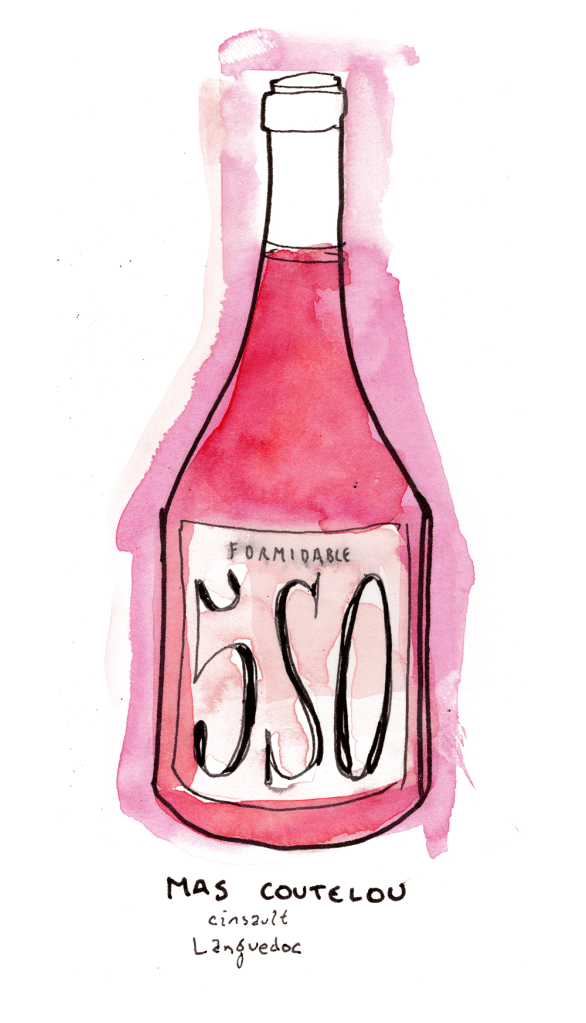
Mas Coutelou, ‘5SO Formidable’ cinsault [Burgundy, adulturation]
In one sentence: We’ll never know how much red Burgundy from the first half of the 20th century was actually Algerian cinsault.
Pair this (bodega): barbecue kettle chips
Pair this (Bridges): my favorite juke pairing there, with a dish that’s become one of their standouts, was always to pull a silky, infusion-y lifted red for the dates with cured tuna and spring onion. I think this would be perfect with those.
Pair this (at home): My mom’s been bugging me for the date / tuna recipe ever since I took her to Bridges a year and change ago, but to be honest the more I learned about it the less I thought it would translate to a home cook (there’s the intricate layering of belly and loin cuts, the yuzu koshu …). Maybe just make devils on horseback? Or — and I mean this — consider waiting.
Why wait? “Formidable” is a version of ‘5SO’ — say it in French, cinq-so, cinsault — in certain vintages where he thinks the quality of the fruit makes it worth it. This is the first time he’s made a ‘Formidable’ bottling of his cinsault since 2017. I tasted an un-formidable bottling from 2019 with him last fall in the East Village — six years old, very pretty and put together — and he talked about the particular tannin of cinsault like what you get chewing on the leaves, like a fig leaf, fine but present, a little vegetal. If you are very, very disciplined you might wait to open this for five or six years yourself and see what happens.
Key dates:
550 BCE – First evidence of wine in present-day France (a Greek mixing bowl in Marseilles).
c. 100 – oak barrels are used for wine storage and transport for the first time, following the Roman conquest of Gaul. They gradually supplant large-scale dolia (large-volume clay containers) factories over the next three centuries.
c. 1100 – Cistercian monks plant the Coulée de Serrant in the Loire, build the walls surrounding the Clos de Vougeot, and establish the Kloster Eberbach in the Rheingau.
1584 – ‘climat’ first used, in a description of the Clos de Bèze in Gevrey-Chambertin. Over the next 200 years, as the Church sells parcels to a new urban elite, those merchants and councilors of Dijon and Beaune will divide, sort, and promote the concept of ‘climats’ and the notion of a hierarchy of vineyard plots.
1847 – Algeria annexed — France completes the conquest of Algeria begun in 1830.
1878 – Champagne technology is all the rage. At the Paris Exposition, champagne-method red Richebourg Grand Cru is poured down the hall from champagne-method catawba from the Ohio River.
1887 – grafting on American rootstock permitted in Burgundy. For the first time, after centuries of provinnage, the tangled acre-wide root systems and chaotic, bush-trained co-planted vineyards are replaced by rows of chosen plants, trained and pruned in modern ways.
1903 – Estimated that 9 in 10 French wines are blended — Chablis with Spanish white, for example, and Burgundy with cinsault from the Languedoc and Algeria.
1907 – The Languedoc revolts, pressured from overproduction, Algerian wine imported through the port at Sête, and widespread adulteration: “Wine must be the ferment of the pure juice of the vine!”
1962 – Algeria wins its independence from France. It is the fourth largest producer of wine in the world (behind Italy, Spain, and France itself). Innumerable hectoliters of Algerian cinsault have become ‘red Burgundy’.
1987 – Jeff Coutelou is among the first growers in France to obtain AB organic certification.

