
Why do wine people light up when someone mentions limestone? How do you smell schist? Where is the taste of slate?
There’s more than one answer to the question! Part of the problem might be that a single word* is being used to mean a few things that are completely different from one another. Part of the problem might be that words themselves sometimes fail us. But of all of the ways to solve a problem, or untangle a riddle, the most fun way is to go digging into some actual wines.
*(minerality)
The Tasting
We tasted in the main dining room at Winona’s, a wine-focused restaurant in Bed-Stuy, on Wednesday, November 3rd, 2021. (At the time, the dining room was closed for regular services during the weekdays, with guests eating in the front café and the outdoor pandemic shed. It was 2021!)
We tasted elbling, riesling’s ancient father, two ways, side by side, both on limestone.
We tasted chenin on schist from Anjou.
We tasted two wines grown on granitic sand: one of the rare reds of Rías Baixas, in Spain’s green northwest, and skin-contact grenache blanc & gris from the Roussillon, in French Catalunya.
We tasted pineau d’aunis from the Loire, and trousseau from the Willamette.
We asked: if you say a wine has minerality, what does that mean to you? Are you picturing mouthwatering acidity, or the smell of flint and smoke, or a texture like sand or powdered chalk?
Are you speaking metaphorically — is there a common feeling to wines grown on the same bedrock that the rock’s name is a shorthand for?
We thought about acid and its shape, with our elbling on limestone. We talked about when and why wine smells like smoke and iodine and flint, sticking our nose in our glass of chenin on schist.
We compared the textures of our bright, etched cool-climate light red and our rose-gold, hazy, Mediterranean skin contact, and looked for something in common: the textural imprint of granitic sand?
We tasted our peppery, spiky pineau d’aunis and our shimmery, pixellated trousseau and asked what minerality, so often a word used to describe white wines, might mean when the wine is red…

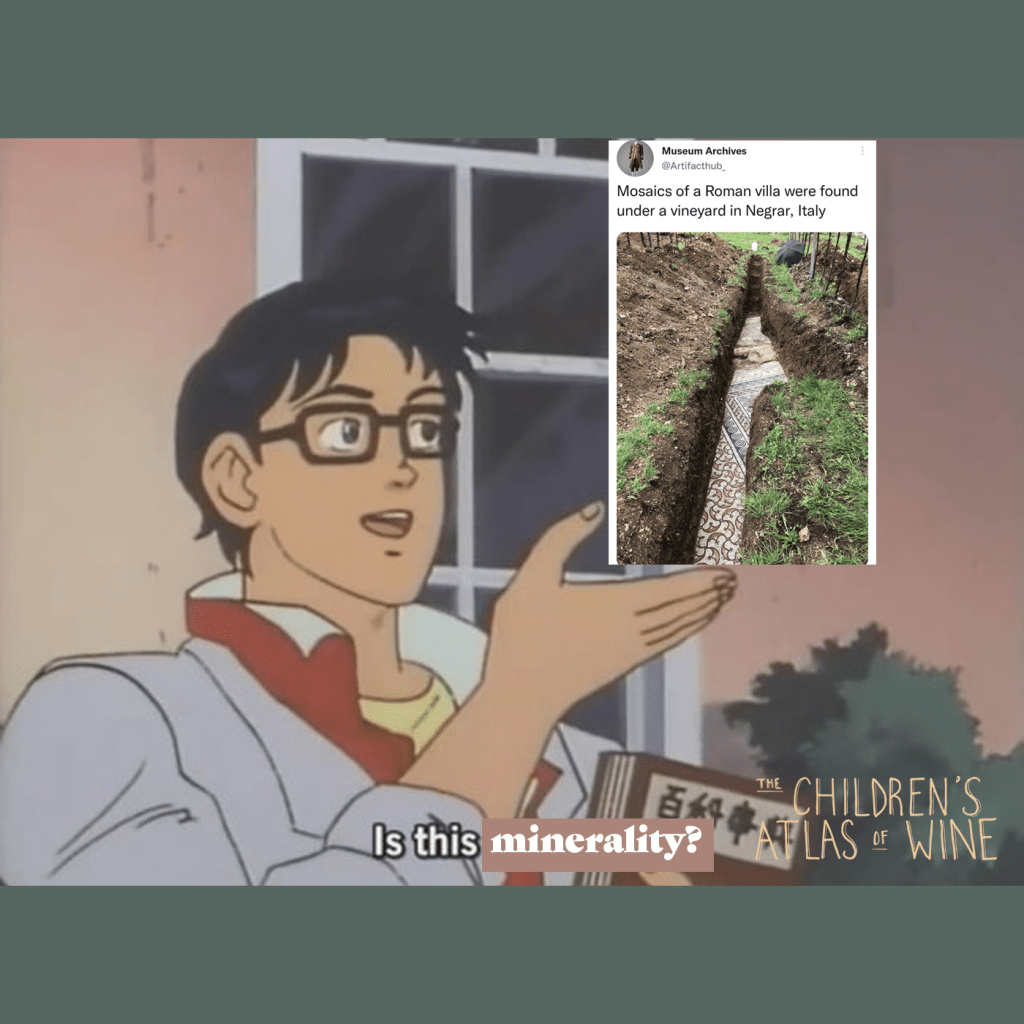
FROM INSTAGRAM, @CHILDRENSATLASOFWINE, FEB 2022:
Long, earnest caption to short silly meme follows:
You can’t taste limestone. You can’t smell schist. Roots don’t suck up crystals like a straw. (Geologists who don’t drink are always telling me this.)
Here are some things absolutely you *can* do:
– measure pH differences between different soils and feel the resulting differences in acidity and freshness as your mouth waters;
– taste the saltiness and crystalline texture and tingly sensation of trace amounts of minerals like potassium and magnesium, part of the dry extract that can comprise as much as 2% or so of a finished wine;
– use a microscope to view tunnels bored into bedrock by mycorrhizal fungi busily transforming inorganic material into trace nutrients (eg. potassium, magnesium) accessible to the plant root systems they have symbiotic relationships with;
– smell the smoky, flinty volatile sulfur compounds that can arise during fermentation for a variety of reasons, one of which is the nutrient content of the grapes that are fermenting;
– notice after tasting a hundred wines grown on the same soil type that there’s a thing-ness to them that they have in common, an inarticulable energy they share that’s brought about by complex, indirect causes;
– use the name of that soil (“limestone”) as a metonymic shorthand for that energy;
– “taste limestone” and “smell schist”
 Children's Atlas of Wine
One thought on ““Licking Rocks””