Lineup notes and recaps for classes hosted in 2026. Updated periodically!
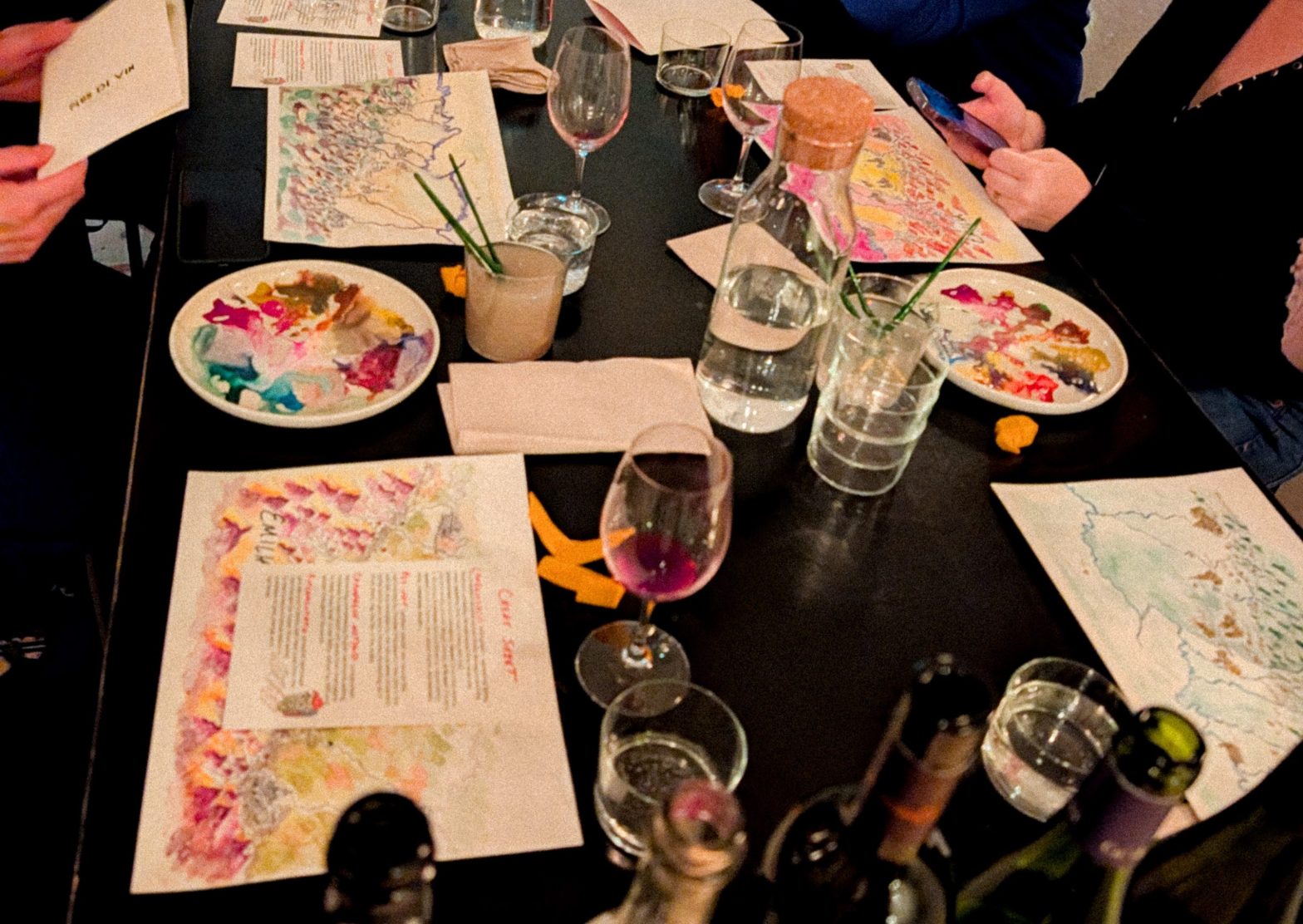
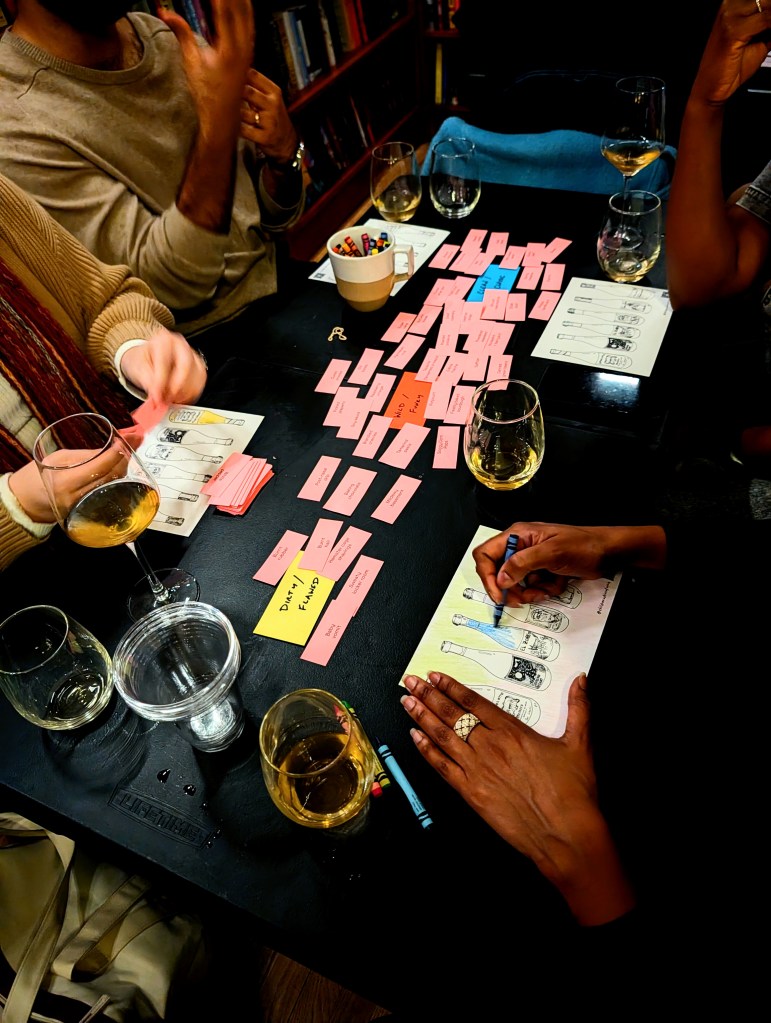
map / paint / sip: club med, 5/10 [tickets]
map / paint / sip: rhône, 5/3 [tickets]
map / paint / sip: danube, 4/26 [tickets]
perfume: a deep dive into aromatic intensity, 4/24 [tickets]
minerality: a deep dive into rocks in wine, 4/10 [tickets]
“spain” 3/30
“italy” 3/29
riesling riesling riesling 3/23
jura 3/22
catalunya 3/15
fermentation is magic: a deep dive into natural wine 3/6
all things pinot, 3/2
industry blind tasting 3/2
champagne, pet-nat, sparkling, 2/9
industry blind tasting, 2/9
burgenland, 2/8
industry blind tasting, 2/2
wine 101, 2/2
alpine wines, 1/21
emilia romagna, 1/18
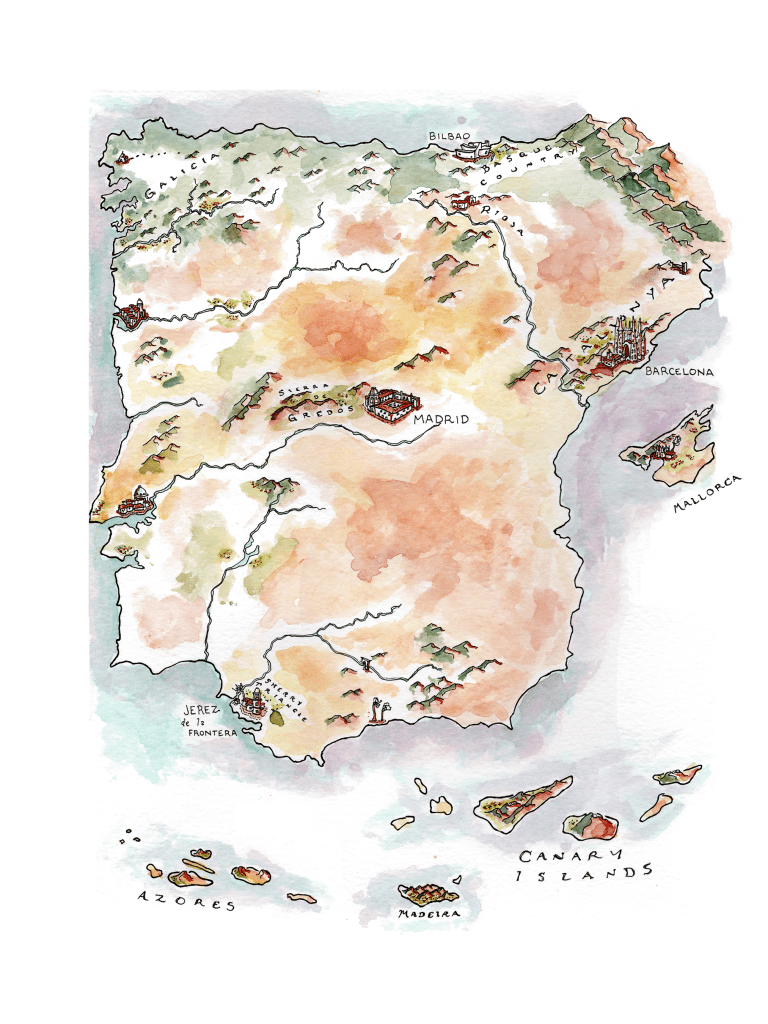
3/30 ‘SPAIN’
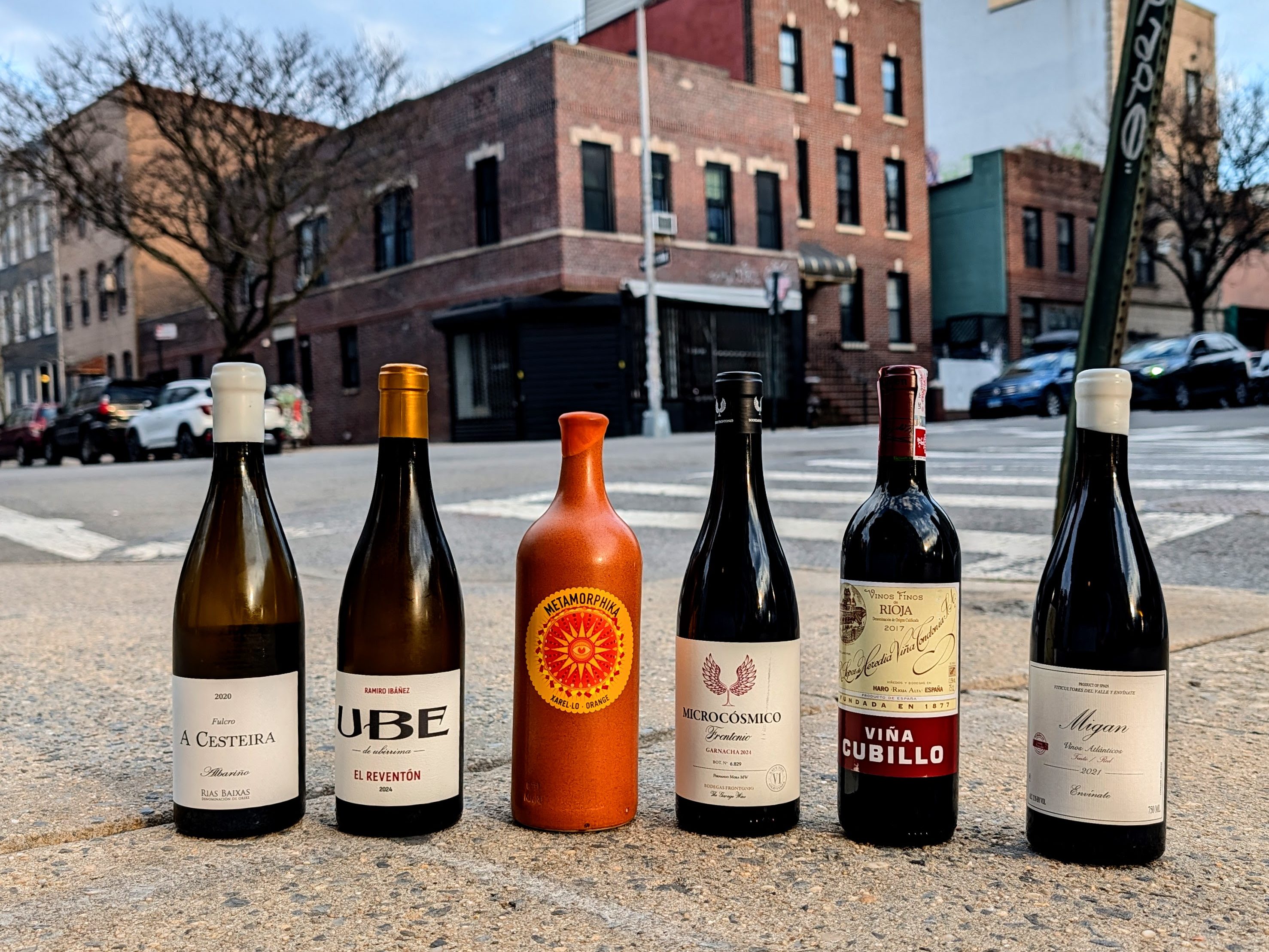
Fulcro, albariño Rías Baixas 2020
From the cool, green northwest in Galicia, whose crinkled estuaries (rías) face the Atlantic. Mild and verdant because of the Gulf Stream carrying warm water from the Caribbean, vibes vaguely Celtic (think bagpipes and rune rocks).
Since a planting boom in the ’80s, the region is overwhelmingly devoted to albariño, which has become an unlikely global brand name — one of the rare grapes local to one particular place to break out and achieve name recognition, be put on exam syllabi, etc.
Here, a year on the lees and another five in bottle give a little savory undertone to the zesty fruit and florals, and there’s an electric spine of acidity that shows us who we are and what we’re made from.
Ramiro Ibañez, ‘Reventón’ palomino Sanlúcar de Barrameda
From electric acidity and Atlantic coast to the Mediterranean: sun, salt, blinding white albariza chalk.
We’re in sherry country, with one of its new-wave growers. Ramiro has kept some elements of the sherry equation here — the soils, the palomino, the fine veil of living yeast that the wine ages under and is transfigured by — while tossing out others (fractional blending from a solera of many vintages, fortification with neutral spirit, harsh filtration).
Costador, ‘Metamorphika’ skin contact xarello Penedès
Penedès, the river valley over the coastal range from Barcelona, is being remade by a new generation of producers bottling their own wines for the first time instead of selling them to the cava factories.
The grape here is xarello, one of the local varieties of the region and the one being most widely embraced for still wines — it has an herbal-mineral dimension and a spine of mouthwatering acidity that makes it really compelling in bottle.
Fermented on the skins and aged in tinajas (clay jars), bottled in a distinctive ceramic jug as a gesture to its origins. (More on cava country here, more on orange wine here.)
Frontonio, ‘Microcósmico’ garnacha Aragón
Aragón is grenache’s birthplace. It ended up leaving home and going on the road to become a widespread workhorse of the western Mediterranean, from coastal Tuscany to Provence to the Languedoc, because of the 13th century Catalán golden age. Catalán merchants and sailors under the crown of Aragón were everywhere in those days, walking the markets of Tunis, fighting for Turkish emirs, setting up trading colonies in Sardinia that still speak a dialect of Catalán today…
Grenache is sun-loving, naturally soft and ripe, and gets used for a lot of high-octane bulk wine, gloopy and soupy. But when it’s treated like this — old bush vines, light extraction — its silkiness and red fruit give you something people pay a lot of money for pinot to do without the strain.
Lopez de Herédia, ‘Cubillo’ tempranillo, garnacha, graciano Rioja 2017
Rioja is maybe the most recognizable Spanish wine to a general American audience. (Cava and albariño follow behind, and once upon a time, before becoming hopelessly uncool, sherry would have been in the mix as well.)
Defined by long aging in oak and time in bottle, it’s a wine that was born out of Bordeaux merchants fleeing the mass extinction event of phylloxera across the Pyrenees. Most of the most established bodegas still cluster around the train station at Haro, and purchase grapes from around the region to vinify, the wines (like Bordeaux) more defined by house style and their relationship to commerce and transportation than they are the transmission of place.
In a 1966 reference I picked up at a used book store, Sherry and the Wines of Spain, published ten years before Franco died, which among other things recommends shipping a wine that you like back home in barrel and talks about the villages where anybody can fill up their jug from the local co-op tank, there’s a bottle of Lopez de Herédia Rioja pictured on the back cover: same front, same label design, basically unchanged 60 years ago from today.
This tells you a little bit about how long this estate has been a benchmark. At 23, a bottle of ‘Cubillo’ was one of the first wines I ordered off a restaurant list in New York. It hasn’t changed a bit.
Envínate, ‘Migan’ listan negro Tenerife, Canary Islands 2021
Two plots of old, braided vines on the volcanic slopes of Tenerife, colonial stepping stone to the Americas. Taken over the course of a hundred years, first by a series of Portuguese and Spanish private ventures and then by the Spanish crown, the Canaries’ grape varieties and where they are planted reflect who got where first. (Listan negro is Portuguese, and widely planted across the island.)
For a while there, ships departing for the Americas that had stopped to replenish and restock here were required by law to carry vine cuttings in their holds.
The centenarian vines clinging to these slopes today are remnants of the island’s high-water mark as a commercial wine region in the 19th century. Old vines survive in places where money and efficiency didn’t see them ripped up and replanted — there are very few really old vines in Bordeaux, or in the grand crus of Burgundy…
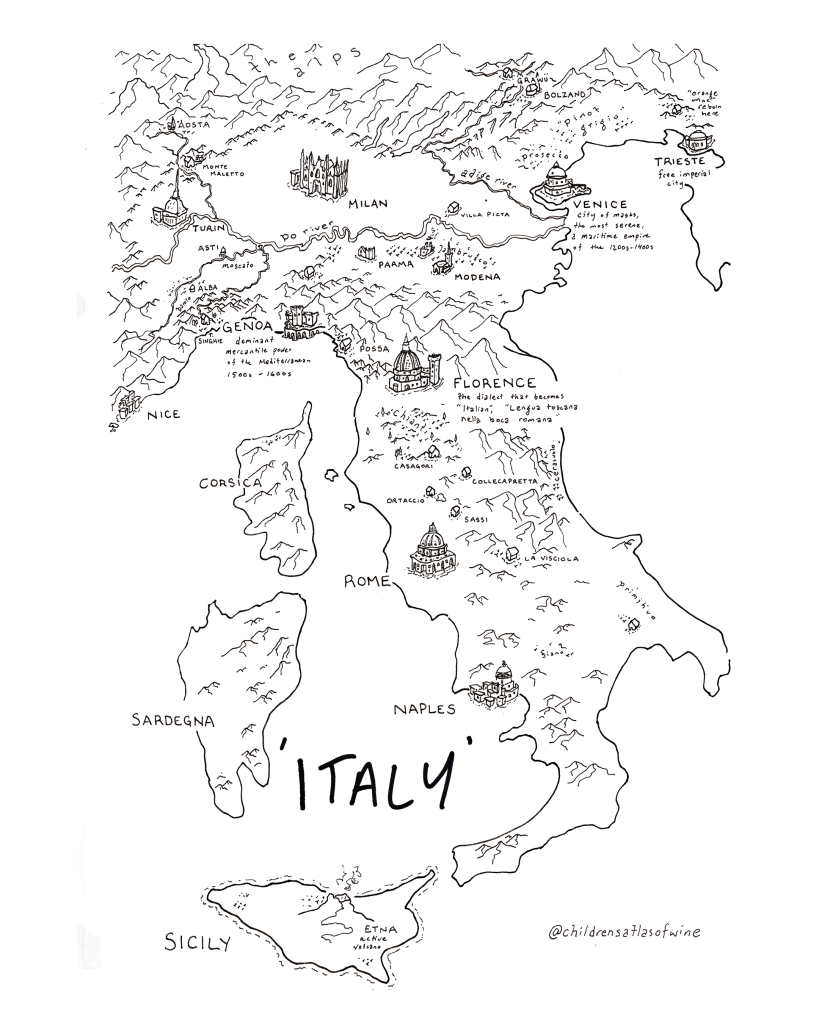
3/29 ‘ITALY’
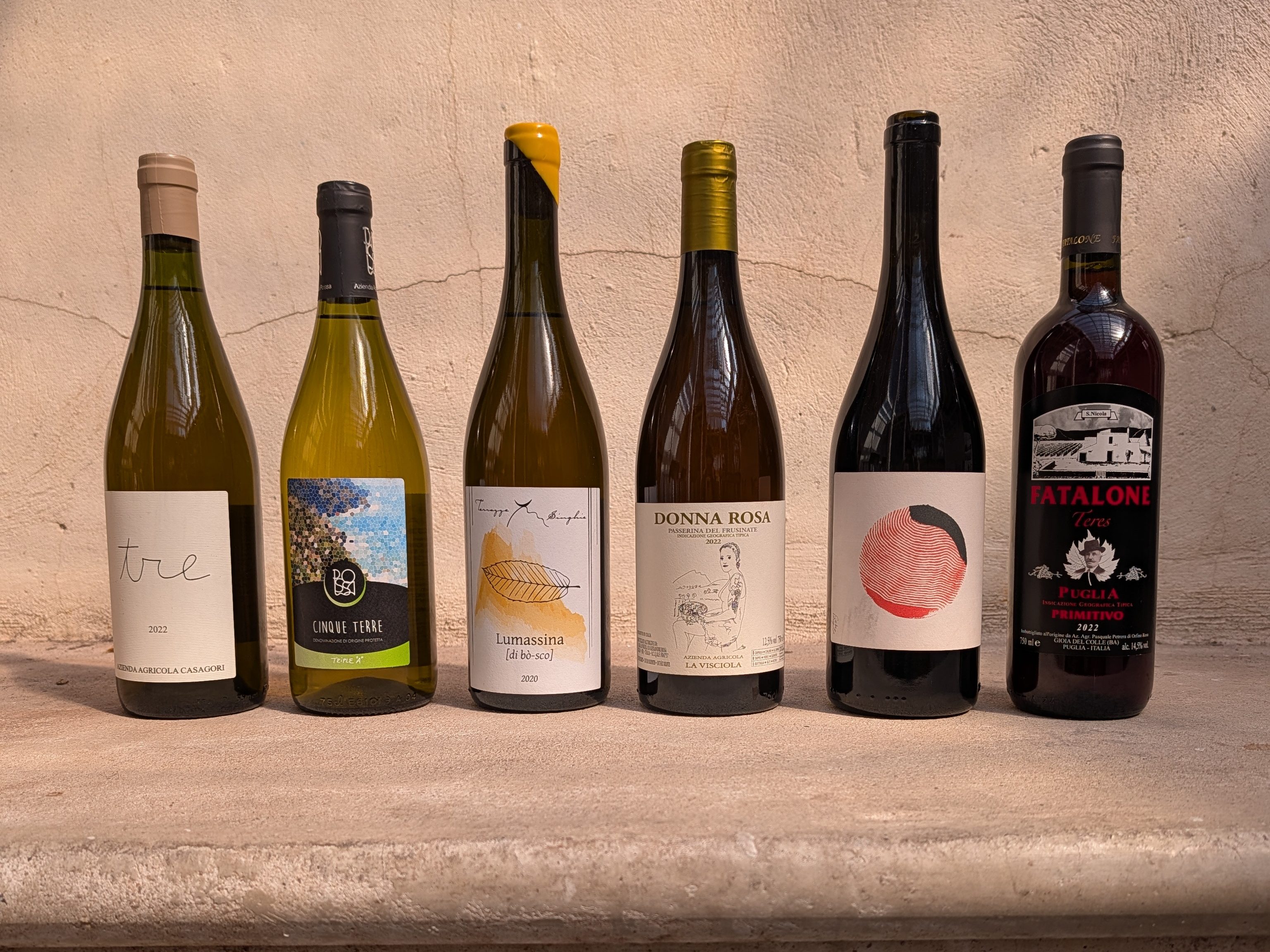
this class was also a lowkey preview of the spring wine club box: ‘ITALY’ — featuring 4 of the producers (and two of the exact bottles) coming in the shipment. Spring wine club signups will go live at the Copake Wine Works site later this week.
Casagori, trebbiano gentile, malvasia lunga ‘Tre’ Val d’Orcia, Tuscany
Mateo + Benedetta Gori, who moved out to the tiny Val d’Orcia in the shadow of the extinct volcano Monte Amiata, in southern Tuscany. They were city kids in their mid-20s looking for something different; they took out a government loan and stewardship over 20 hectares of mixed farming from a retiring oldtimer, and spent a decade restoring it.
After ten years, they were ready for their first vintage. (They also brew beer from the ancient grains they grow, make pecorino from the sheep they herd, and tend olive groves, vegetable gardens, chickens, and goats.)
To their west are the big-money sangioveses of Brunello de Montalcino, a region created in the 70s out of wealth and luxury markets. To the north? The rest of the rolling hills of Tuscany, your black cypress lining crushed white gravel roads, your thousands of hectares of sangiovese for Chianti (good, bad, and indifferent). Here, you have something a little more unusual, handmade, and small-scale, the rare minimalist natural producer around these parts.
“Tre” is 85/15 trebbiano and malvasia lunga, traditionally planted together in Tuscany, here destemmed, basket-pressed (this gives the extraction that deepens its color), aged on the lees in big old barrel, and bottled without anything added or taken away except for a tiny dash of sulfur.
Possa, bosco, rossese bianco, albarola, picabon, frapelao ‘Cinque Terre’ Cinque Terre, Liguria
‘Heroic viticulture’ is the term given to the kind of back-breaking, intense work required on these narrow, handmade stone terraces carved into the cliffs of Cinque Terre, with the Ligurian Sea straight below you.
Heydi Bonnanini began his work in 2004, tending single rows of nearly extinct local grape varieties he wants to preserve grown on sea and stone. (He also keeps bees and lemon trees, and revived the use of local wood instead of imported oak, aging his wines in barrels made from chestnut, acacia, and cherry trees).
The five varieties in his Cinque Terre (the name for the string of five colorful cliffside villages on this stretch of coast) are all local and rare, and one — frapelao — is so obscure that it doesn’t even appear in Wine Grapes, the 1,242 page reference guide to 1,368 vine varieties I turn to when I haven’t heard of something. There’s a little bit (4 days) of skin contact here before the ferment is drained off the skins into steel and barrels of different woods, but it presents as basically a white wine with a little extra texture — and a vibrant, shivering spine of acidity.
Terazze Singhie, lumanissa ‘di Bò-sco’ Savona, Liguria
Moving up the Ligurian coast to another vertiginous set of terraces, this one in the middle of wild forest! (Here’s a short video of the landscape to give you a sense of how wild this place is.)
Sara Polo and Mauro Migliavacca came here in 2017 after working in wine in Italy and around the world with the goal of rehabilitating and traditionally working terraces that date back centuries. Lumanissa, a grape found in three valleys in Sovano, is naturally fermented after several different picks for 10-20 days on the skins and then aged in a few barrels of different sizes until the next harvest. A really wild savory, forest-y kind of bay leaf quality to the aromatics here I almost never get in a wine.
La Visciola, passerina del frusinate ‘Donna Rosa’ Piglio, Lazio
And back to the center of Italy! — Piglio, in Lazio, just to the east of Rome, a tiny region that rings vines and olives and pine woods around a striking volcanic summit. Piero Macciaocca and his father have been farming grapes here since the ’60s — a tiny four and a half hectare domaine — but it wasn’t until 2008 that they started bottling wines for themselves instead of selling.
The vines are interspersed with old fruit trees and a riot of other plants and crops. This is a red wine region — the specialty of this tiny collection of 300 or so hectares of vines around this little volcano is a grape called cesanese, which Piero makes separately by parcel in four or five different bottlings labeled by the vineyard — but there is a local white grape, passerina, interplanted throughout. To make their intense, golden white wine they have to pick everything in bits and pieces and separate the white grapes in order to assemble enough for a bottle.
Barbán, nibiò, muetto, mostarino ‘Albera Rosso’ Alessandria, Piedmont
In an isolated river valley that’s technically in the Piedmont but historically was pulled towards Genoa and Liguria (it also touches the western edge of Emilia). Cascina Barbán is the “peasant project of two families” — two young couples from Genoa who moved out to the country to make natural wine and farm in polyculture in 2011. There are vegetables, wheat, and fruit as well as the kaleidescope of (say it with me) obscure, hyperlocal grape varieties.
(Nibiò is apparently a local type of dolcetto. The 1,242 pages of Wine Grapes have never heard of muetto or mostarino. They say that muetto and mostarino are “native abandoned vines of the Val Borbara that we are recovering and multiplying.”)
Vinification is super-minimalist and all in fiberglass, with zero additions including zero sulfur.
Fatalone, primitivo, ‘Teres’ Gioia del Colle, Puglia
Finally, so as not to neglect the south — although in six wines we have missed so much, from the Alpine heights of the French-speaking Aosta river valley and the long mountain valley of (German-speaking) Alto Adige to the eastern coastal regions of Abruzzo and the Marche, to the rumpled hills on the Slovenian-Italian border that saw the rebirth of orange wine, to the natural wines being made against the grain of Emilia-Romagna’s lambrusco factories, to say nothing of Tuscan sangiovese or Piedmontese nebbiolo or prosecco and pinot grigio from the Veneto — we went to Puglia, with maybe the benchmark natural winegrower of the region.
“Teres” ends up looking like a really intense, 14.5% alcohol rosé — it’s a second harvest of the little wings that primitivo grows and that ripen at a different time than the main cluster, made to be easy-drinking and chillable.
As for Fatalone, and why their work matters?
This is what I wrote, seven years ago, after a verticals tasting of the wines I was lucky enough to attend in 2018. (Natural wine writer Alice Feiring organized the event, and published detailed notes although they are subscriber-only):
“So you’re in Giola del Colle, in Puglia, in 1969, and nobody bottles their own wine. Everybody makes wine to drink themselves & to trade with their neighbors, vines have been here for centuries, your family & your wife’s family are both multi-generation landowners, but the stuff that’s sold for money goes to the co-ops or out in bulk somewhere. There’s a lot of rosé-type stuff, it’s hard to tell exactly what the wines were like. And you have this dream, a dream that you’ll end up fulfilling in 1987, of doing this thing: of bottling your own family’s wine, of being an estate producer, of making wine that is aged under cork and shipped overseas and drunk by people everywhere, for years after it’s harvested.
“So you make test bottlings of some of your family’s wines, your father’s wine & your father-in-laws’s, over a number of years (straight out of whatever they were aged in, I guess? Out of tank? I might get some of these details wrong despite good-faith attempt & note-taking), and kind of stash some around the cellar, and fifty years later your son pulls two of bottles out & opens them at the end of a thirty-year retrospective of these wines, made without the makeup or falsity that people occasionally mistake for prestige, and this, this small taste of primitivo harvested in 1969 and aged in chestnut and made by the mother’s family, the Orfinos, is—well. For starters, it’s one of the most bananas things I’ve ever seen in a glass, pale caramel-colored with little flecks of suspended cayenne-red sediment in it, which might be alarming but it’s alive & kicking, chocolate & mint & quinine & hay & bitter almond liquor, a survivor and a herald, from the past, of all of the things that existed without any evidence or trace remaining afterwards to tell you they’d been there.”
3/23 RIESLING
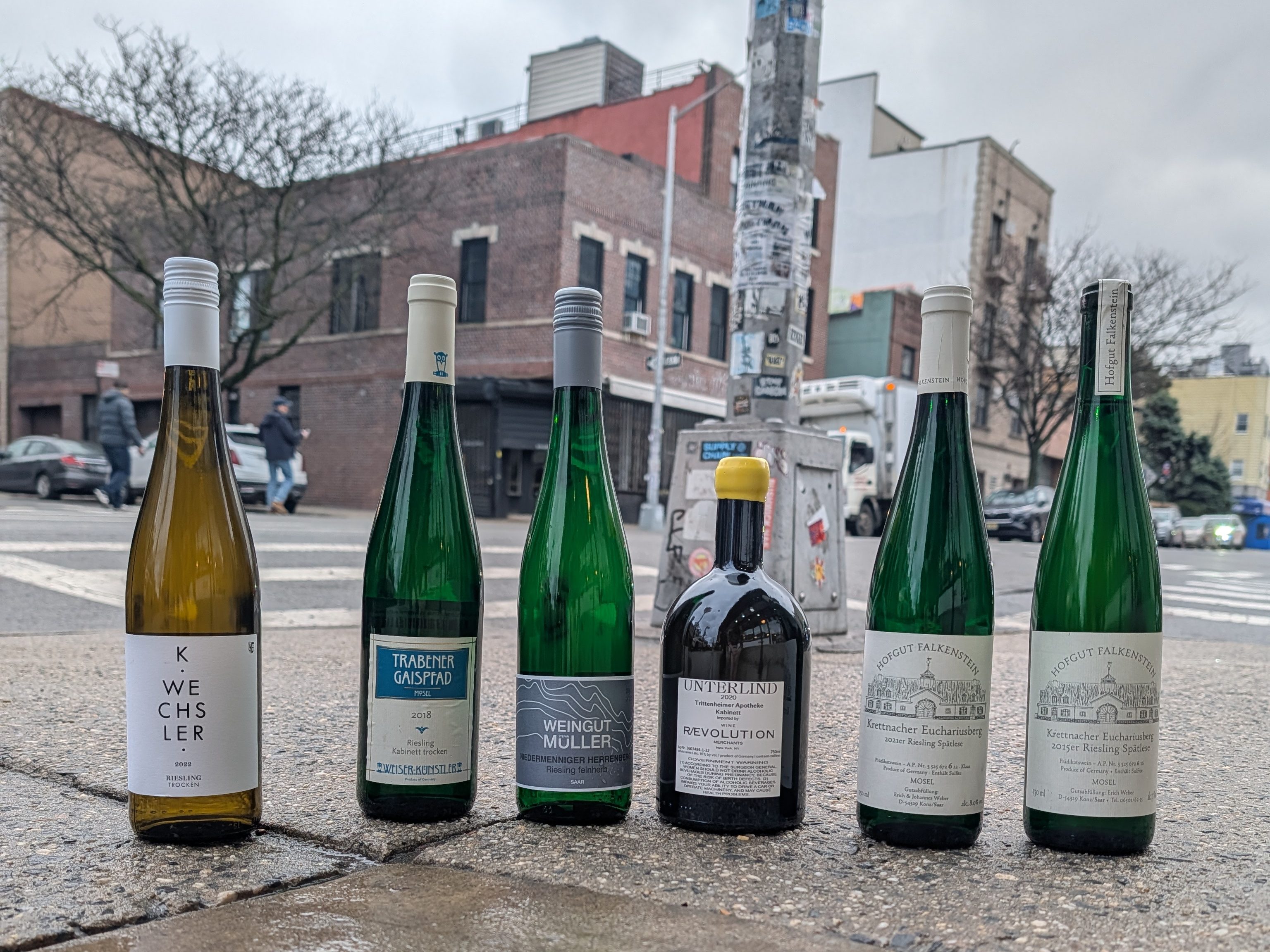
note: order of first two wines was reversed in class
1. “trocken” = dry
K. Wechsler, riesling trocken, Rheinhessen
Katharina is a young new producer in the rumpled limestone bedsheet of the Rheinhessen. She worked for the region’s superstar, Klaus Peter Keller (on the Vine Wine shelves, you can buy some Keller for between $135 and $265/bottle).
Her parents were farmers, but they farmed grapes (as well as other things) for the bulk wine market, and didn’t really drink wine themselves. The goal was to hit a certain sugar ripeness so you could sell at a higher price. That was the story in the Rheinhessen generally, for a lot of years and still to this day: bulk production, industrial farming, uninspired wine.
It’s kind of wild that in that regional context Keller’s (very good) wines became a cult object that big money collectors go crazy for, but I guess everybody likes an exception, the narrative of a unique genius without peer. For a lot of these guys, Keller is the only riesling they buy or drink, because it’s “the best one”. Personally, it sounds to me like an incurious way to go about living life, but what do I know? I’m just a bartender.
Katharina, after leaving home to study literature in Paris and working in German television in Berlin, eventually came back to take over the family business and dramatically change the approach in the vineyard — and become the first in the family to bottle her own wines. Her riesling, in addition to being dry, is lower intervention than the German riesling mainline, farmed without chemicals in the vines, allowed to ferment naturally, bottled with minimal filtration. She also makes zero-sulfur natural wines, skin contact, light reds, weissburgunder…
2. “-er” = from that thing (Trabener = ‘from a village named Traben’)
Weiser-Künstler, riesling kabinett trocken, ‘Trabener Gaipsfad’, Mosel 2018
The first winegrowers I think I ever met in person — they came to the restaurant I’d just started working at back in 2013 or so with their U.S. importer to teach a staff education class.
Anyway this was a pre-pandemic gem from 2018, back when it was called “Trabener Gaipsfad Riesling Kabinett Trocken.” More recent bottlings just say “Gaipsfad,” the name of the vineyard, on the front label. Everything else has been moved to the back or relegated to tech sheets. (Which says something, evolutionarily, about the unwieldiness of German wine label language and what contemporary producers maybe think is important versus superfluous. For a baroque, maximalist example that is the direct opposite of this, scroll down to the last pair of wines.)
3. “feinherb” = bittersweet
Stefan Müller, riesling feinherb, ‘Neidermenniger Herrenberg’, Saar
Feinherb is a traditional word without a legal definition, often used by people letting fermentation stop or slow by itself and bottling the resulting slightly sweet wine that is less sweet than a typical off-dry kabinett.
It takes a lot of patience to make a sweet wine without the arsenal of 20th century winemaking tools (temp control / sterile filtration / etc).
In Germany (cold), with riesling (high acid / low pH), in cool cellars on gross lees in giant old casks, you would have raised a wine patiently as it worked itself out, fermentation slowing to a crawl and going to sleep in the winter, fizzing back to life in the spring, until eventually it hit equilibrium. Often, there would have been a little — or sometimes, in riper years, or after a late harvests, a lot — of grape sugars in the juice left unfermented.
Like a daquiri, this balance — your rum, your lime, your demerara syrup to temper the tart — was part of riesling’s traditional equation. But it’s also fair to say that before, let’s say, the 1890s, sweet rieslings would have been rarer than they are today, and dry wines (settled until crystal clear on the gross lees over the years) maybe more common than you’d think.
4. “kabinett” = post 1971, a ripeness minimum for wines with no sugar added. Without “trocken” on the label, it usually means a lighter wine, say 7-9% alcohol, with anywhere between 20 and 50 grams/liter of sugar. Pre-1971, it just meant a bottle that a grower thought was special in a particular featherweight style and would hold back for special guests in the wine cabinet. Today, many “kabinetts” are as rich as the next level up, “spätlese”, would have been 20-30 years ago.
Unterlind, riesling kabinett, ‘Trittenheimer Apotheke’, Mosel 2020
This is their first commercial vintage, I think? (they started in 2019), in what is objectively a very silly jug bottle with an etched-glass label. There’s an assurance here about the heft and quality of the wine that I think led them to this cultish packaging and speaks to both of them working for (and meeting at) cult Saar producer Egon Müller. (Heiner was the vineyard manager, Veronika was a sommelier in Alto Adige.)
Egon’s top wines are on Michelin-starred restaurant list around the world and sit on retail shelves in the mid-$200s, and there is something about how working in that context teaches you the language of the high end. These bottles aren’t $200, exactly, but I do see them sitting on some store shelves for $60–75, and the packaging tells me that’s how they want it.
For our tasting purposes, this was also a great example of how kabinett (“lighter”) and spätlese (“richer”) are relative — this was much more pineapple-y and unctuous than our final two wines, positively zippy little bolts of electricity by comparison.
This was also our opportunity to do a 10–15 minute digression on the cultural prestige / industrialization of sweetness, colonization and sugarcane, sterile filtration that enables dialed-in sugar levels coming out of filtration mechanisms for German buzz bomb fuel in WWII, Sidney Mintz’s 1985 text Sweetness and Power, moscato d’Asti, etc which I would do here except it would be another 2,000 words….
5. 1971 German Wine Law = a massive attempt to rationalize and regulate German wine and how label language expressed what was inside a bottle. Over 10,000 named vineyard sites were condensed into a “mere” 2,600 legally defined named places that could be put on labels. A hierarchy of ripenesss based on a hydrometer measuring the sugar content of grape must classified wines made without sugar added during fermentation (the OG “naturwein” debate, going back to the 1890s). for our purposes, we only need to focus on the lightest — kabinett — and the next level up in ripeness, spätlese
Hofgut Falkenstein, riesling spätlese barrel AP 6, “Klaus”, ‘Krettnacher Euchariusberg’, Saar 2021
6. “spätlese” = late harvest. if it doesn’t say trocken, expected richer wines with more sugar than a kabinett — but not always! for example, the two spätlesen from Falkenstein we tasted, because of site and bottle age and producer style, were much racier and closer to feinherb than the unctuous, quite rich and sweet kabinett from Unterlind.
Hofgut Falkenstein, riesling spätlese barrel AP 6, “Klaus”, ‘Krettnacher Euchariusberg’, Saar 2015 (!!!)
Finally, a very special ultra-deep dive side by side: the same plot inside of the same vineyard, matched, as the brothers Weber of Hofgut Falkenstein like to do, to the same fuder (big cask) year after year, which is notated (in their hyper detailed front label) by a number hidden inside the code that every prädikat wine receives after inspection (that is, any wine that is part of the system that classifies kabinett, spätlese, vineyard site, etc). The numeric code tells you vintage, region, inspector, and bottling or batch number, and where for most people “batch” means something big, the Webers are maniacs. The “batch” number is actually the big barrel the wine was aged in, settling to clarity on the same lees it fermented on, matched year after year to the same vineyard plot and usually nicknamed for the previous owner of the vines. (In this case, Klaus.)
From the hyper-detailed notes of their importer, Lars Carlsberg: “When Jean Joseph Tranchot and his team mapped the region between 1803 and 1813, as instructed by Napoleon, Euchariusberg, listed as ‘Kruschock,’ had only about 5 ha of vineyard and was the only area on that hill and neighboring hills to be planted to vines. The Webers have the best part, about 2.3 ha, all in one block, on the prime south-facing slope of Euchariusberg (also known as Großschock), one of the top sites for growing grapes on the Saar.”
You can see what I mean about hyper-detailed notes if you read his 2015 vintage report (this stuff is just free on the internet!), which if you’re a design nerd includes some information about how they tweaked the color of their label font and changed the paper slightly.
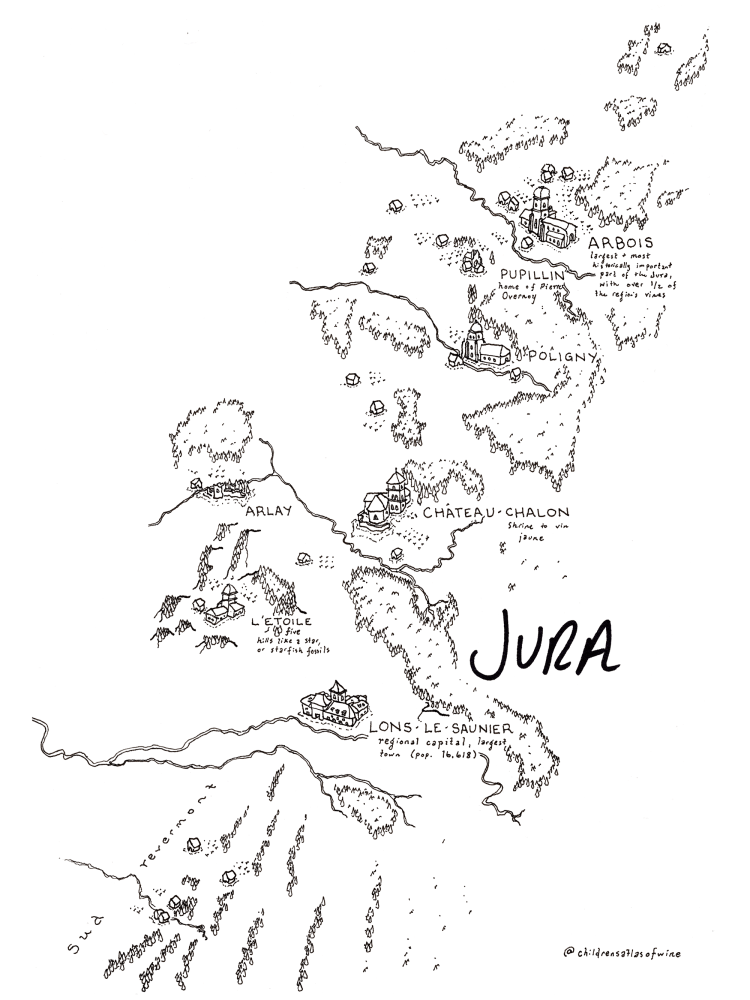
3/22 map / paint / drink
JURA
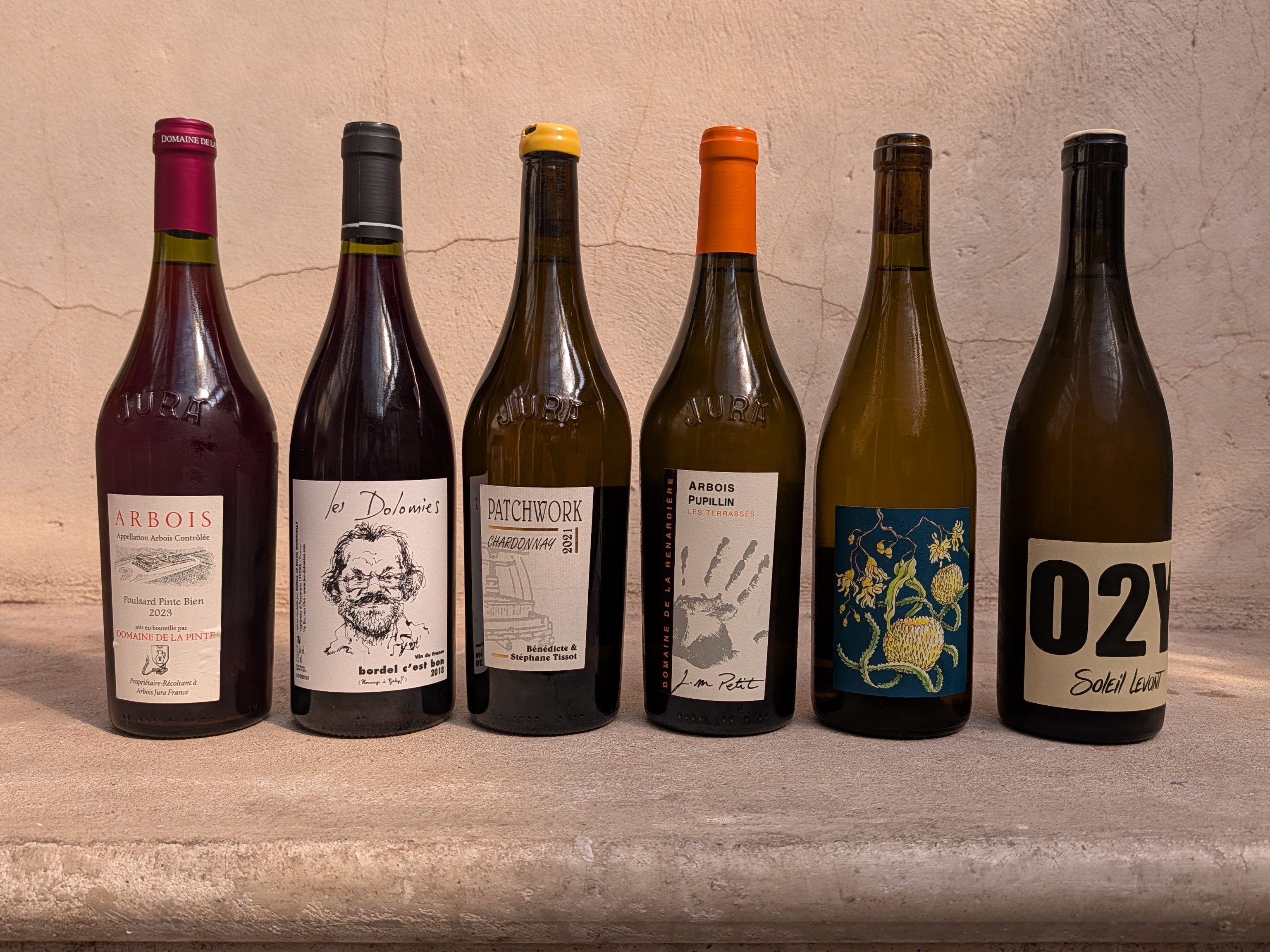
de la Pinte poulsard Arbois
les Dolomies trousseau ‘Bordel c’est bon’ 2018
Tissot chardonnay ‘Patchwork’ 2021
Renardières savagnin ouillé ‘Terrases’ 2022
Borachio savagnin / chardonnay Adelaide Hills
O2Y gewürztraminer ‘Soleil Levant’ négoce from Alsace
3/16 map / paint / drink
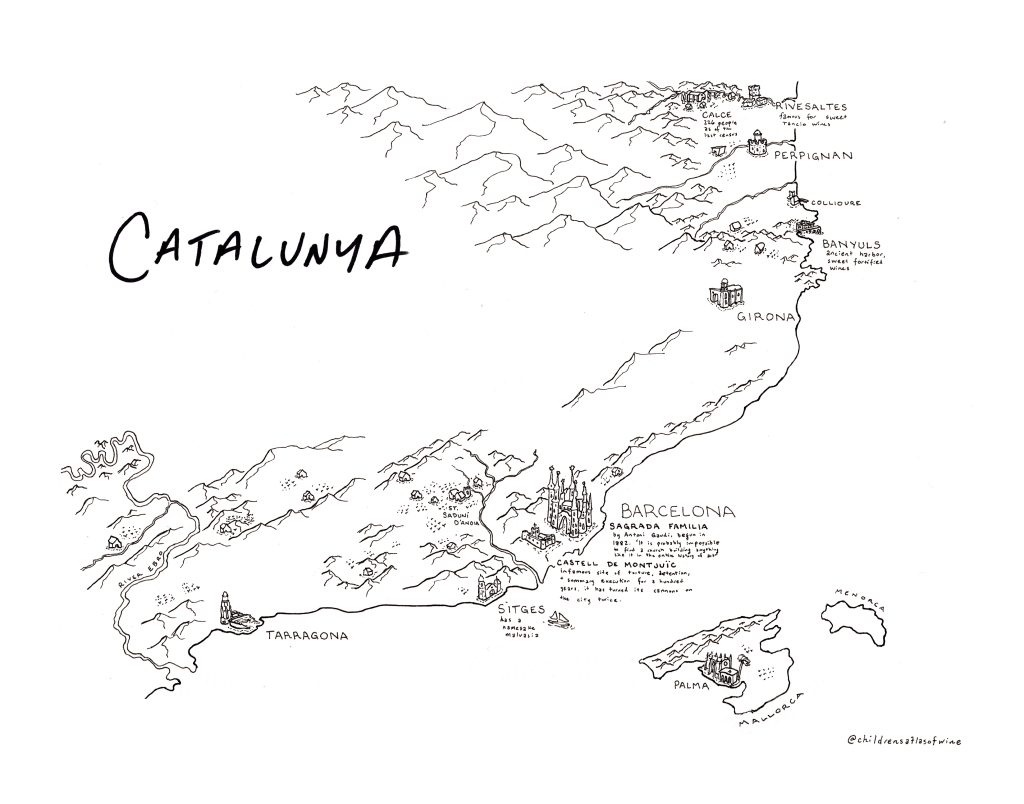
CATALUNYA
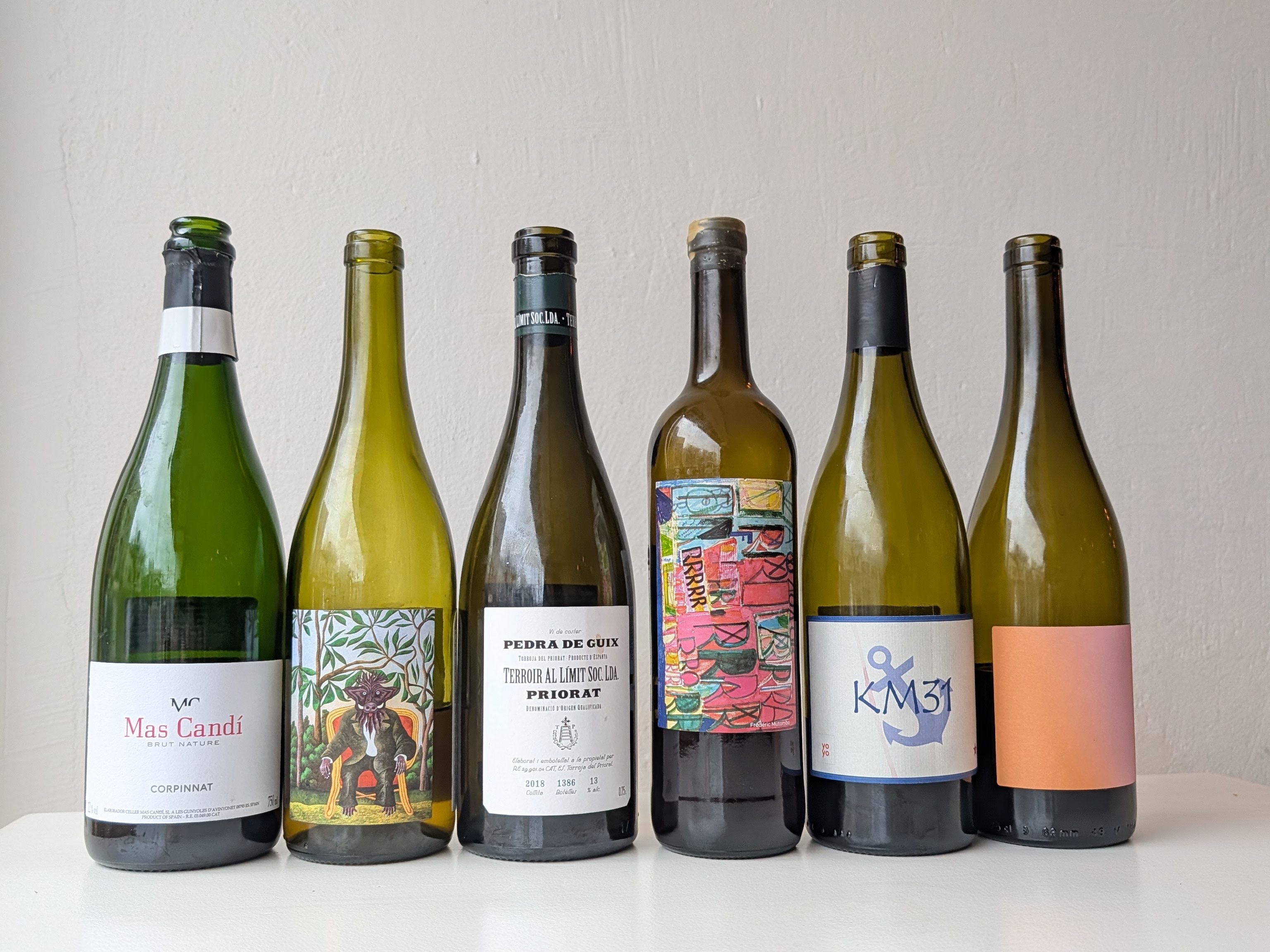
Mas Candí Corpinnat [Penedès] champagne-method sparkling wine from cava country, in Penedès. Mostly xarello (one of the region’s native white varieties, textural with a salty taut high-acid spine). Long lees aging (32 months!). Ten years ago, this would have been D.O. Cava — now, it’s Corpinnat. (read more about the cava – corpinnat fight here)
Cal Xurriu ‘Insint Animal’ [Penedès] centenarian xarello and macabeo with a young, newly-planted vineyard of the almost extinct malvasia de Sítges, from Augustì Costa and Paula Sandoval. Augustí’s father was a farmer who sold bulk grapes to the Cava factories; he and his partner are part of the new generation doing something more idiosyncratic and lightly touched. (importer page here)
Terroir al Limit ‘Pedra de Guix’ 2018 [Priorat] named for a 12th-century Carthusian charterhouse, Priorat is a bowl of vertigenous slope and broken blue slate llicorella soil, like gravestones smashed with a hammer. It’s probably the best known fancy wine region Catalunya has to offer, at least for the last 40 years or so — but it’s also one with something of an identity crisis. The wines teeter between older school garnacha and cariñena, powerful but with a certain mineral finesse, and torqued-up, slick bottles made to chase a global luxury market. Terroir al Limit, started a little over 20 years ago, was seen as cutting against the grain at its inception, the project of two outsiders to the region chasing freshness and finesse at the height, culturally, of Michael Bay movies and Big Red. ‘Pedra de Guix’, one of the region’s rare whites, is garnatxa blanca, macabeo, and sherry grape pedro ximenez, all old vines planted in the same vineyard plot, blended and fermented in large wood, golden and almost honeyed despite being dry.
Emilie Mutombo ‘Omnia’ [Bonastre] a compact group of mountains (“massif”) on the west end of Penedès. Emilie is Belgian with Congolese heritage, and got turned on to natural wine while working events in Brussels. Eventually, she found herself in Bonastre, with longtime natural wine stalwarts Partida Creus (an Italian couple that moved out to the countryside from Barcelona in 2001, and became one of the early figures in the Catalán natural wine scene). Her first full-time solo vintage was 2020. This bottling, ‘Omnia’, was a little experiment from odds and ends in the cellar (the name means ‘everything’) at the end of her second vintage. Some merlot she’d done carbonic for another wine still looked pretty juicy, so she added the clusters to a tank of co-fermenting macabeo and bobal, and was happy enough with the result that in 2022 she did a version of the same thing but on purpose: merlot and bobal whole clusters infused in direct-press macabeo and parellada. Just cooking, over here.
Yoyo, ‘KM31’ [Banyuls] Crossing the border where Republicans fleeing the fall of Barcelona came through the mountain pass (and where, in the opposite direction, folks fleeing the Nazis crossed into neutral Spain, or failed to cross, as it was for the German-Jewish writer and philosopher Walter Benjamin, whose fate haunts me). We’re in Banyuls, in other words, ancient port town and home to France’s answer to port, fortified and oxidized and often sweet grenache that ages indefinitely and shares the name of the town. Laurence Manya Krief has been here since 2005 with her mule, Uma. ‘KM31’ is a co-ferment of grenache in all three colors with a splash of carignan, destemmed and infused for a week and a half in steel and bottled without anything added. (More info about Laurence here.)
Panduro ‘Quarto’ [Mallorca] Not part of Catalunya today, but one of the places marked by its 14th century golden age, when the Counts of the Roussillon and the Dukes of Barcelona were politically united under the crown of Aragon and the kingdom dominated Mediterranean commerce. Catalán traders walking the streets of Tunis and setting up Catalán speaking merchant colonies on the northwest tip of Sardegna, Catalán mercenaries working for the emirs of Turkey’s Aegean coast and at one point sacking and ruling Athens for 40 years. It’s why the Balearic islands still speak a group of Catalán dialects, and why grenache and carignan ended up across the western Mediterranean. Panduro is Ibon Apezteguia, who started making wine with a Swedish chef friend living on Mallorca in 2018. ‘Quarto’ is a pixelated red, like many of our red wines in the lineup finding freshness in a place where ripeness and sunlight are a guarantee, made from callet, a local and intensely colored / structured red variety, here with a light touch and (like 3/6 of the wines we tasted) bottled without sulfur.
3/6 a deep dive into natural wine
FERMENTATION IS MAGIC!
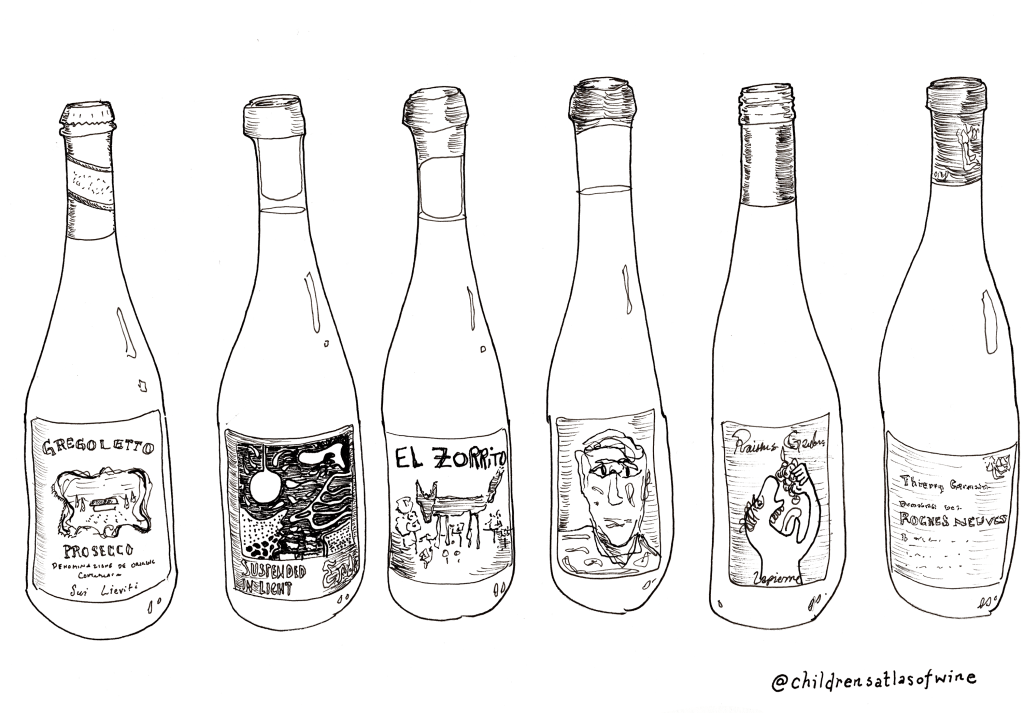
Gregoletto glera prosecco col fondo the way the grandparents made fizzy wine: put in bottle after a cold winter, refermenting there in the warmth of spring. It spends the rest of its life on the slurry of spent yeast (lees) trapped in the bottle. The lees change the wine, too: texture, aroma, flavor…
Erde albariño + grüner veltliner ‘Suspended in Light’ Columbia Gorge foot-stomped whole clusters in big open bins (part of the reason it feels a little thicker — the other part is two years of lees aging after fermentation finishes, which layers some savory yeast-derived stuff onto the more aromatic albariño and grüner). This was Kirk’s second vintage — he started his little project (just 250 cases or so) after leaving NYC restaurants and moving to the Pacific Northwest in the heart of the pandemic.
Santa Julia skin contact chardonnay ‘El Zorrito’ Mendoza poor chardonnay! It never did anything other than be really easy to grow and really easy to project style onto. Here, it’s fermented on the skins (“orange wine,” a style whose worldwide embrace co-evolved with the rise of the natural wine movement—you can read a little history of the media discourse and why fermenting this way might matter at the link).
Naboso skin contact field blend ‘Doma’ Little Carpathians I’m glad a lot of you liked this bottle! Nadja and Andrej make some of my favorite wines in Central Europe. (For more proof: I used a different bottle from them in last fall’s wine club.) The full slew of varieties in this field blend: welschriesling (ubiquitous throughout ex-Hapsburg central Europe and for example the most-planted white grape in Croatia), grüner veltliner, riesling, and two rare color mutations, red traminer and red sylvaner.
Lapierre gamay ‘Raisins Gaulois’ Beaujolais “chillable red” from the birthplace of the French natural wine movement and a producer who was part of it from the beginning (although it’s Marcel’s kids now). More on chilled red’s rise and rise and why Beaujolais and natural wine are intertwined in the newsletter.
Thierry Germain cabernet franc ‘Domaine’ Saumur Cabernet franc is often described in classical wine resources as vegetal and green — but what about tamarind paste? What about red pepper coulis, curry leaf, oolong, pepper? We’re in the heart of the Loire, here, west of Tours, on buttery yellow tuffeau limestone that 80ish million years ago was the floor of shallow tropical seas swum by plesiosaurs and spiral-shelled ammonites.
3/2 all things pinot
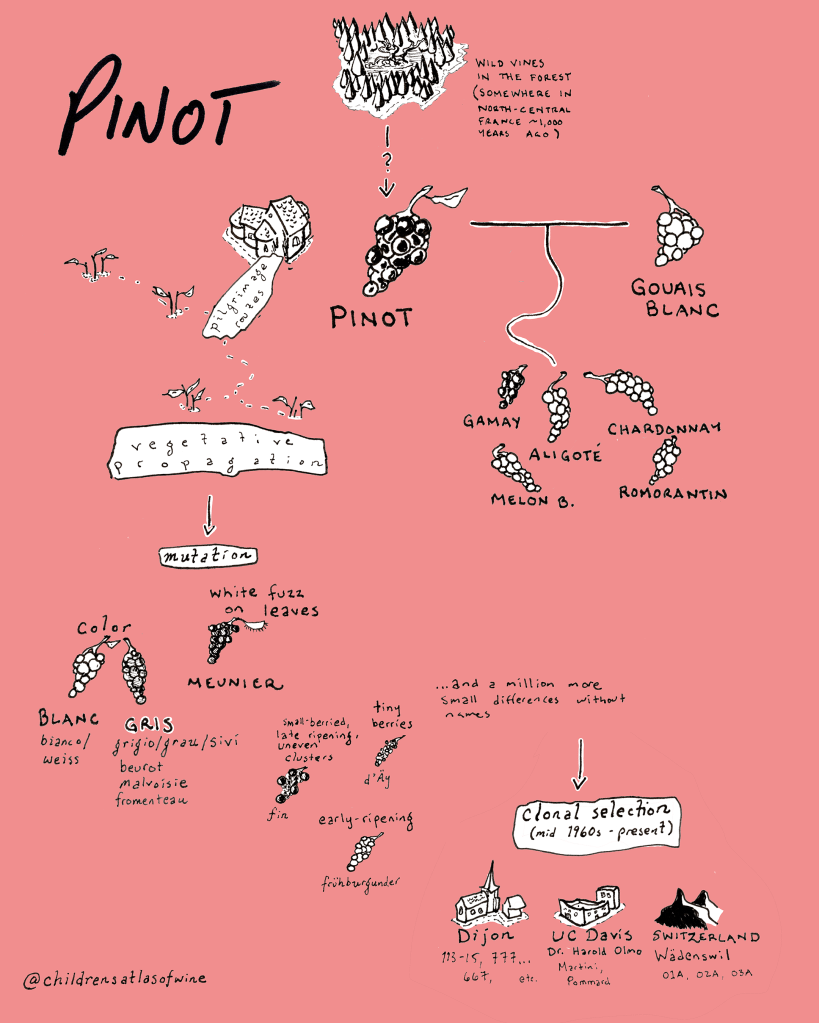
GRIS, WEISS, NOIR, MEUNIER …
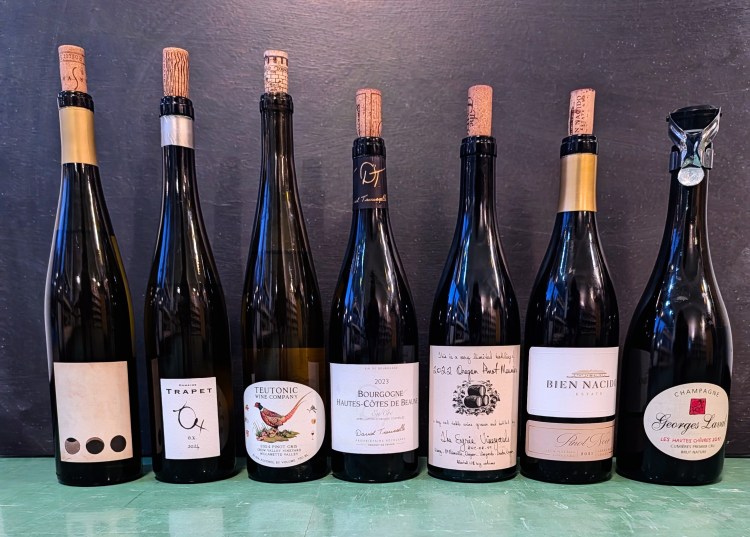
Pinot blanc from Robert Sinskey, in Napa Valley from 2018, finding richness via time on the lees + aging under cork once bottled, softer + rounder with time. it’s almost impossible to track pinot blanc’s history past a certain point — historically, it was also a name for chardonnay, and the two varieties were frequently confused in the vineyard
Pinot auxerrois from Trapet, in Alsace one of pinot’s many children with gouais blanc, and, in Alsace, often blended together with pinot blanc / used interchangeably.
Pinot gris from Barnaby and Gisela of Teutonic Wine Co, which makes Alsatian-inspired wines in Portland, Oregon pink-skinned pinot mutation, often found amidst the pinot noir in old vineyards, made paradoxically into everything from insipid, light pinot grigio to slightly sweet, unctuous white in Alsace to coppery or rose gold skin contacts that look like rosé and are built like orange wines and drink a little like light reds — a true chameleon
Pinot noir in its birthplace from David Trousselle, in a little valley off of the Côte d’Or’s main drag, better known for racy, electric white wines, and here showing the lean, rhubarb and beet side of pinot noir when it is cool and bright
Pinot meunier from the O.G. in the Willamette, Jason Lett of Eyrie regeneratively farmed, own-rooted, beautifully expressive wines with the capacity to age for decades. Meunier, the “miller’s pinot,” named for the fine downy white fuzz on the underside of its leaves that looks like a dusting of flour, is often treated as a totally different grape from pinot noir — but it’s just a more noticeable mutant. Often softer, as well, with a sappy, lavender and violet side to its aromatics
Pinot noir on the West Coast from Bien Nacido, a Santa Maria Valley vineyard site probably better known as a source of prestige fruit for a slew of ambitious California producers than it is for its own wines. This is a plush, darker-fruited, richer side to pinot noir that may be a little closer to what a lot of people picture when they say they “like a pinot” in a bar or a retail store — the inverse of the lean and savory side of Trousselle’s bottling
Bonus! — pinot meunier grower champagne from organic farming pioneer George Laval in Cumières, in the heart of the Vallée de Marne 2017, from a single vineyard plot planted between the ’30s and ’40s, with a pink-fruited perfume and deep, vinous bassline — really special stuff
3/2 industry blind tasting
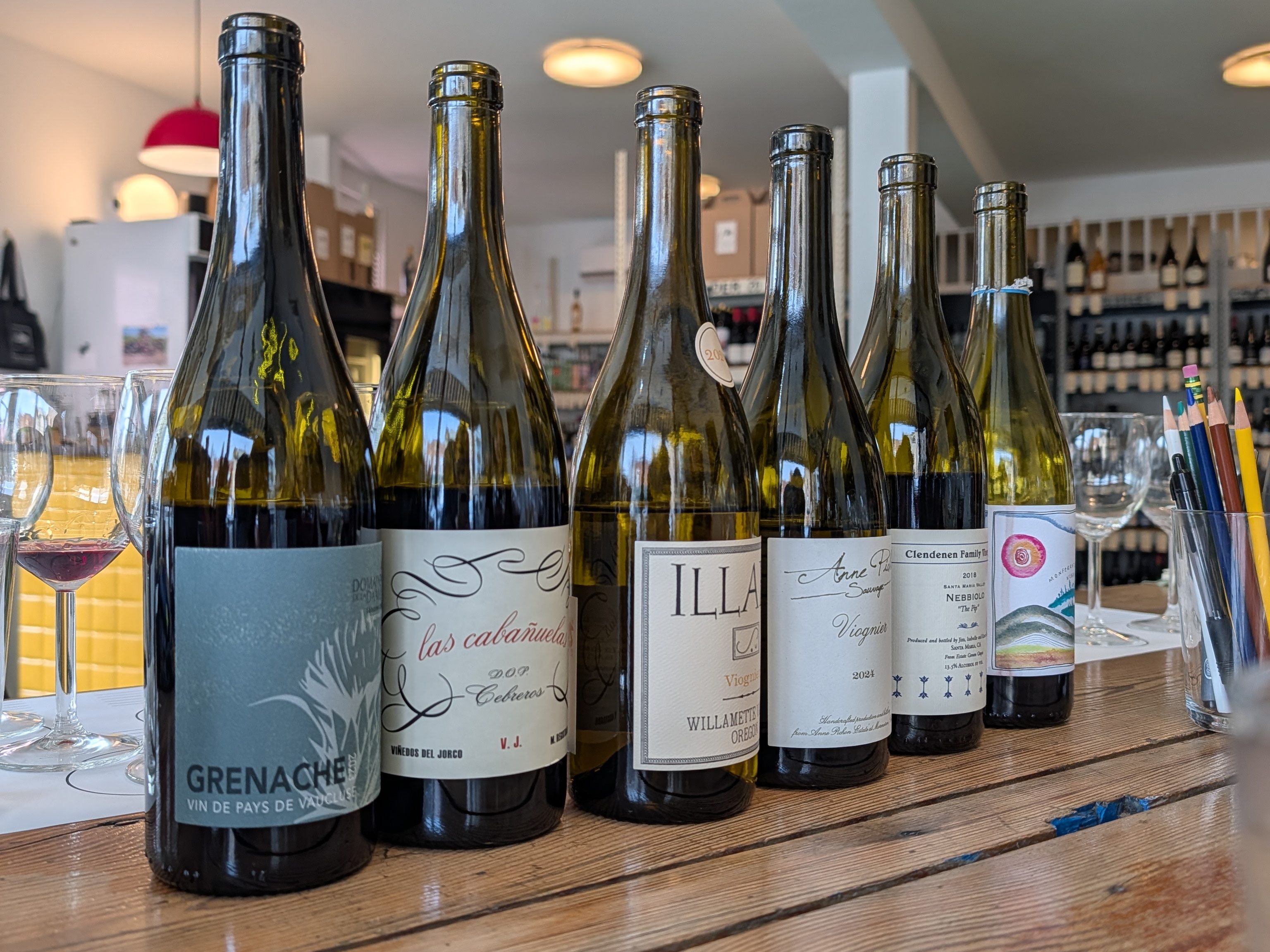
We tasted backwards, from F to A:
F. PRIMA PIUMA nebbiolo Monferrato, Piedmont
E. CLENDENON nebbiolo Santa Maria Valley, Central Coast 2018
Younger, fresher, lighter extraction coupled with full ripeness and a warmth of alcohol (14.5%) + zero sulfur on one hand — long extraction, 3-year oxidative aging in barrel and 5 more years under cork on the other
D. ANNE PICHON, ‘Sauvage’ viognier Vaucluse, Southern Rhône
C. ILLAHE, viognier Willamette Valley
Viognier, tamed?
B. JORCO, ‘Las Cabañuelas’ garnacha Sierra de Gredos
A. DAMASE, grenache Vaucluse, Southern Rhône
More on Gredos, and on grenache.
2/9 sparkling!
CHAMPAGNE, PET NAT, and MORE
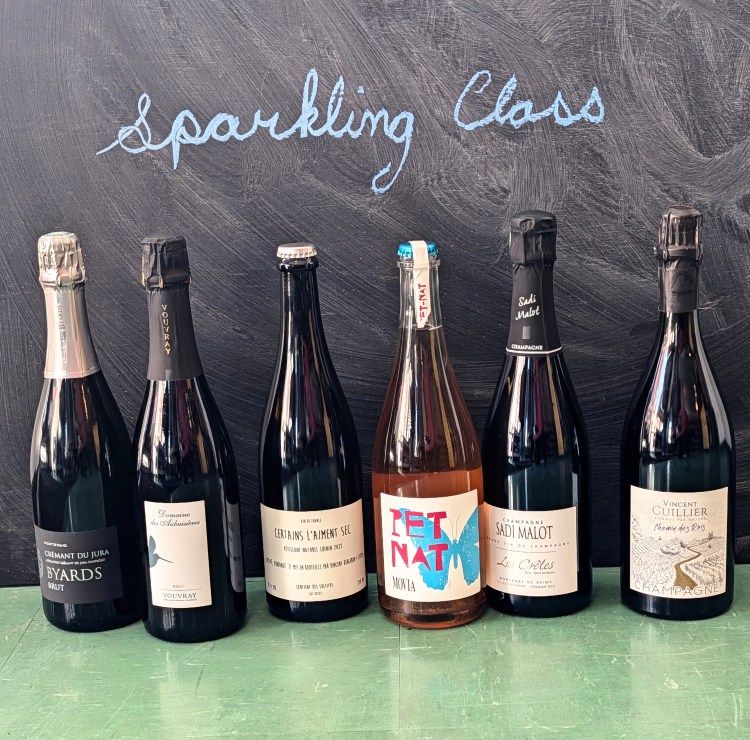
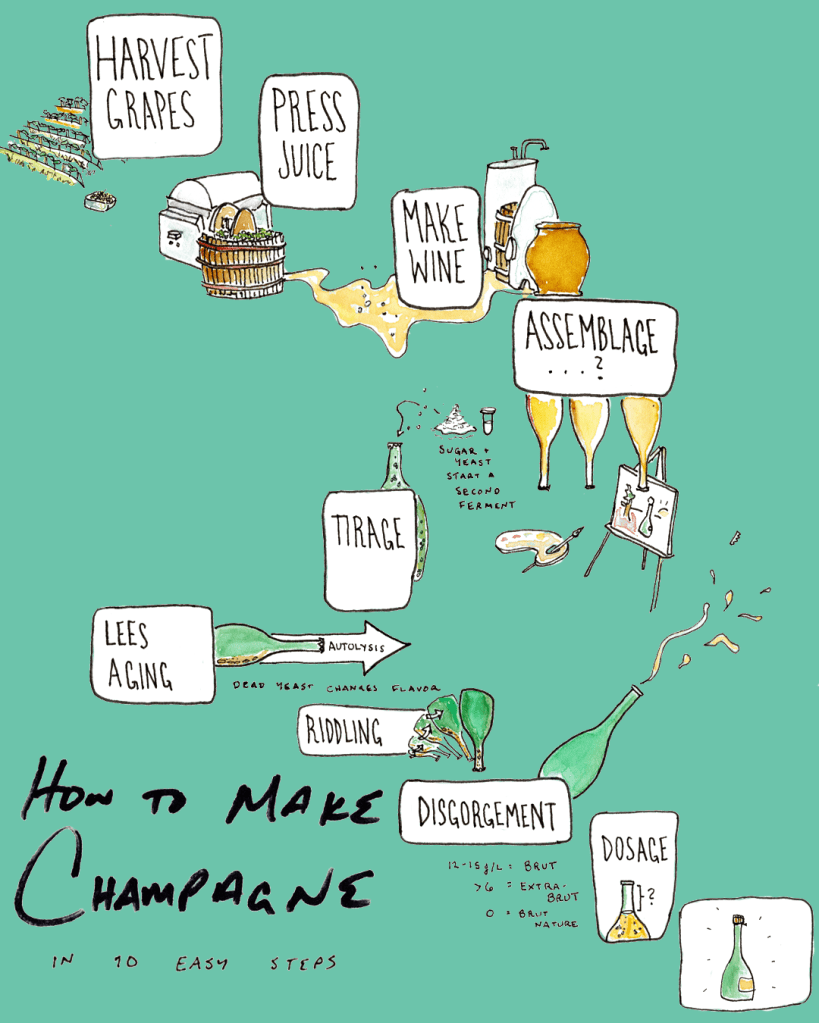
We tasted Crémant de Jura from a small co-op in the foothills of the French Alps — ‘crémant’ is champagne-method wine with a regional designation like the Jura, the Loire, Burgundy, etc — and talked about how champagne technology works.
We tasted Sparkling Vouvray, another appellation for champagne-method wine in France outside of Champagne — how does shifting the grape variety to chenin change the wine?
We tasted Montlouis Pét-Nat, chenin just across the Loire river from Vouvray, made by bottling the fizzing fermenting wine before it finishes so that it can complete its fermentation in bottle. How does this more direct, lo-fi way to make a wine sparkling compare to the same grape and region made like champagne?
We tasted a skin-contact pét nat out of rebula and chardonnay from Slovenia, on the border with Italy, to talk about the wide spectrum and wild range of possibility of pét nats and other alt sparklings. Just how many different ways could they taste?
And finally, we tasted two grower champagnes side by sie, both on the forested crown of the Montagne de Reims, to celebrate the new generation of farmers bottling the fruits of their labor and dive deep into the little differences:
Sadi Malot’s ‘Les Crêtes’ is a blanc de blancs (100% chardonnay, unusual up here), largely from a single vintage with about a fifth of the wine blended from a perpetual solera reserve started in 2010. They are certified organic — vanishingly rare in Champagne, although the number of farmers committing has grown significantly over the last decade. (Pre-pandemic, only 8% of Champagne’s vines were farmed without chemicals.)
Vincent Cuillier’s ‘Chemin du Rois’ meanwhile is a co-planted parcel — about 70/30 pinot noir / chardonnay — whose farming is even more noteworthy, not just organic but embracing year-round cover crop, no-till regenerative practices to build soil microbiology and sequester carbon, and agro-forestry, introducing trees and building an ecosystem in the midst of industrial monoculture. The wine is avant-garde too, fermented without additions including yeast or sulfur, disgorged by hand without dosage — transparent, expressive, and the antithesis of the big house champagnes that defined the region for two centuries and focused on brand consistency above all else.
2/9 industry blind tasting
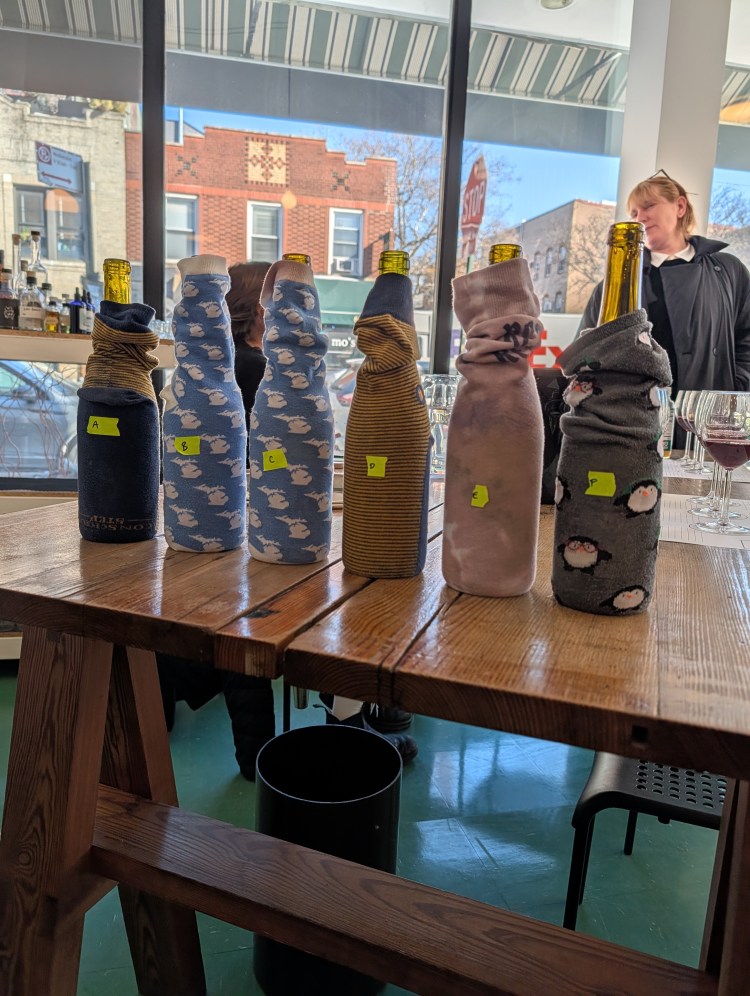
we tasted backwards, started with the final two wines and ending with the whites at A & B:
E. Bloomer Creek, ‘Vin d’Ete’ cabernet franc Finger Lakes
F. Villeneuve, Saumur-Champigny cabernet franc Loire
Semi-carbonic infusion in steel tank versus cold soak + a crusher-destemmer and a little bit of oak. I think the focus on “pyrazine = green bell pepper” as a tasting note does a disservice to cabernet franc and how it can actually show up — in warm vintages or at full phenolic ripeness that herbaceous / forest / pepper streak feels more like red pepper coulis, curry leaf, Red Hots candies. One of my favorite things to do at Kabawa is to deploy cabernet franc in this vein against warming spices.
I also have a side theory that the widespread way Finger Lakes cabernet franc doesn’t “taste like cab franc” — it’s often more sour cherry driven, without the tea leaf or pepper you’d expect — might be clonal selection. Someone was telling me that Cornell released a cabernet franc clone a few decades ago that was widely planted throughout the Great Lakes and New York that was supposed to be more resistant to rot, and I’ve wondered if the apparent varietal difference I’ve heard so many people talk about when tasting Finger Lakes cab franc might have as much to do with vine selection as with place.
C. Kewin Descombes, ‘Keke’ gamay Beaujolais
D. Laurent Lebled, ‘Ça C’est Bon!’ gamay Cheverny
bonus (not pictured) Villemade, ‘Bovin’ gamay Cheverny liter
Semi-carbonic on granite, full carbonic in steel on clay-limestone (and, with apologies to Laurent Lebled, super mousey and volatile — hence the bonus Villemade, which I opened partly to give another bite at the apple and partly to show that zero sulfur doesn’t have to mean microbially flawed).
A. Leo Steen, chenin, Dry Creek Valley
B. Sérol, ‘Pourquoi Faire Sans Blanc?’ chenin, Loire Volcanique aka Côte Roannaise
This was a cool face of chenin from Sérol, all the way down among the extinct volcanoes of the Côte Roannaise — I was only previously familiar with their gamay d’Auvergne (which always has, whether it’s soil or genetics, a distinct pepper-flint structure and smokiness).
Leo Steen’s, meanwhile, gave us a chance to talk about the way that chenin can fool you — late ripening, phenolically dense and complicated, it can also be vegetatively productive and innocuous especially if irrigated in a hot place, pushed to work, and harvested a little too early. Chenin before it’s fully ripe kinda tastes like tart pinot grigio, and in a lot of the sites it was planted in South Africa and California it was being used more for its ability to be a high-acid vigorous blending grape (or distilling grape) than for its capacity to transmit place. If you don’t understand that chenin has two faces, you’ll always be surprised when it shows you its other one.
2/8 @ plus de vin — community.
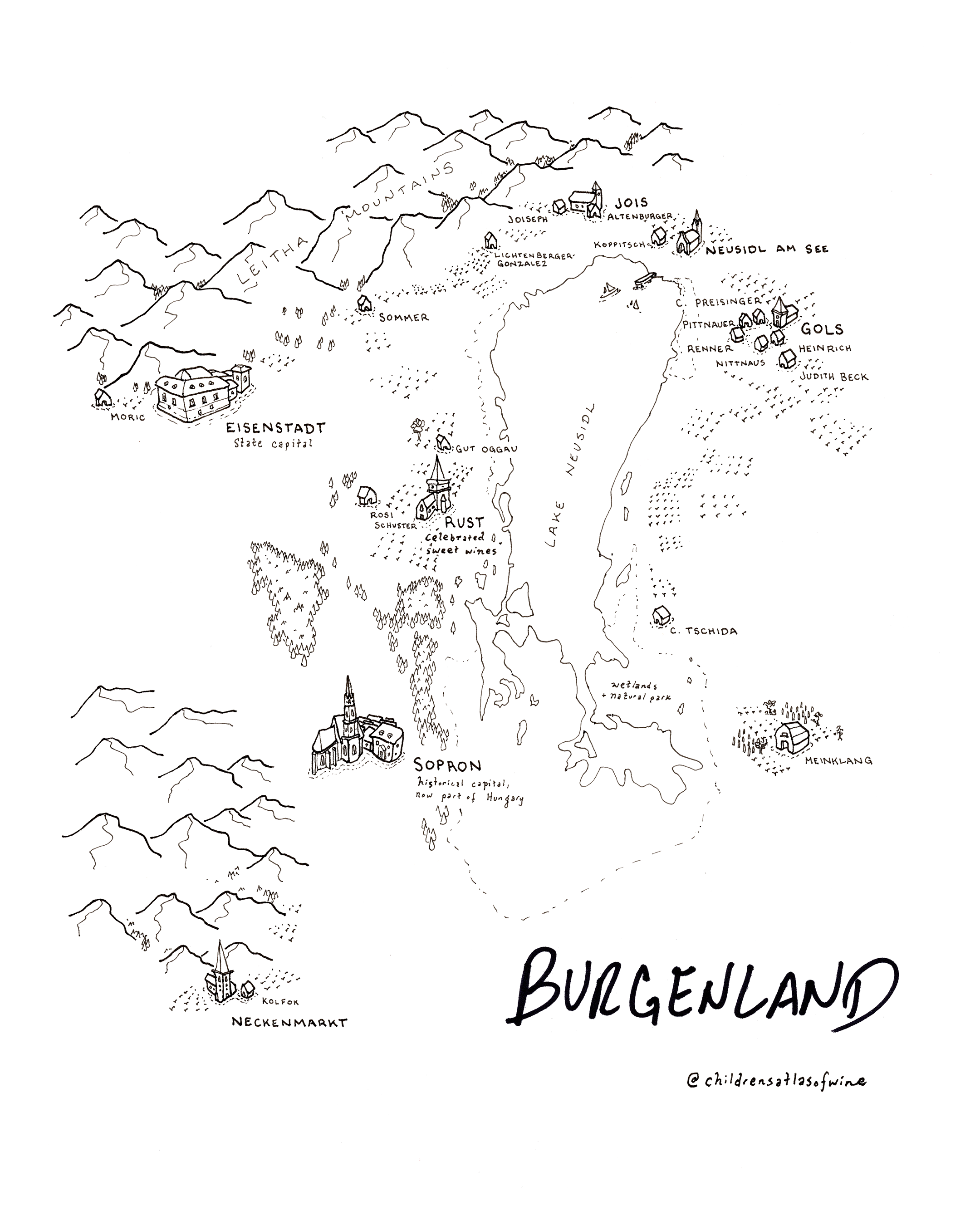
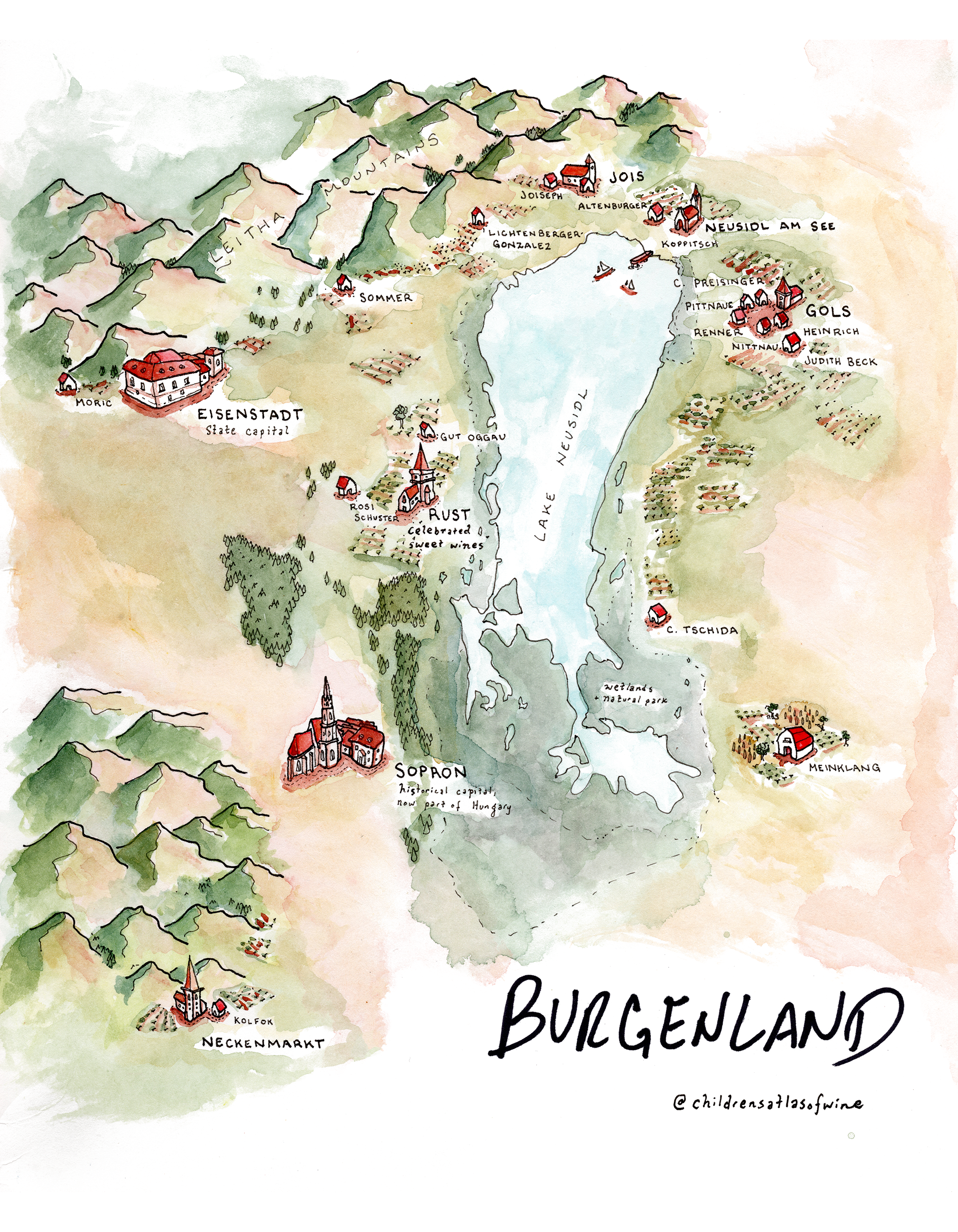
BURGENLAND, or who makes a wine region?
Burgenland facts:
1. where are we? curled around the second largest lake in Europe (the Neusiedlersee), shallow and reed-choked and home to many migratory birds, at its deepest it would only come up to my eyebrows
behind us, the last bit of the Alps, the schist hills of the Leithaberg
in front, the wide steppe
2. we‘re also curled around a border (not drawn here), that was hardened — tank emplacements and barbed wire — within living memory
it’s also a border that has ~moved~
after a 1921 plebiscite, Sopron, the region‘s historic capital, became Hungarian. The rest? Austria‘s newest state.
3. oh btw the lake isn’t fed by rivers, in technical terms it’s a giant puddle
it has also dried up completely from time to time, most recently in the 1840s, which sounds like a nightmare, dried mud and dust storms
4. like a lot of borderlands, wine wise, Burgenland‘s whole situation isn’t a lot like whatever “Austrian wine” is supposed to be (statistically, white wine, mostly grüner and dry riesling in both fancy versions — the roman-era terraces of the Wachau, north of Vienna — and friendly screwcap liters)
5. Burgenland has red wine — most of the red wine Austria makes is from here
and the white grapes aren’t riesling or (mostly) grüner, they’re a Central European slew of cultivars like welschriesling and weissburgunder and muscat ottonel and neuburger
6. Burgenland was historically poorer than the rest of Austria, and post WWII there was a ton of infrastructure investment + support for its wine industry, with the result that what you have today is a lot of young people taking over and radicalizing prosperous family wineries from the 70s/80s
7. those kids have often lived and worked outside of the region and then come home (like Stefanie Renner of Rennersistas, below, who did harvests with Tom Shobbrook in Australia and Tom Lubbe in the Roussillon, both foundational natural wine guys of their respective regions) — and over the last 15 years or Burgenland has become a nexus for Austria’s natural wine movement, home to icons like Claus Preisinger, Christian Tschida, and very culty Gut Oggau as well as dynamic and younger newcomers
8. the wines cover the gamut, in technicolor.
About those reds: there’s blaufrankisch (“Blue, from the Franks”, called the same thing, ‘kekfrankos’, on the Hungarian side), which reminds me of something between syrah and cab franc, pepper + smoke
9. there’s also (cue ominous music) Austria‘s signature red grape and the most planted grape in the country, widely adopted in the 60s and 70s after a few surviving vines were rescued postwar and named by the in honor of the scientist who had made the cross, in the 1920s: zweigelt 💀
- we’ve got to talk about zweigelt
Dr. Friedrich Zweigelt was (this had been conveniently forgotten) an enthusiastic Nazi — a Party member even in the days when the party was illegal. After German annexation his fortunes rose, he reported colleagues and ran an Aryan viticultural journal, etc. (Read the full story here)
11. this history resurfaces in 2018 and there’s a fair bit of conversation around what to do about it, which is still ongoing.
some folks prefer to use the original name given to the variety, “rotburger”, rather than glorify a Nazi scientist (unfortunately, it’s a bit generic — “red vine”)
12. others say erasing the name erases the history — they’d prefer the reminder on a practical level, decades were spent making “zweigelt” recognizable in export markets — it’s not a niche! it’s their most-planted red grape! — so there’s a real sense of paralysis / inability to move forward
13. as an outsider, I don’t have a solution other than to talk about the history when I pour the wine (and I often choose to list the wines as rotburger on my menus)
14. to sum up: – borderlands! – nexus of Austrian natural wine scene – rainbow of wine styles, (mostly) not grüner – soils, high to low: schist in the hills, then limestone, then squelchy – curled around giant puddle – cool birdwatching – the past isn’t over, it’s not even past – exciting to drink from because of the community of maker that has coalesced around this place over the last two decades
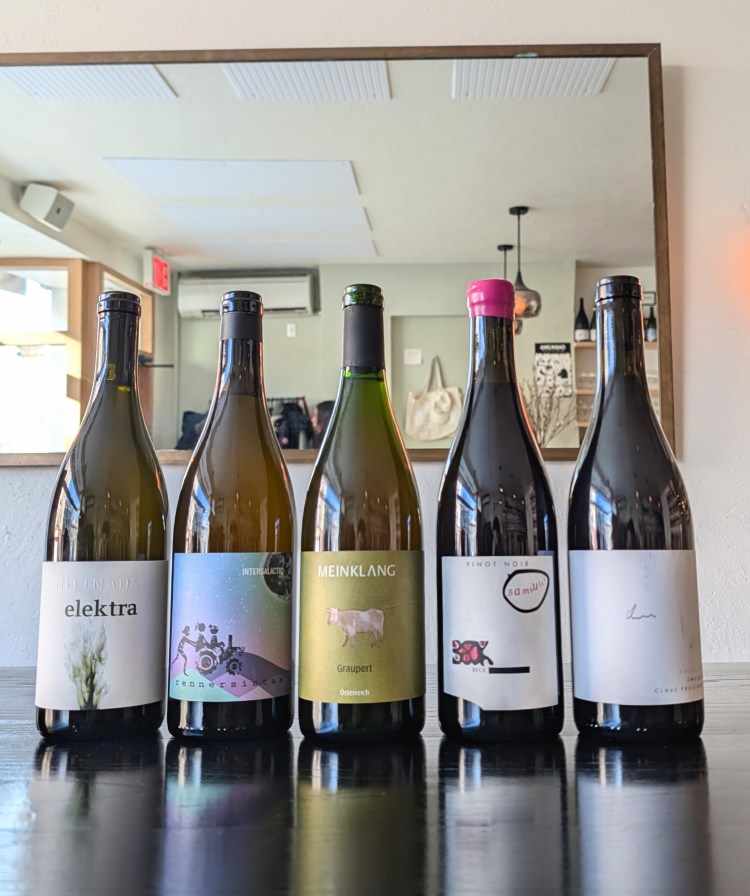
Here’s what we tasted!
Nittnaus, ‘Elektra‘ grüner veltliner Gols
Rennersistas, ‘Intergalactic’ welschriesling, muscat ottonel, gewürz, weissburgunder… Gols
weirdo version of ‘standard-issue Austrian white’ (grüner! — but with a few days of skin contact, raised in concrete egg, deeper and richer because of climate) versus hazy, fragrant kitchen sink blend that captures the slew of grape varieties in the ground
Meinklang, ‘Graupert’ skin contact pinot gris Pamhagen
Judith Beck, ‘Bambule’ pinot noir Gols
brief detour into ‘what is a grape variety’ corner with pinot two ways, a rose-gold pinkish skin contact from a huge biodynamic farm and a lean, rhubarb-and-beet inflected pinot noir from Judith Beck
Claus Preisinger, ‘Kieselstein’ zweigelt aka rotberger Gols
we’ve gotta, as we said, talk about zweigelt! Claus Preisinger’s biodynamic winery looks like a Star Trek: The Original Series shuttlecraft.
2/2 @ vine wine — wine 101.
SAVVY B? PINOT? DRY? ORANGE? these questions and more.
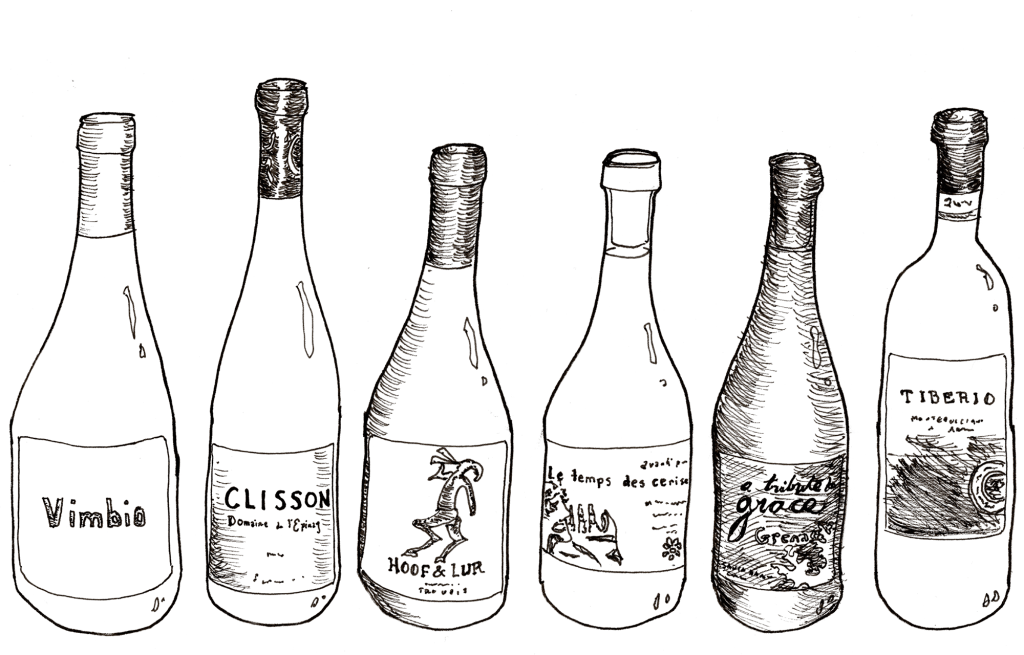
Vimbio ‘ACL’, albariño, caiño blanco, loureiro Rías Baixas, Green Spain
OR ‘DO YOU HAVE A SAUVIGNON BLANC?’
In a universe with only four commercial white wine styles, sauvignon blanc is the one that isn’t sweet (like stereotypical riesling), buttery (like stereotypical chardonnay), or tastes like nothing (like stereotypical pinot grigio).
Luckily, we live in a world with more than four grape varieties! Here, on the river that splits northern Portugal from northwestern Spain, in the mild green verdant Atlantic-facing region of Rías Baixas, zesty albariño is grown alongside two local rarities: caiño blanco (more umami-savory and saline) and loureiro (creamier and rounder).
Plenty of freshness and a kind of orange peel quality here, but there’s more going on than in your typical grocery store albariño, especially after it warms up a little.
l’Epinay ‘Clisson’, melon b Muscadet, Loire Valley 2019
OR ‘CAN WHITE WINE AGE?’
The mouth of the Loire Valley around Nantes is a place where wines won’t find richness because of the warmth of the sun. If you’re going to put meat on the bones of your fresh, high-acid white wines, you need time and a little bit of winemaking on your side.
This bottling, from historically prized granite slopes around the village of Clisson, spends three years aging on the slurry of spent yeast that falls to the bottom of the cement tanks where it ferments. The lees aging (aka spending time on that yeast slurry) gives a pillow-y, marshmallow-y cheesy richness to wine that would otherwise be all oyster shell, no give. After bottling it has spent another three years evolving under cork, with that little bit of exposure to oxygen making it more savory, soft, and contemplative.
Muscadet is often talked about as a simple shellfish wine for bistros, refreshing and crisp, but this shows off muscadet’s deeper side: candelight, kombu, and time.
Troupis ‘Hoof & Lur’, moschofilero Peloponnese, Greece
OR ‘ORANGE WINE?’
What happens when you steep skins in fermenting juice? The same thing as when you steep tea leaves in hot water: color, aromatics, texture. (The tannin molecules in grapeskins and in tea are functionally the same).
This is basically how we make red wine: steep blue-purple skins in their pale juice for the whole length of fermentation. Rosé? Really weak tea — a couple of hours, or a day at most. White? Usually no skin steeping at all — the juice runs off the press clear.
This wine, though, presents one of my favorite paradoxes: what do you get when you take a pink-skinned grape associated with direct-press white wine (here, moschofilero, a floral and delicate Peloponnese native, but it could equally be pinot gris, or gewürztraminer), ferment it on the skins like an orange wine, and end up with a wine somewhere between the color of a summer sunset, a bronze kettle, or a dark rosé?
Vine has been selling this bottle since I worked there over a decade ago, and every year it’s a little bit different. This year, the floral aromatics were really amped up — skin contact can do that, especially with naturally aromatic varieties — and it was so pink most of the class wondered whether there was any orange wine to taste at all.
What matters more? Aesthetics, or process?
Temps de Cerises ‘Avanti Popolo’, grenache, merlot, cabernet sauvignon, syrah Languedoc
OR ‘CAN I CHILL THIS RED?’
From 23-year natural wine stalwart Axel Prüfer, a great example of how grape variety (big-boy cultivars like merlot and syrah) is not destiny. A blend of direct-press juice and short maceration, it’s a wine that is all about finding freshness in a place where ripeness and intensity is a given.
It’s also a zero-addition wild child, holding itself together for our tasting but with a whisper on the finish that tells you it’ll go mousey in a few hours or the next day. We talked about how this stage of barely-there mouse can be off-putting if it’s all you’re left with but dovetails nicely with certain foods: bitter braised greens, mushrooms, barley tea, kimchi, shrimp and Thai basil…
A Tribute to Grace ‘Santa Barbera County’, grenache Santa Barbara, California
OR ‘DO YOU HAVE A PINOT?’
TKTK
Tiberio ‘Montepulciano d’Abruzzo’, montepulciano Abruzzo
OR ‘IS THIS DRY?’
TKTK
2/2 @ vine wine — industry blind tasting
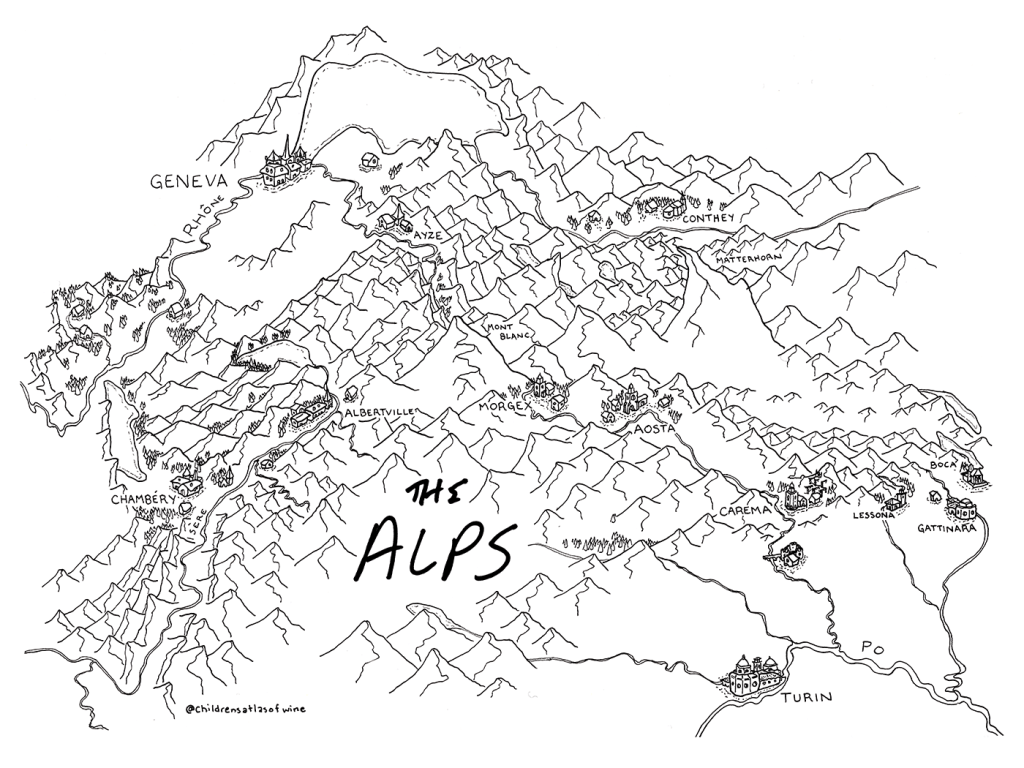
1/21 @ with others — alpine wines.
BUGEY, SAVOIE, VALLE D’AOSTA. every mountain valley is an island.
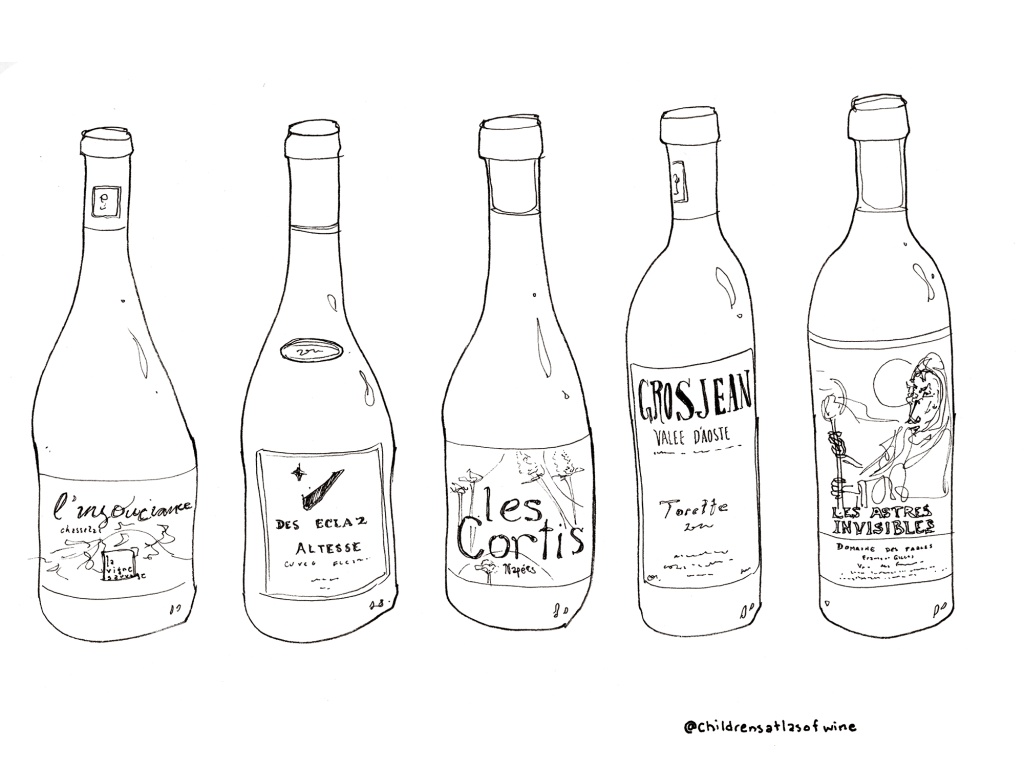
Vigne Sauvage, ‘l’Insouciance’ chasselas Lake Geneva
Chasselas is a quiet, barely-there variety that, at its best, is all about minimalism and springwater clarity. At its worst, people just call it boring. You can find it in southern Baden, Alsace, and in a few pockets in Central / Eastern Europe, but the place where it gets the most respect and care is in Switzerland.
Swiss wine is, on average, carefully farmed, high quality, and drunk almost entirely by Swiss people. Only a tiny fraction is exported, and it tends to be super expensive once it makes it to the other side of the Atlantic. This is as close as we’ll get to Swiss wine in this tasting, but it’s not so far off: an hour bike ride from the border, on the French shores of Lake Geneva (Lac Lémant).
David Humbert of Vigne Sauvage farms two little postage stamps of land there that together amount to just one and a half hectares, grown on glacial scree and limestone — a little bit bigger than Gramercy Park, or a major league baseball field. He makes his wines in a little garage-sized room lined with plywood, in a handful of small vats made out of stainless steel and fiberglass, and bottles them without addition or subtraction.
des Eclaz, ‘Fleurus’ altesse Bugey
les Cortis, ‘Napées’ altesse Bugey
What is Bugey, anyway?
Let’s talk about it!
Politically it was a fief of the House of Savoy for almost 600 years, before European nation-states began to coalesce like planets. It was ceded to France in the 1601 treaty of Lyon, which concluded a yearlong war between the King of France and the Savoyards over a little French enclave in the Piedmont called Saluzzo. (Motto of the marquisate: Non sol per questo, ‘Not only because of this’.)
Geographically it’s defined by a loop of the Rhône river around the crumpled-up southernmost foothills of the Jura mountains: little island clusters of vines separated by forested limestone plateaus mostly trying to face south and soak up the sun. And those clusters are tiny — Bugey as a whole only has 500 scattered hectares under vine, a drop in the bucket compared to Saint-Joseph (~1200), Croze-Hermitage (~1800), or oh my god the southern Rhône (50,000++?!!). There are structural reasons you’ll find Côtes du Rhône in Costco and not Bugey, you know what I mean?
As for the wines themselves, it’s a place where you feel the transition between that Alpine energy and Lyon, due west, with Beaujolais orbiting that city like a purple granite moon. There’s Savoyard altesse and mondeuse, but also Burgundians like gamay and chardonnay and pinot noir. Bugey makes, proportionally, a lot of sparkling wine.
Here, we get a side-by-side of one of my favorite Alpine white grapes: altesse. (Literally, ‘your highness’.) Princess-peachy, a kind of reddish-bronze when fully ripe, like a softer chenin.
These two growers are a 24 minute bike ride from one another. Apart from all of the tiny differences that can make wines from basically the same place taste a little bit different, the biggest one here is probably the amount of air these two fermentations breathe. One was pressed into stainless steel (less air, tighter, fresher), and the other into a big 600L neutral barrel (more air, looser, wider).
Can you guess which was which?
(des Eclaz = Jean-Pierre Gros and Michel Roussille, first vintage 2017. Les Cortis = Jérémy and Isabelle Decoster Coffier, first vintage 2016. Bugey is dynamic!)
Grosjean, ‘Torette’, petit rouge Valle d’Aosta
du Fables, ‘Les Astres Invisibles’ mondeuse Savoie
The Alps are a wall, but they’re also a crossroads.
On the one hand: immense isolation, every valley its own pocket universe, like a chain of islands, each one with its own dialect and local wildflowers, an incredible diversity of genetic variation, grape varieties, and customs. The Valle d’Aosta, today Italy’s smallest wine region, has a dizzying range of native varieties, including not just petit rouge but humagne (called cornalin in Swizterland), neyret, petit arvine, prié blanc, the red-fleshed roussin de morgex, fumin,
On the other hand, connection and movement. Aosta, fiercely independent, and populated by speakers of Valdôtain, a variety of Franco-Provençal, was ruled by the House of Savoy for something like 800 years, and has had French as an official language since 1536. (It only became part of the Kingdom of Italy in 1861.)
You can see this, too, with a grape like mondeuse, on the one hand the unique specialty red of the Savoie, on the other related both to syrah and viognier (in the northern Rhône) and teroldego (in the Italian Dolomites).
In what ways do these two red varieties remind you of each other?
How are they different?
1/18 @ plus de vin — ferment.
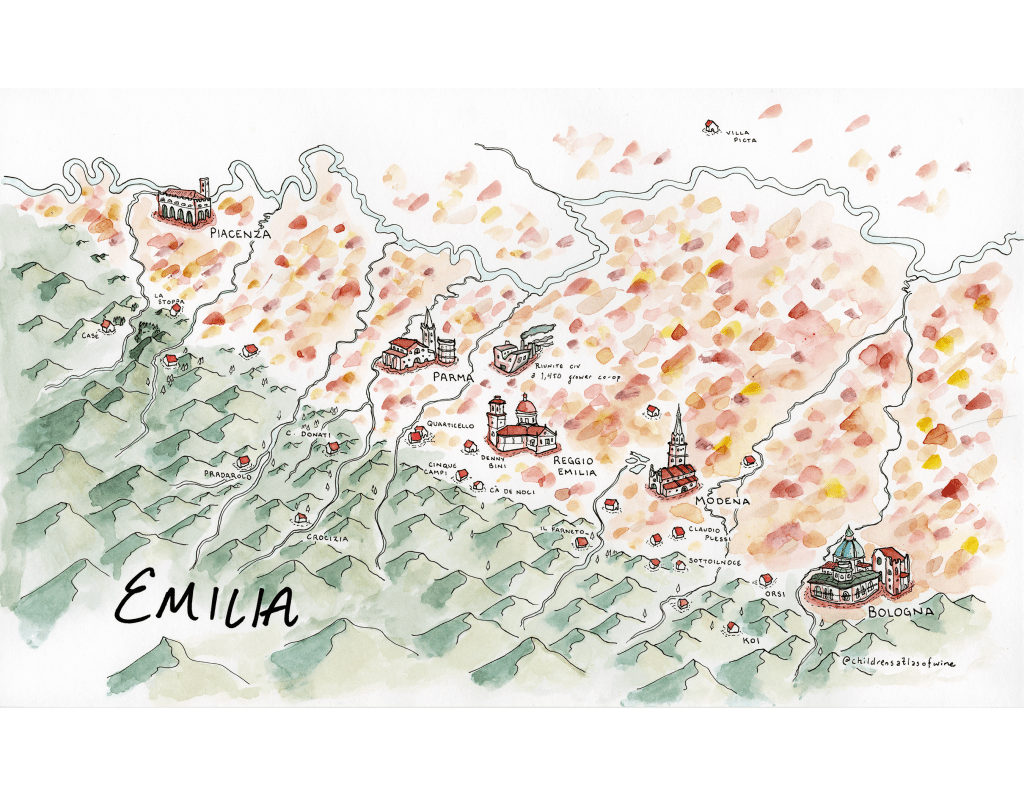
EMILIA ROMAGNA. a rainbow of alt sparkling
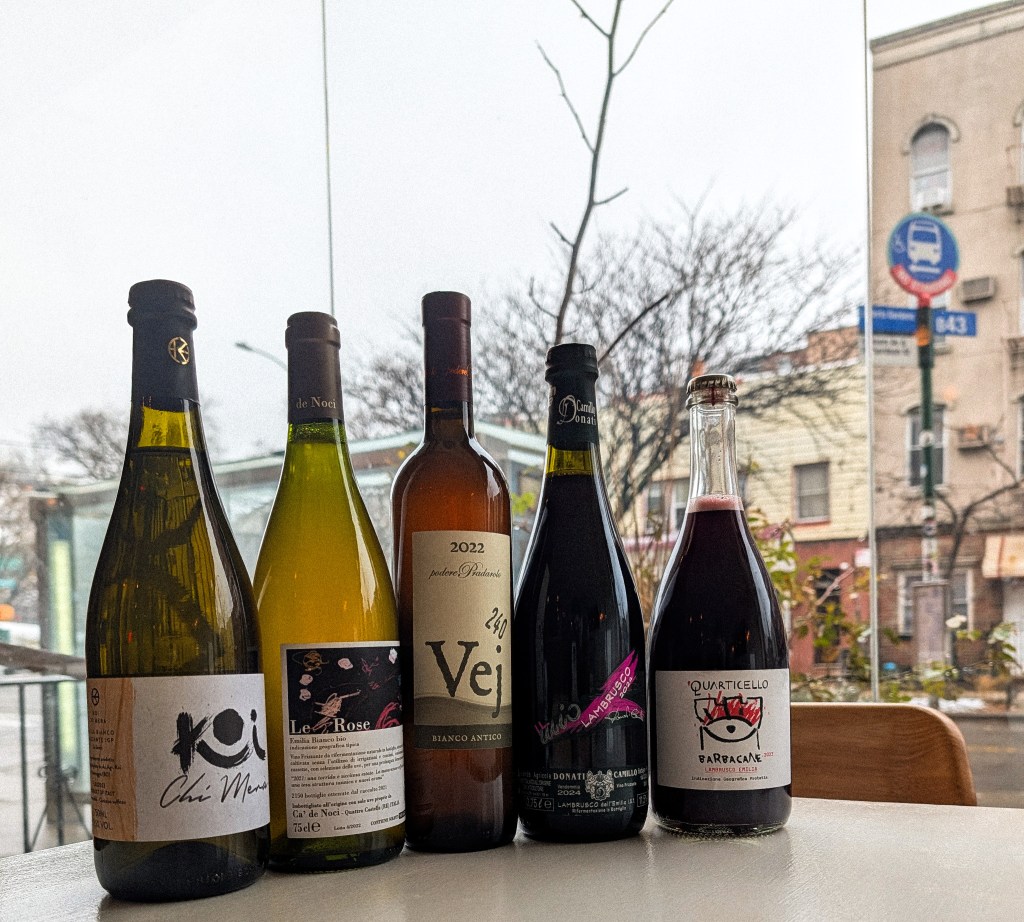
Koi, ‘Chi Mera’ pignoletto, montuni Samoggia valley, southwest of Bologna 2021
Tasted next to a Corpinnat, a Catalán grower sparkling from Mas Candí, and in fairness to all of us, this is a less straightforward comp with champagne-method sparkling than you might think!
While it’s hazier and wilder than traditional method sparkling, it is aged col fondo, on those lees, for years, after a second ferment in the bottle, which lets it tiptoe towards some of the bread-ier, yeastier, less fruit forward tones of far fancier fizzy wines.
(It’s not so much a pet-nat as a rifermentato, which we’ll come back to: rather than being bottled before fermentation is over, it’s bottled and the second ferment started with frozen juice from the year’s harvest.
This bottle was harvested in 2021, so it’s been waiting quite a while to end up in our glass!)
Koi was started by Flavio Restani in 2018 out of a collection of vine parcels farmed by his parents and grandparents. Flavio wears very technical zipped cargo pants and chose the koi for his label as a symbol of perseverance and non-conformity.
This bottling is from a single co-planted parcel of very obscure local white grapes that was planted in the early ’60s, farmed without chemicals, fermented with native yeasts, and bottled without filtration or sulfur.
Ca’ de Noci, ‘Le Rose’ malvasia di candia near Reggio Emilia
Pradarolo, ‘Vej 240’ malvasia di candia near Parma
Malvasia di candia is a lightly aromatic, orange-blossomy variety pushed further into perfume and dimension by the skin contact in both of these wines. Malvasias were prized for thousands of years for their ability to ripen to high sugars and turn into golden wines that could survive a sea voyage. They were traded throughout the eastern Mediterranean, and often named for the ports they set sail from (in this case, Candia, in Greece).
Ca’ de Noci (walnut farm) was started by brothers Giovanni and Alberto Masini way back in 1993, which makes them very early to the northern Italian natural wine party. This lightly sparkling wine (it’s sealed with a regular cork, which makes it a little nerve-wracking to open) is bottled after a short (4-5 days, I think?) time on the skins while it’s still fermenting, with a little more juice to help it along the way.
Alberto and Claudia Carretti of Pradarolo are also old-school — Alberto converted the farm to fulltime winemaking in I want to say 1989 — and their wines are slow-cooked braises, favoring long, long extractions and extended maceration, all bottled without sulfur. (In this case, 240 days on the skins in concrete tanks.) They make some sparkling wines, too, in a similiarly serious vein: very rustic champagne-method, refermenting base wines a lot like this one and then aging them on the lees for years before disgorgement.
Camillo Donati, Lambrusco mostly lambrusco maestri near ParmaQuarticello, “Barbacane” lambruscos maestri, salamino, and grasparossa near Reggio Emilia
Maybe the best way to put these two producers into context — bone-dry rifermentato from organically farmed grapes bottled with zero sulfur — is to compare them to what mainline industrial lambrusco looks like.
Riunite was a consortium of nine cooperative wineries in Emilia founded in 1950 whose lambrusco was brought to the U.S. in 1967; the wine, marketed by Banfi, was at one point the number one imported wine in the country, and at its height in the mid-80s it was selling over 11 million cases per year. Today, the co-op group has 1,450 grower members, and sales hover around 7 million cases annually. It sits on a shelf for less than $10.
For Riunite’s lambrusco, and the other conventional lambruscos like it that still dominate the market, grapes will be mechanically harvested and (largely) farmed with chemical inputs. Fermentations take place under controlled conditions, in giant steel tanks, assisted with cultured yeasts and added nutrients. After a short maceration and fermentation, the bubbles are obtained as in prosecco: a second fermentation (more yeast and sugar) in another giant tank before bottling, so the wine (unlike champagne, and unlike ancestral rifermentato) doesn’t have any of the characteristics imparted by lees in the bottle. It’s bottled after a sterile filtration and about 100ppm of sulfur addition to keep it as shelf stable as a can of Coke. (Coke has a little over 100 grams/liter of sugar; Riunite Lambrusco has 58. It also clocks in at only 8% alcohol — the 58 grams are the sugars that would have fermented it to the 12.5 or 13% of the wines we tasted.)
 Children's Atlas of Wine